 Blaine Siding
 Bellingham sits where the Salish Sea, the Nooksack lowlands, and the foothills of the Cascades all meet, and that geography shows up on the outside of every house in town. Homes here deal with salt-laden air rolling in off Bellingham Bay, long stretches of driving rain between fall and spring, and a moss and mildew season that can run eight months or more on shaded north- and west-facing walls. Siding that isn't built for that combination doesn't just look tired after a decade — it can fail structurally, and by the time the damage is visible from the ground, it's often already reached the sheathing underneath.
We're based in Blaine and work throughout Whatcom County, and Bellingham is one of the areas we're in most often. This page covers what the local climate actually does to exterior siding, how we approach siding, roofing, window, and deck work for Bellingham properties, and why we install exclusively James Hardie fiber cement siding rather than the vinyl, engineered wood, or other fiber cement products you'll see offered elsewhere.
What Bellingham's Climate Does to a House
Three factors drive almost everything we see on Bellingham exteriors:
Salt air and marine moisture
Proximity to the bay means airborne salt and near-constant marine humidity, even on properties that aren't waterfront. Salt air accelerates corrosion on fasteners, flashing, and any exposed metal trim, and it degrades certain paints and coatings faster than manufacturers' standard weathering estimates assume. Siding systems that rely on field-applied paint tend to show chalking and color loss noticeably sooner near the coast than they would inland.
Driving rain, not just rainfall totals
Whatcom County doesn't get the heaviest rainfall totals in the Northwest, but wind-driven rain off the Strait of Georgia and Bellingham Bay pushes water sideways into wall assemblies, not just straight down. That matters because a lot of siding failures aren't about how much rain falls — they're about water finding a horizontal or angled path behind panels, around windows, or through poorly lapped seams. A siding job that looks fine on a calm day can still be letting water in during a January storm if the flashing details and panel spacing weren't done correctly.
Moss, algae, and prolonged dampness
Shaded walls under tree cover or on the north side of a house can stay damp for days after a storm passes, especially from November through April. That prolonged moisture exposure is what feeds moss and algae growth on siding, trim, and roofing. Organic material holding moisture against a wall surface is one of the most common causes of premature rot and coating failure we see on older homes in this area, particularly on properties with mature landscaping close to the house.
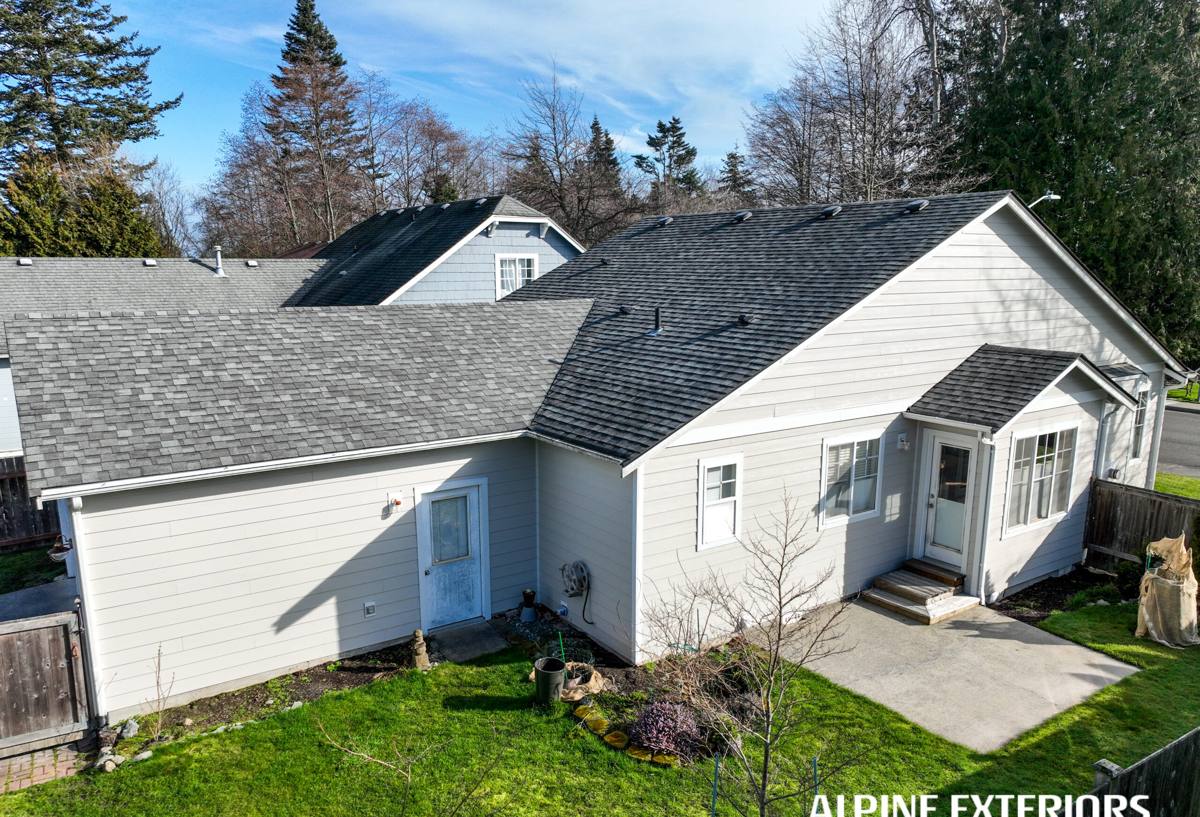
Why We Only Install James Hardie Fiber Cement
Homeowners in Bellingham are usually offered a handful of siding options: vinyl, engineered wood products like LP SmartSide, other fiber cement brands such as Cemplank or Allura, or traditional cedar or primed spruce. We've made a deliberate decision to install only James Hardie fiber cement siding, and it comes down to how each of these products actually performs against the specific conditions described above — not marketing claims.
Vinyl
Vinyl is inexpensive and low-maintenance in a general sense, but it's a poor match for a marine climate with driving rain. It's installed with expansion gaps that let water get behind the panels by design, relying on a drainage plane rather than a sealed surface. In freeze-thaw swings and constant damp, that drainage-dependent design is more failure-prone than a product that sheds water at the face. Vinyl also softens, warps, or cracks with age and UV exposure, and it can't be painted to match evolving color preferences without voiding warranties on most product lines.
Engineered wood (LP SmartSide and similar)
Engineered wood siding is wood-based — strand board coated with resin and overlaid — and wood-based products are inherently more moisture-sensitive than cement-based ones. In a climate with Bellingham's rain patterns and moss exposure, any breach in the factory coating (a nail pop, a cut edge left unsealed, a scratch from a ladder or branch) becomes an entry point for water into a wood substrate that can swell, delaminate, or rot from the inside. These products can perform reasonably well when installed and maintained perfectly, but that's a high bar to hold for 20-plus years on a house that sees this much wet weather.
Other fiber cement brands
Cemplank, Allura, and similar products are also cement-based and share some of the same basic durability advantages as James Hardie. Where we see the difference is in the factory finish system, the depth of climate-specific engineering in the product lines, and the strength and transferability of the warranty. James Hardie's ColorPlus finish is baked on in a controlled factory process and backed by a specific finish warranty separate from the substrate warranty — a distinction that matters when a marine climate is actively working against paint adhesion. Hardie also engineers HZ5 and HZ10 product lines specifically for regional moisture and temperature profiles, which is the kind of climate-matched engineering we want behind a product before we put our name on the installation.
Cedar and primed spruce
Real wood siding has genuine appeal, and we understand why some homeowners want it. But solid wood is the most maintenance-intensive option in a wet marine climate — it needs regular refinishing, is the most vulnerable to moss and mildew staining, and is the most attractive material to moisture-loving pests. For homeowners who want the look of wood without that maintenance cycle, Hardie's Artisan and shingle-style product lines are worth a look; we're happy to talk through the options during an estimate.
James Hardie Product Lines We Install
| Product Line | Style | Best Fit For |
|---|---|---|
| HardiePlank | Horizontal lap siding | Most residential homes; traditional or modern facades |
| HardieShingle | Staggered or straight-edge shingle | Craftsman and cottage-style homes |
| HardiePanel | Vertical panel | Modern builds, accent walls, gable ends |
| HardieTrim | Trim boards | Window and door surrounds, fascia, corner boards |
| HardieSoffit | Vented and non-vented panels | Eave and porch ceilings, attic ventilation |
How We Approach a Bellingham Siding Job
Inspection and moisture check
Before we quote a siding replacement, we look at the sheathing and framing condition wherever it's exposed or accessible, paying particular attention to north- and west-facing walls and any area under heavy tree cover — these are the spots most likely to show moss-related moisture damage in Bellingham. Catching rot or soft sheathing before siding goes back on saves a homeowner from paying to cover up a problem that will keep getting worse underneath.
Weather-resistive barrier and flashing
Given how much of the damage in this climate comes from wind-driven rain finding its way around window and door openings, we treat flashing details as the part of the job that determines whether the siding actually keeps water out — not just how it looks. That means proper head flashing, kick-out flashing where rooflines meet walls, and a continuous weather-resistive barrier behind the Hardie panels.
Correct fastening and clearances
James Hardie specifies fastener types, spacing, and minimum clearances from grade, roofing, and decks for a reason — get those wrong and you create the entry points for moisture that the product itself is designed to resist. We follow Hardie's installation instructions to keep the manufacturer warranty intact, which also happens to be the same standard that produces a durable result.
Working around existing landscaping and moss exposure
On properties with mature trees or shaded yards — common in established Bellingham neighborhoods — we talk through options like trimming clearance and ventilation gaps that reduce how long walls stay damp after a storm, since that has a direct effect on how soon moss returns.
Roofing, Windows, and Decks: The Rest of the Exterior
Siding doesn't work in isolation — a roof that's shedding water improperly, windows with failed flashing, or a deck ledger that's trapping moisture against the house all undermine even a well-installed siding job. We handle all four trades so the water management on a Bellingham home gets looked at as one connected system rather than four separate contractors each assuming someone else covered the transitions.
- Roofing: proper underlayment, flashing, and ventilation matched to the moss and moisture load typical of this area
- Windows: flashing and sealing details that tie correctly into the new siding plane
- Decks: ledger flashing and structural connections that keep water from tracking back into the wall assembly
- Siding: James Hardie fiber cement, installed to manufacturer spec, sized to the specific exposure of each elevation
Signs a Bellingham Home May Need Siding Work Soon
- Persistent moss or dark streaking on siding that returns shortly after cleaning
- Soft or spongy spots when pressing on siding near the bottom courses or around windows
- Visible gaps, warping, or buckling in panels, especially on the west or north side
- Paint that's chalking, peeling, or fading unevenly compared to the rest of the house
- Rising energy bills that coincide with visible siding deterioration, which can point to compromised insulation or air sealing behind the panels
What a Job Typically Involves
Timelines and scope vary by house size and condition, but a straightforward full-siding replacement on an average Bellingham home generally moves through removal of the old siding, an inspection and any needed sheathing repair, installation of the weather-resistive barrier and flashing, then the Hardie siding and trim itself, followed by caulking and touch-up at seams and penetrations. Weather windows matter here — we plan around the wetter months when possible, since fiber cement installation goes best in dry conditions, though the material itself is unaffected by cold once it's properly installed.
Cost Factors to Expect
| Factor | Why It Affects Price |
|---|---|
| Home size and wall area | More square footage means more material and labor |
| Number of stories and roof lines | Complex cutting, staging, and access add time |
| Existing damage found during tear-off | Rotted sheathing or framing needs repair before new siding goes on |
| Product line and finish selection | Shingle-style, custom colors, and trim details vary in material cost |
| Trim and detail complexity | Corner boards, window surrounds, and soffit work add labor |
We give specific numbers after seeing the house in person, not off a phone estimate, since siding condition underneath is the biggest variable on any older Bellingham home.
Why a Local Crew Matters Here
A contractor who works Whatcom County regularly knows which walls in a given Bellingham neighborhood tend to hold moisture, how local building and permitting processes work, and what moss and salt exposure actually do to a house over years rather than in a brochure. That local pattern recognition is part of what makes an inspection accurate and an installation last — it's the difference between a crew guessing at generic best practices and one that's seen how this specific climate treats the specific product they're installing.
If you're seeing early signs of siding wear, planning ahead of a larger renovation, or just want an honest read on the condition of your home's exterior, we're happy to take a look. Reach out for a free, no-pressure estimate — use the form below to get started.