 Blaine Siding
 What Primed Spruce Siding Actually Is
Primed spruce siding is solid or finger-jointed spruce lumber milled into lap boards or panels, then coated with a factory or site-applied primer before it goes on the wall. It's been a staple of Pacific Northwest home building for decades because spruce is affordable, easy to mill, and takes paint well. Homeowners in Blaine and across Whatcom County still see it on older homes, and some builders continue to offer it as a lower-cost option compared to fiber cement or engineered wood.
The key thing to understand is that "primed" is not the same as "protected." Primer is a preparation layer meant to help topcoat paint bond to the wood — it is not a moisture barrier, and it is not designed to be a home's final line of defense against weather for more than a season or two.
Solid vs. Finger-Jointed Boards
Most primed spruce siding sold today is finger-jointed — short lengths of wood glued end-to-end into long boards, then primed to hide the joints. That construction keeps costs down and reduces waste at the mill, but it introduces glue lines that behave differently than the wood around them when they take on moisture. Solid spruce avoids the glue joints but is harder to source, costs more, and still carries all the same moisture and maintenance characteristics of any untreated softwood.
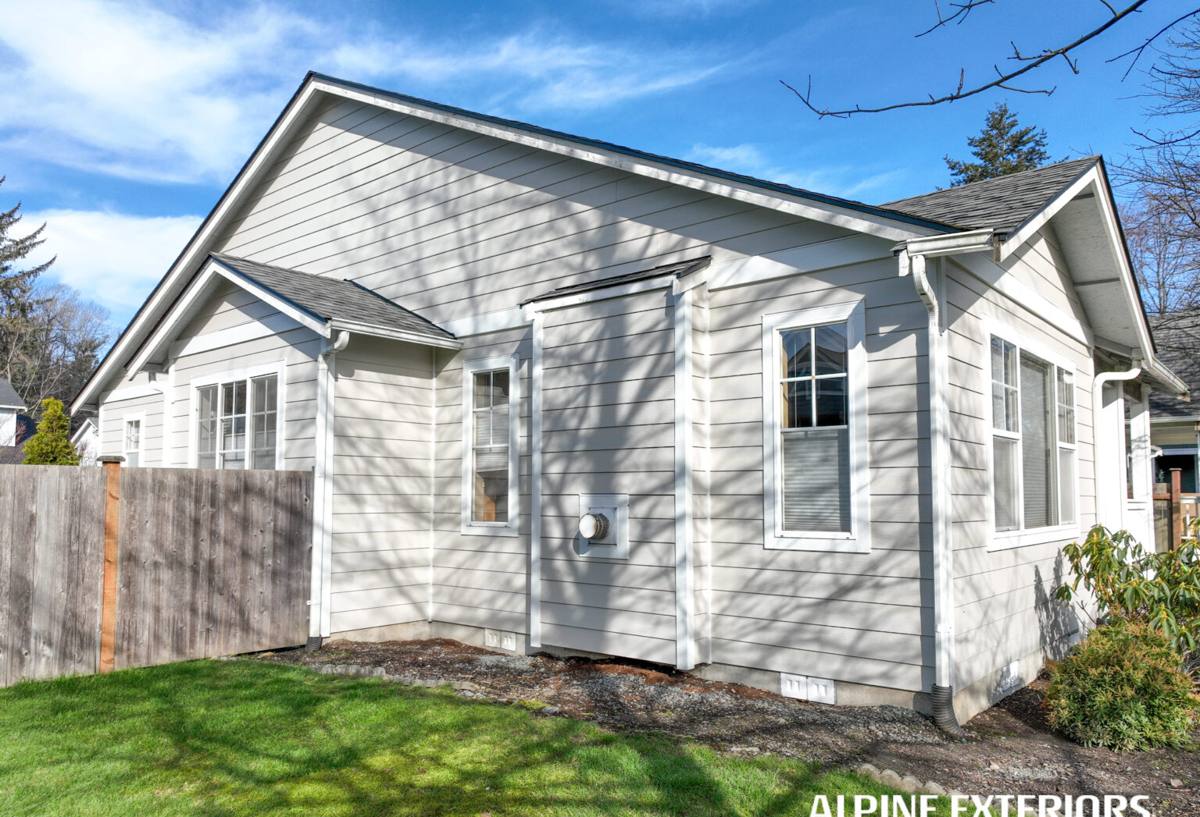
Where Primed Spruce Does Make Sense
We'll give this product its due. In a dry, sheltered climate with deep roof overhangs and an owner committed to a strict repainting schedule, primed spruce can perform reasonably well and give a home an authentic wood-grain look that manufactured products only approximate. It's also lighter to handle and simpler to cut with basic tools, which is part of why it stayed popular for so long. None of that changes once the house sits a few miles from the water in Blaine — the climate here is the deciding factor, not the product's quality on a spec sheet.
The Moisture Problem in a Salt Air, High Rain Climate
Blaine sits on Semiahmoo Bay, and homes throughout Whatcom County deal with a long wet season, driving rain off the Strait of Georgia, and salt-laden air moving in off the water. That combination is close to the worst-case scenario for a wood product that depends on an intact paint film to stay dry.
Wood siding manages moisture by drying out between rain events. In a drier interior climate, that drying window is long enough that the wood rarely stays saturated. In Blaine, driving rain can push moisture past lap joints and butt seams, and the region's damp, overcast stretches mean siding often doesn't get a real chance to dry before the next system rolls through. Salt air adds another layer: airborne salt holds moisture against surfaces longer and accelerates the breakdown of paint films and caulking, which are the only things standing between the wood and that moisture.
Once water gets behind or into primed spruce, the failure pattern is predictable — swelling at butt joints, cupping along the board length, paint bubbling and peeling, and eventually soft or rotted wood at the bottom edges of laps where water sits longest. Repairs at that point usually mean replacing boards, not just repainting.
Moss Season Compounds the Issue
Whatcom County's moss season runs long — shaded, north-facing walls and anything under tree cover can stay damp with moss and algae growth for much of the year. Moss holds moisture directly against the siding surface, and on primed wood that means prolonged contact between water and a material that's only as good as its paint film. Pressure washing to remove moss is also harder on wood siding than on fiber cement, since aggressive cleaning can strip primer and open the wood to more water intake right where you were trying to protect it.
The Maintenance Reality: Priming Isn't Paint
A lot of the disappointment we hear about with primed wood siding comes down to a simple misunderstanding at the time of purchase: primer is a base coat, not a finish coat. Manufacturers are explicit that primed boards need a full topcoat of quality exterior paint applied promptly after installation, and then a realistic repaint cycle after that — often every 5 to 8 years in a coastal climate, sooner on sun- and weather-exposed elevations.
That's a real, recurring cost that doesn't show up in the sticker price of the siding. Skipping or delaying a repaint cycle is the single most common way primed spruce siding fails early, and it's an easy mistake for a homeowner to make once the original contractor is long gone and the siding still looks fine from the curb.
Primed Spruce vs. Fiber Cement: A Side-by-Side Look
| Factor | Primed Spruce Siding | James Hardie Fiber Cement |
|---|---|---|
| Moisture behavior | Absorbs water; relies entirely on intact paint/caulk | Engineered to resist moisture-driven swelling and rot |
| Repaint cycle | Typically every 5-8 years in coastal climates | ColorPlus factory finish backed by a long-term finish warranty; field-painted Hardie repaints far less often |
| Combustibility | Combustible wood product | Non-combustible fiber cement core |
| Insect/rot vulnerability | Susceptible without diligent upkeep | Not a food source for insects or fungi |
| Warranty structure | Varies by mill; limited coverage tied to proper maintenance | Manufacturer warranty designed around correct installation practices, transferable to new owners |
| Climate engineering | General-purpose product, not climate-zoned | HZ5 product line engineered for wet, moderate-freeze Pacific Northwest conditions |
Why We Standardized on James Hardie
We made a decision as a company to install James Hardie fiber cement siding exclusively — not LP SmartSide, not vinyl, not Cemplank, not Allura, not primed spruce or cedar. That's not a marketing position; it's a practical one built around what actually holds up on homes we service in Blaine and the rest of Whatcom County year after year.
ColorPlus Factory Finish
Hardie's ColorPlus finish is baked on at the factory under controlled conditions, rather than relying on field-applied paint over primer. That finish is engineered specifically to resist the fading and cracking that comes from UV exposure and constant moisture cycling — the exact conditions Blaine's marine climate produces.
HZ5 Climate Engineering
Hardie's HZ product lines are formulated for specific climate zones rather than sold as one generic board everywhere in the country. The HZ5 formulation used in our region accounts for the freeze-thaw and moisture exposure typical of the Pacific Northwest, which is a meaningfully different engineering target than a general-purpose spruce board.
Non-Combustible Core
Fiber cement doesn't burn the way wood siding does. That's a real difference in wildfire-adjacent conditions and in general home safety, and it's one more reason we don't feel comfortable recommending a combustible wood product when a non-combustible, climate-engineered alternative exists at a comparable installed cost.
Warranty Backed by Correct Installation
Hardie's warranty is structured around proper installation practices — flashing, clearances, fastening, and caulking done to spec. We install to that standard as a matter of course, which means the warranty is actually meaningful rather than a document with so many maintenance conditions attached that a homeowner is unlikely to stay in full compliance with it for decades.
Questions Worth Asking Before You Choose Wood Siding
- Who is responsible for the first full topcoat of paint after installation, and is that spelled out in writing?
- What is the realistic repaint interval for this specific product in a coastal, high-moisture climate — not the manufacturer's best-case estimate?
- Does the warranty require documented maintenance, and what voids it?
- How will butt joints, corners, and the bottom courses near grade be flashed and sealed?
- What's the plan for moss and algae growth on shaded or north-facing walls?
- Is the siding rated or engineered for this specific climate zone, or is it a general-purpose product?
The Bottom Line
Primed spruce siding isn't a bad product in the abstract — it's a product that asks a lot of its owner in a climate that doesn't give much back. Between the salt air off Semiahmoo Bay, the driving rain typical of a Whatcom County winter, and a moss season that stretches for much of the year, primed wood siding puts homeowners on a maintenance treadmill that's easy to fall behind on. We'd rather install something once, to spec, that's engineered for exactly these conditions than sell a product we know will need repainting and repair long before it should.
If you're weighing wood siding against fiber cement for a home in Blaine or anywhere in Whatcom County, we're happy to walk the exterior with you, point out the trouble spots specific to your home's exposure, and put together a free, no-pressure estimate for a James Hardie installation.