 Blaine Siding
 Two Very Different Materials, One Whatcom County Climate
Homeowners in Blaine usually narrow a siding decision down to two finalists: vinyl and fiber cement. Both are common, both are sold by reputable manufacturers, and both will look fine on the day they go up. The differences show up later — in year five, year ten, year twenty — once salt air off the Strait, driving winter rain, and a long moss season have had time to work on the material.
Vinyl siding is an extruded PVC plastic panel, usually with a color mixed into the material itself and a "capstock" outer layer for UV resistance. James Hardie siding is fiber cement — a mix of Portland cement, sand, and cellulose fibers pressed into panels or planks, then kiln-cured. One is a plastic product engineered to be light and inexpensive. The other is engineered to be dense, rigid, and non-combustible. That core difference in what the material actually is drives almost everything else in this comparison.
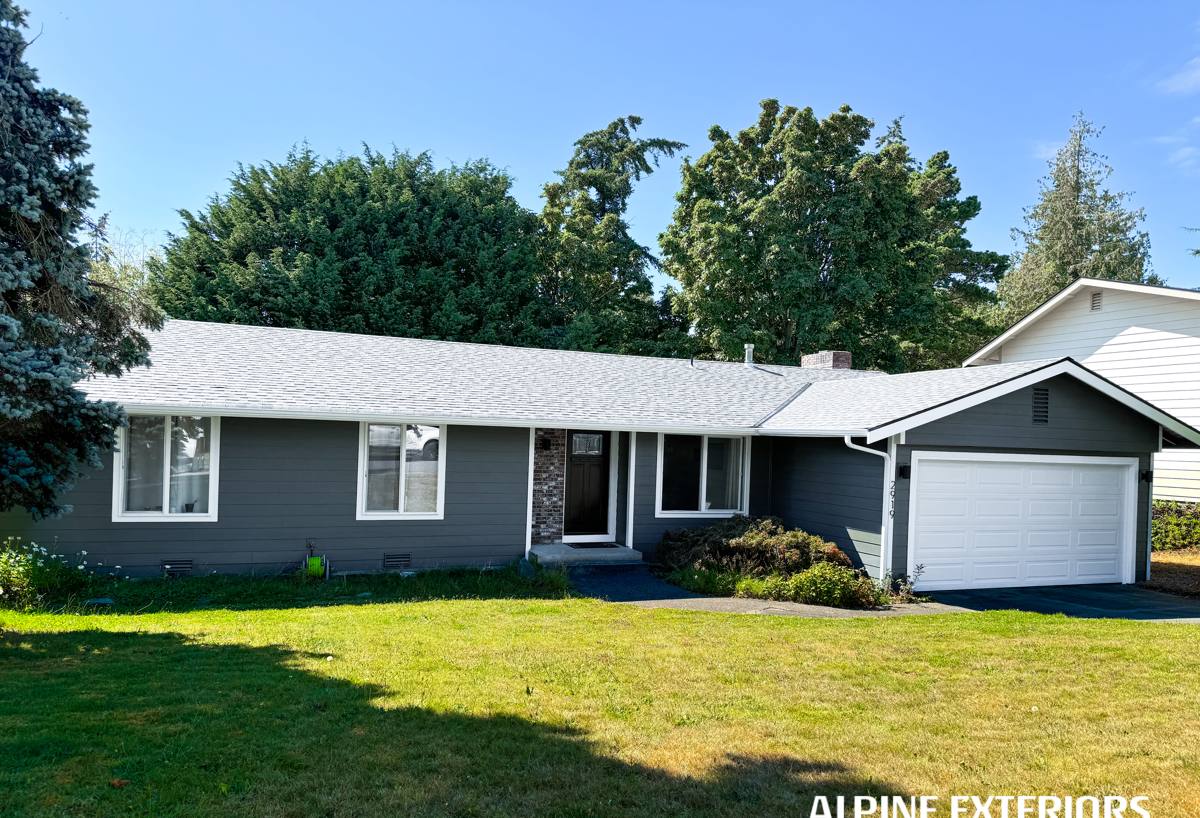
How Each Handles Blaine's Weather
Salt Air and Coastal Exposure
Blaine sits right on the Strait of Georgia and Semiahmoo Bay, and homes closer to the water take a steady dose of salt-laden air. Salt doesn't rot fiber cement or vinyl outright, but it accelerates wear on fasteners, trim, and any exposed seams. Vinyl panels expand and contract more than fiber cement with temperature swings, and that movement, combined with salt exposure, tends to loosen fastener slots and open gaps at corners and J-channel over time. Fiber cement is dimensionally stable — it doesn't expand and contract nearly as much — so seams and fasteners stay tighter for longer in a coastal environment.
Driving Rain
Whatcom County gets wind-driven rain off the water, not just straight-down rainfall. Vinyl siding is installed as a rain-screen-style overlap system that relies on the panels shedding water outward — it's not sealed, and it's not meant to be. When wind pushes rain sideways with enough force, water can get behind panels at butt joints and corners. Properly installed fiber cement, especially with correctly flashed and caulked joints, handles wind-driven rain with a more rigid, tighter-fitting assembly. Neither product is waterproof on its own — the house wrap and flashing detail behind the siding still do the real waterproofing work — but fiber cement gives that assembly less to fight against.
Moss Season
The long moss season here is more of an aesthetic and maintenance issue than a structural one for either material, but it plays out differently. Moss and algae grow on the surface of both vinyl and fiber cement equally — neither is moss-proof. The difference is in the finish. Vinyl's color is baked into the plastic, so a stained or moss-streaked panel is a wash-and-hope situation, and pressure washing too aggressively can crack or bow older, brittle panels. James Hardie's factory-applied ColorPlus finish is a baked-on acrylic coating specifically formulated to resist mildew and hold up to regular cleaning, so a soft wash restores the surface without damaging the substrate underneath.
Impact Resistance and Fire
Blaine isn't a high wildfire-risk area the way parts of eastern Washington are, but fire rating still matters for insurance conversations and simple peace of mind. Vinyl is a petroleum-based plastic — it will soften, melt, and burn under direct heat or flame contact, such as from a nearby fire pit, grill, or a neighboring structure fire. James Hardie fiber cement is non-combustible; it doesn't contribute fuel to a fire.
On impact, vinyl is more flexible but also more prone to cracking or punching through in cold weather, when the plastic gets brittle — a thrown rock, a ladder bump, or hail can crack a panel that would only dent or scuff fiber cement. Fiber cement is heavier and more rigid, which makes it more resistant to impact damage but also means it's not a forgiving material to install poorly — more on that below.
Finish and Color Longevity
This is where the two products diverge the most in day-to-day appearance. Vinyl's color is molded into the panel, which sounds durable, but UV exposure over years causes that pigment to fade and chalk, especially on darker colors, and it cannot be repainted without extensive prep because paint doesn't bond well to PVC's low-friction surface. James Hardie's ColorPlus Technology is a multi-coat, baked-on finish applied and cured in a factory-controlled environment — it resists fading and chipping far better than field-applied paint, and it comes backed by its own finish warranty separate from the substrate warranty. If a homeowner ever does want to repaint Hardie siding down the road, it accepts standard exterior paint far more predictably than vinyl does.
Installation Sensitivity
Vinyl siding has a reputation for being relatively forgiving to install — panels hang loosely on nail slots by design, allowing for expansion. That same forgiveness is also its weak point: hang it too tight and it can buckle in the heat; hang it too loose and it rattles or blows off in wind. James Hardie siding demands more precision. Fastener placement, joint flashing, gaps at trim, and the caulking schedule all have to be done to the manufacturer's specification, or the product will not perform as designed — trapped moisture behind poorly flashed fiber cement is the single most common cause of problems with the material. This is exactly why we only install Hardie and don't spread ourselves across multiple siding systems: getting fiber cement installation right, every time, on every home, is a discipline, not an afterthought.
Cost Factors Compared
| Factor | Vinyl Siding | James Hardie Fiber Cement |
|---|---|---|
| Material cost | Lower upfront cost | Higher upfront cost |
| Installation labor | Faster, less specialized | Slower, requires trained crews |
| Repainting | Difficult; often full replacement instead | Rarely needed; can be repainted if desired |
| Impact/fastener repair | Panel replacement, color-match risk | Localized patch or plank swap |
| Expected service life | 15-25 years typical | 30-50+ years with proper install |
| Resale perception | Viewed as a standard, lower-cost finish | Widely marketed by builders as a premium, upgraded finish |
The upfront cost gap is real, and we won't pretend otherwise. But when you spread the cost over the material's expected service life, and factor in that vinyl often needs a full re-side rather than a repaint when it fades or cracks, the gap narrows considerably over a 20-to-30-year ownership window.
Maintenance Over the Years
Neither product is maintenance-free, but the maintenance looks different:
- Rinse both materials annually to clear salt residue, pollen, and moss spores before they set into the surface
- Inspect vinyl J-channel and corner posts yearly for gaps that open from expansion and contraction cycles
- Inspect Hardie caulk joints at trim and butt joints every couple of years and re-caulk as needed
- Avoid high-pressure washing on older or brittle vinyl — use low pressure and a soft brush
- Watch for chalking or fading on vinyl in south- and west-facing exposures, where UV load is highest
- Trim back vegetation and tree cover that keeps siding shaded and damp longer, which speeds up moss growth on either material
Warranty Structure
Vinyl warranties vary widely by manufacturer and are often prorated — meaning the payout for a failure shrinks the longer you've owned the siding, and they frequently exclude fading or color change outright. James Hardie backs its fiber cement products with a non-prorated limited warranty on the substrate, plus a separate finish warranty on ColorPlus color that specifically covers fading and chipping, and the warranty is transferable to a new owner if the home sells — a detail that matters to buyers and appraisers alike in a market where curb appeal and remaining siding life both get scrutinized during a sale.
Why We Only Install James Hardie
We don't install vinyl, and it's not because vinyl is a scam or a bad product for every application — it's a legitimate, widely used siding material that works fine in a lot of climates and price points. Our decision comes down to what we've chosen to be good at and what we're willing to stand behind. Fiber cement gives us a non-combustible, dimensionally stable material with a factory finish, a strong transferable warranty, and a track record of holding up to exactly the kind of salt air, wind-driven rain, and moss exposure that Blaine and the rest of Whatcom County deal with every winter. Standardizing on one system means our crews install it the same correct way on every job, instead of splitting attention and expertise across multiple product lines with different installation rules.
If you're weighing a re-side and want a straight answer about what each option would actually cost and how it would hold up on your specific home, we're happy to walk the property with you and give you a free, no-pressure estimate.