 Blaine Siding
 What Lynden's Climate Does to a House Over Time
Lynden sits inland from Blaine in the heart of Whatcom County's agricultural valley, but it shares the same marine-influenced weather pattern that defines this whole corner of Washington. Moist Pacific air moves in off the Salish Sea and settles over the lowlands for months at a stretch. The result isn't dramatic storms so much as a slow, steady grind: driving rain that comes in sideways during winter fronts, heavy morning fog and dew that keep exterior surfaces damp long after sunrise, and a moss and algae season that can run eight months or longer on north-facing walls and anything shaded by trees or nearby structures.
None of this is unusual for Whatcom County — it's just the cost of living somewhere green. But it matters enormously for siding, because the material on the outside of a house is the only thing standing between that moisture cycle and the framing underneath. Products that handle a dry climate fine can struggle here, and the failures usually aren't dramatic either. They show up as soft spots, peeling paint, swollen edges, and creeping discoloration that homeowners often don't notice until a contractor points it out during a roof or window job.
Moisture and a Long Moss Season
Moss and algae need three things to establish themselves: moisture, shade, and a surface they can grip. Whatcom County's damp, temperate climate provides the first two for most of the year, and porous or textured siding materials provide the third. Once moss gets a foothold on a wall, it holds water against the surface even longer than the weather alone would, which accelerates whatever moisture damage is already happening underneath.
Temperature Swings and Freeze-Thaw
Lynden's winters aren't brutal by national standards, but the region does see repeated freeze-thaw cycles — nights that dip below freezing followed by daytime thaws, sometimes several times in a single week. Any siding material that has absorbed moisture is vulnerable during these cycles, because water expands as it freezes. Over years, that repeated expansion is what causes cracking, delamination, and paint failure in materials not engineered for it.
Why We Only Install James Hardie Fiber Cement
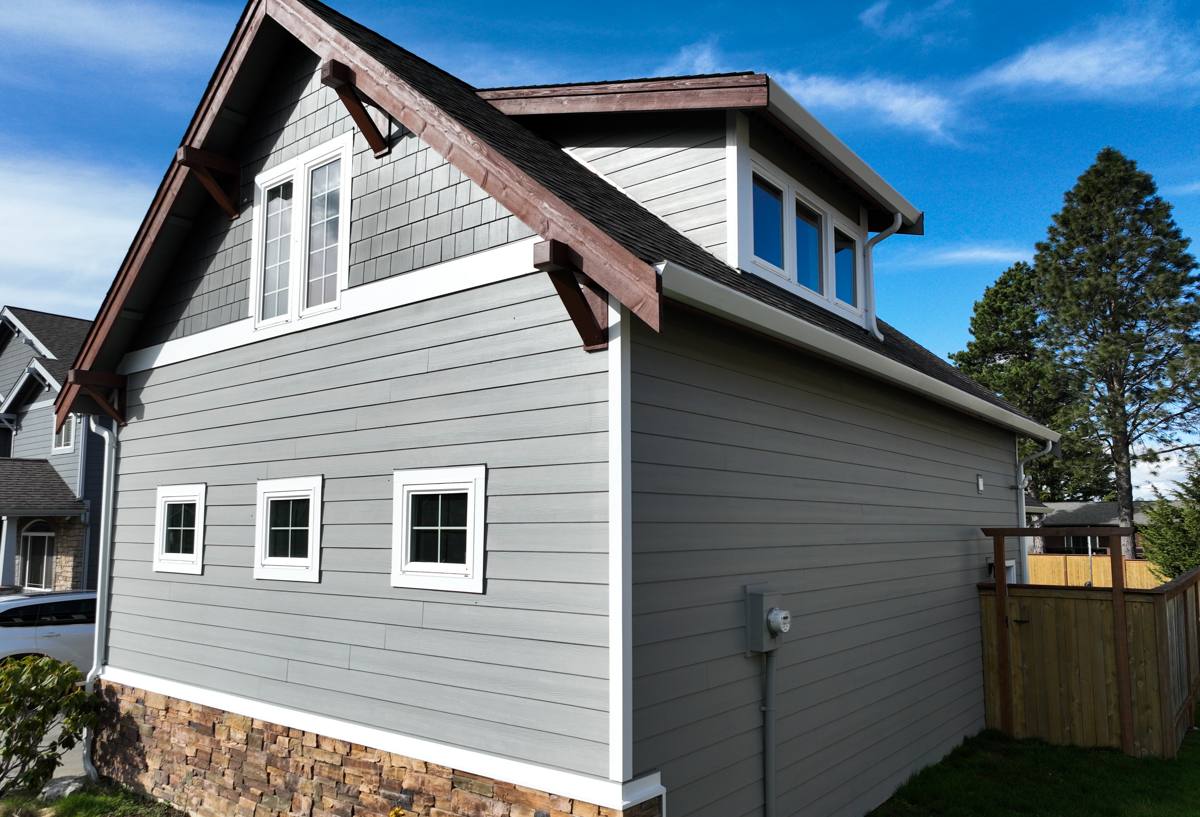
We made a deliberate decision as a company to install James Hardie fiber cement siding exclusively. We don't install vinyl, LP SmartSide, cedar, primed spruce, or other fiber cement brands like Cemplank or Allura. That's not a marketing angle — it's a standard we hold because of what we've seen play out on homes across this climate over time.
Wood-based products, including engineered wood siding, rely on a factory treatment and field-applied paint to keep moisture out. That system works, but it depends entirely on every seam, cut edge, and nail penetration being sealed correctly and staying sealed. In a climate with this much sustained moisture exposure, any gap in that seal becomes an entry point, and wood-based products don't tolerate trapped moisture well — they swell, soften, and eventually need to be replaced in sections or entirely. Vinyl siding avoids the moisture-absorption problem but brings its own trade-offs: it can warp or distort in direct afternoon sun, it becomes brittle and prone to cracking in cold snaps, and it's a petroleum-based product with a look that reads as siding rather than as the material it's imitating.
Fiber cement, by contrast, is made from cement, sand, and cellulose fibers. It doesn't rot, it isn't a food source for moss or insects, and it holds paint and factory finish far longer than wood because it doesn't expand and contract with moisture the way wood does. James Hardie is the company that pioneered and still dominates this category, and their manufacturing consistency and regional engineering are why we standardized on their product specifically rather than a lower-cost fiber cement alternative.
What Hardie Gets Right for This Climate
James Hardie's ColorPlus factory-finish system bakes color onto the board under controlled conditions before it ever reaches the jobsite, which produces a more consistent, longer-lasting finish than field-applied paint. The company also engineers its product lines by climate zone rather than selling one board for the whole country, which is directly relevant to a place like Whatcom County.
HZ5 Engineering and Why It's the Right Fit Here
James Hardie makes a version of its siding — the HZ5 line — specifically engineered for regions with significant moisture exposure and freeze-thaw cycling, which describes the Pacific Northwest well. It's formulated to hold up to sustained damp conditions and repeated temperature swings without the cracking or moisture uptake that generic fiber cement or wood products can experience in the same conditions. For a Lynden home facing eight-plus months of damp, shaded exposure on at least one elevation, that engineering isn't a marketing detail — it's the difference between siding that looks the same in fifteen years and siding that needs early intervention.
Fiber cement is also non-combustible, which is a genuine, if secondary, benefit in a region where wildfire smoke and dry-season risk have become more of a summer concern across Washington in recent years.
Warning Signs We See on Whatcom County Homes
When we're called out to a Lynden property for a siding, roofing, or window estimate, these are the issues that show up most often on homes with wood-based or lower-grade siding products:
- Soft or spongy spots when pressed, especially near the bottom courses and around window trim
- Paint that's peeling, bubbling, or flaking rather than just fading
- Persistent moss or black-green streaking on north- and west-facing walls
- Visible cupping, warping, or gaps opening up at panel seams
- Caulk that's cracked or pulled away from trim and window edges
- Discoloration or staining that tracks downward from a specific point, suggesting a leak path
- Siding that feels noticeably cooler or damp to the touch compared to surrounding sections
Any one of these on its own isn't necessarily an emergency, but they're worth having a professional look at before the next wet season, because moisture problems in siding rarely stay contained to a small area.
Comparing Exterior Siding Options for This Area
| Material | Moisture Performance Here | Maintenance Burden | Typical Lifespan (Well Installed) |
|---|---|---|---|
| James Hardie Fiber Cement (HZ5) | Engineered for damp, freeze-thaw climates | Low — occasional wash, no repainting needed for years | 30+ years, often longer |
| Vinyl Siding | Doesn't absorb moisture but can warp/crack with temperature swings | Low, but panels can't be spot-repaired invisibly | 20-30 years, variable |
| LP SmartSide / Engineered Wood | Vulnerable at cut edges and seams if seal fails | Moderate — needs inspection and recaulking over time | 15-25 years depending on maintenance |
| Cedar / Primed Spruce | Absorbs moisture readily, prone to rot in shaded/damp zones | High — regular repainting and sealing required | 10-20 years without diligent upkeep |
These are general ranges, not guarantees — actual performance depends heavily on installation quality, sun and shade exposure, and how consistently a home gets maintained. But the pattern holds across the industry: materials that resist moisture absorption require less intervention over a Whatcom County lifespan than materials that depend on a maintained finish to stay dry.
Siding, Roofing, Windows, and Decks — Handled Together
Most exterior problems on a Lynden home don't come from one failed component — they come from how the roof, siding, windows, and any attached deck or porch structure interact with water as it moves across the building envelope. A roof edge that doesn't properly flash into the siding, or a window that isn't correctly integrated with the weather barrier behind the cladding, can undermine even the best siding material. Because we handle siding, roofing, windows, and decks, we look at a home's exterior as one connected system rather than a series of separate trades that don't talk to each other. That matters most at transition points — roof-to-wall intersections, window and door openings, and deck ledger connections — which is where the majority of real-world moisture intrusion actually starts.
What Correct Hardie Installation Actually Involves
James Hardie's product is only as good as the installation behind it. Manufacturer specifications call for proper fastener spacing and type, correct clearances above rooflines, decks, and grade, a weather-resistant barrier installed and lapped correctly behind the siding, and joints and butt seams treated according to spec rather than just caulked and painted over. Skipping these details is the single biggest reason any siding product — Hardie included — underperforms its expected lifespan. It's also why the manufacturer's warranty structure matters: proper installation by a factory-trained crew keeps that warranty intact, while shortcuts can void it before a homeowner ever finds out.
Why a Local Crew Matters for a Lynden Project
A contractor working across Whatcom County day in and day out has a practical feel for how this region's weather actually behaves against a house — not just in general terms, but in terms of which elevations take the worst of the driving rain, how long moss really takes to establish on a shaded wall here, and what freeze-thaw cycling does to a poorly sealed seam over a few winters. That local pattern recognition shapes real decisions on a job: where to add extra flashing attention, which details deserve a second look, and how to sequence work around this area's wet-season timing. It's a different level of judgment than a crew that installs siding occasionally in a climate they don't work in every week.
Ready to Talk About Your Home
If your Lynden home is showing early signs of moisture damage, or you're simply planning ahead for a siding, roofing, window, or deck project, we're happy to take a look and give you a straightforward, no-pressure estimate. There's no obligation — just an honest read on where your home stands and what your options are.