 Blaine Siding
 Custer sits in the rural stretch of Whatcom County between Blaine and Ferndale, close enough to Drayton Harbor and the Strait of Georgia that salt-laden air is a constant companion, and far enough into open farmland that homes take the full brunt of driving rain off the water with little tree cover or terrain to break it up. Add in a moss season that can run from October clear through April in a typical Pacific Northwest year, and you've got a climate that is genuinely hard on exterior building materials. We've spent years installing and repairing siding, roofing, windows, and decks across this stretch of the county, and Custer homes tell a pretty consistent story about what holds up and what doesn't.
What Custer's Climate Actually Does to a House
It's worth separating out the specific stresses, because they don't all attack a house the same way.
Salt Air
Being close to Semiahmoo Bay and the Strait means airborne salt is present even miles inland, carried by the prevailing westerly winds. Salt is corrosive to fasteners, flashing, and any metal trim, and it accelerates the breakdown of finishes that aren't formulated to resist it. On wood-based siding products, salt exposure combined with moisture speeds up the checking and cupping that eventually lets water behind the boards.
Driving Rain
Custer doesn't get sheltered the way some tighter Bellingham neighborhoods do. Open exposure means wind-driven rain hits siding at an angle, forcing water into laps, seams, and butt joints that would stay dry on a calmer site. This is where installation quality matters as much as the product itself — proper flashing, house wrap integration, and lap spacing decide whether that rain stays on the surface or works its way behind the cladding.
Moss and Sustained Moisture
A long, cool, damp season means siding surfaces — especially north-facing walls and anything shaded by trees or outbuildings — stay wet for extended stretches. Moss and algae don't just look bad; on porous or absorbent siding materials, sustained moisture retention feeds rot at the substrate level, particularly around butt joints and lower courses near grade.
Why We Only Install James Hardie Fiber Cement
Homeowners in Custer often ask us why we don't offer the vinyl, LP SmartSide, or cedar options other contractors quote. It's a fair question, and the honest answer is that after years of doing exterior work in exactly this climate, we made a standard for ourselves and stopped installing products that didn't meet it.
The Trade-Offs We Weighed
- Vinyl siding is affordable and low-maintenance in mild climates, but it can become brittle in cold snaps, expands and contracts more than fiber cement, and its seams and J-channels give wind-driven rain more opportunities to find a way behind the panel over time.
- LP SmartSide and other engineered wood products perform reasonably well when installation and maintenance are perfect, but they're wood-based at the core — meaning sustained moisture exposure (like Custer's moss season delivers) is exactly the condition that stresses them most over a 15-20 year horizon.
- Primed spruce and cedar are traditional and attractive, but they demand a repainting and caulking cycle that most homeowners underestimate, and in a salt-air, high-moisture environment that cycle compresses further.
- Cemplank and Allura are also fiber cement products and share much of Hardie's core chemistry, but we've standardized on one manufacturer so our crews install to one spec, one warranty structure, and one set of factory-finish standards every time — consistency that protects the homeowner as much as it protects us.
None of this means these products are bad — it means we decided we'd rather install one system extremely well than several systems adequately. For a climate like Custer's, "extremely well" is the bar that matters.
What Hardie Gets Right for This Climate
James Hardie fiber cement is non-combustible and dimensionally stable, meaning it doesn't swell, cup, or rot the way wood-based products can when exposed to sustained moisture. Its ColorPlus factory finish is baked on under controlled conditions rather than field-applied, which matters directly for salt air exposure — the finish is formulated to resist fading and moisture intrusion better than most site-applied paint systems, and it carries a longer warranty against that finish failing. Hardie's HZ5 product line in particular is engineered for climates with more moisture and freeze-thaw cycling, which fits the Whatcom County coastal-to-inland gradient Custer sits in.
How Correct Installation Changes the Outcome
Fiber cement siding is only as good as its installation. We see failures on Hardie siding in this region, and almost every one traces back to installation shortcuts, not the product itself.
| Installation Detail | Why It Matters in Custer |
|---|---|
| Proper lap and clearance from grade | Keeps splash-back and standing moisture off the lowest courses during long wet spells |
| Correct fastener type and placement | Salt air corrodes the wrong fasteners faster; Hardie specs matter for wind uplift resistance too |
| Flashing at every penetration and butt joint | Directly counters wind-driven rain forcing water into seams |
| House wrap and weather barrier integration | Second line of defense if any moisture gets past the siding surface |
| Caulking only where Hardie specifies (not everywhere) | Over-caulking traps moisture instead of letting assemblies dry |
This is also why a local crew matters more than it might seem. A contractor who works Whatcom County's rural, open-exposure sites regularly knows to treat Custer differently than a sheltered in-town lot — heavier flashing detail, more attention to grade clearance, and an eye for where moss and algae are already telling you where water lingers.
Siding Isn't the Only Envelope Under Stress
The same conditions that wear on siding wear on the rest of a home's exterior, which is why we approach these as one connected system rather than separate trades.
Roofing
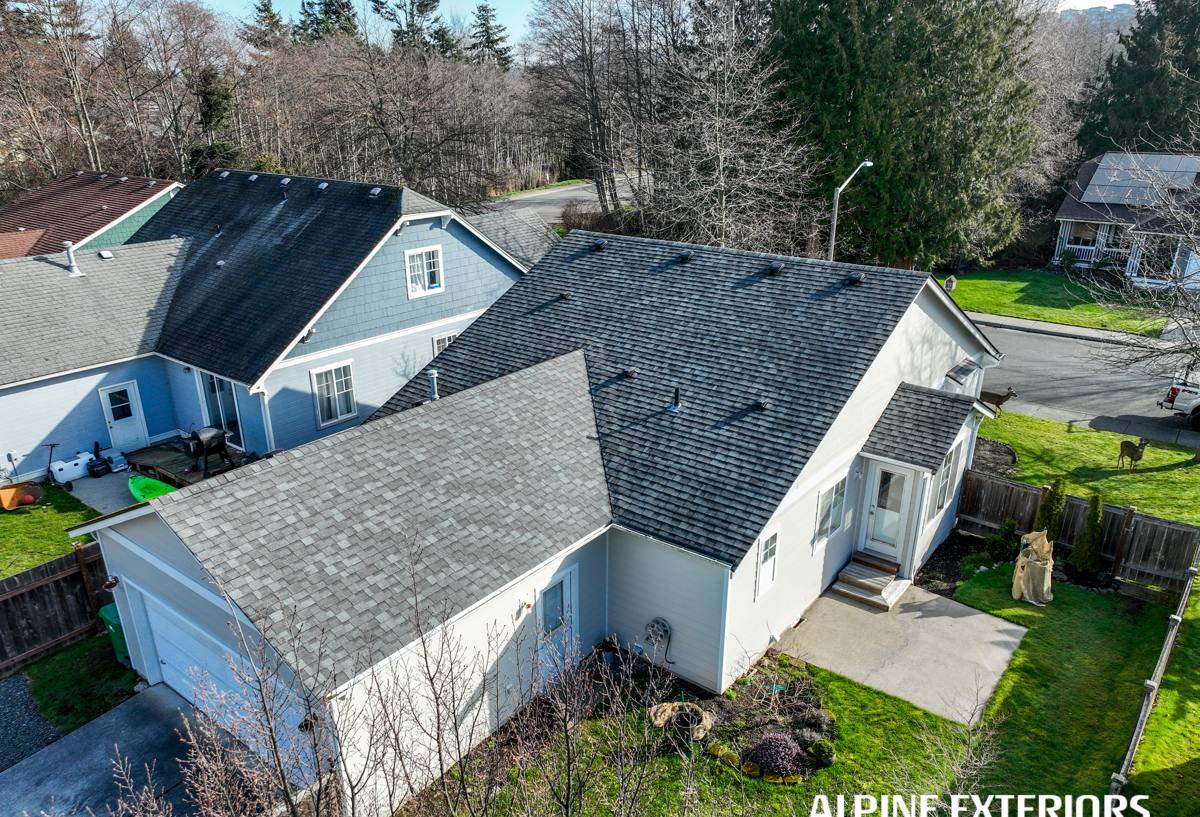
Moss growth on roofs in this area isn't cosmetic — moss holds moisture against shingles and can lift edges over time, and salt air ages roofing materials and flashing metal faster than an inland climate would. Roof and siding flashing details need to work together at every transition.
Windows
Window flashing and the siding-to-window interface is one of the most common leak points we find on older homes in this area. Driving rain finds gaps at window trim before almost anywhere else on the wall.
Decks
Exposed decks take the same driving rain and moisture cycling as siding, and ledger board connections back to the house need the same careful flashing attention siding does — it's often the same failure point, just at grade level instead of on the wall.
A Practical Look at Signs to Watch For
- Persistent moss or algae streaking on north-facing or shaded siding, especially near ground level
- Soft spots, bubbling paint, or visible cupping on wood-based siding sections
- Rust staining below fasteners or metal trim, a sign salt air is corroding hardware
- Gaps or separation at butt joints and corner boards after a windy, wet winter
- Peeling or chalking finish, particularly on walls facing the prevailing wind and rain direction
- Water staining on interior walls near window and door trim after heavy storms
What a Siding Project Looks Like Here
Every Custer property is a little different depending on how exposed the site is and what condition the existing siding is in, but the general path is the same: an on-site assessment of current siding condition and moisture history, a look at flashing and window/door details that may need correction regardless of new siding, then installation to Hardie's fastening and clearance specs with attention to the specific exposure of each elevation. Homes facing open fields or closer to the water usually need more conservative detailing on the windward sides than homes with more wind protection.
Cost Factors Worth Understanding
| Factor | Why It Affects Price |
|---|---|
| Home size and number of stories | More surface area and access complexity |
| Existing siding removal vs. tear-off condition | Rot repair or sheathing replacement adds labor |
| Trim and corner detail complexity | More architectural detail means more cut work and flashing |
| ColorPlus color and plank style selection | Some finishes and profiles carry different material costs |
| Site exposure and access | Open, wind-exposed sites may call for more conservative flashing detail |
We don't quote broad numbers without seeing the actual house, because rot repair and flashing corrections found during tear-off can shift a project significantly — but we'll always walk you through exactly what we find and why before moving forward with anything unexpected.
Why a Local Crew Matters
A contractor based near Blaine who works this part of Whatcom County regularly has seen how Custer's open exposure differs from a sheltered Bellingham lot or a drier east-county site. That familiarity shows up in small decisions — where to add extra flashing, which elevations need tighter attention, how much clearance to leave at grade — that a crew unfamiliar with the area's specific rain and salt exposure might not think twice about.
If you're weighing a siding, roofing, window, or deck project on a Custer property, we're happy to take a look and give you a straightforward, no-pressure assessment of what your home actually needs — no hard sell, just an honest read on condition and options. Reach out anytime to schedule a free estimate.