 Blaine Siding
 Why Bellingham's Marine Climate Is Hard on a Roof
Bellingham sits right on the water in Whatcom County, and that location shapes what a roof has to survive year after year. Salt-laden air off Bellingham Bay works on fasteners, flashing, and exposed metal edges long before most homeowners notice anything wrong. Wind-driven rain off the Salish Sea doesn't fall straight down — it gets pushed sideways under poorly lapped panels and around trim that wasn't detailed for the direction the weather actually comes from here. And because the region stays cool, damp, and often shaded well into spring, moss and algae get a long runway to establish themselves on any roof surface that holds moisture.
None of that makes metal roofing a bad fit for Bellingham — it's actually one of the better-performing materials for this exact combination of conditions. But it only performs that way when the installation accounts for salt exposure, rain intrusion, and moss/debris buildup from day one. A metal roof installed the same way you'd install one in a dry inland climate will underperform here, sometimes badly, within a decade.
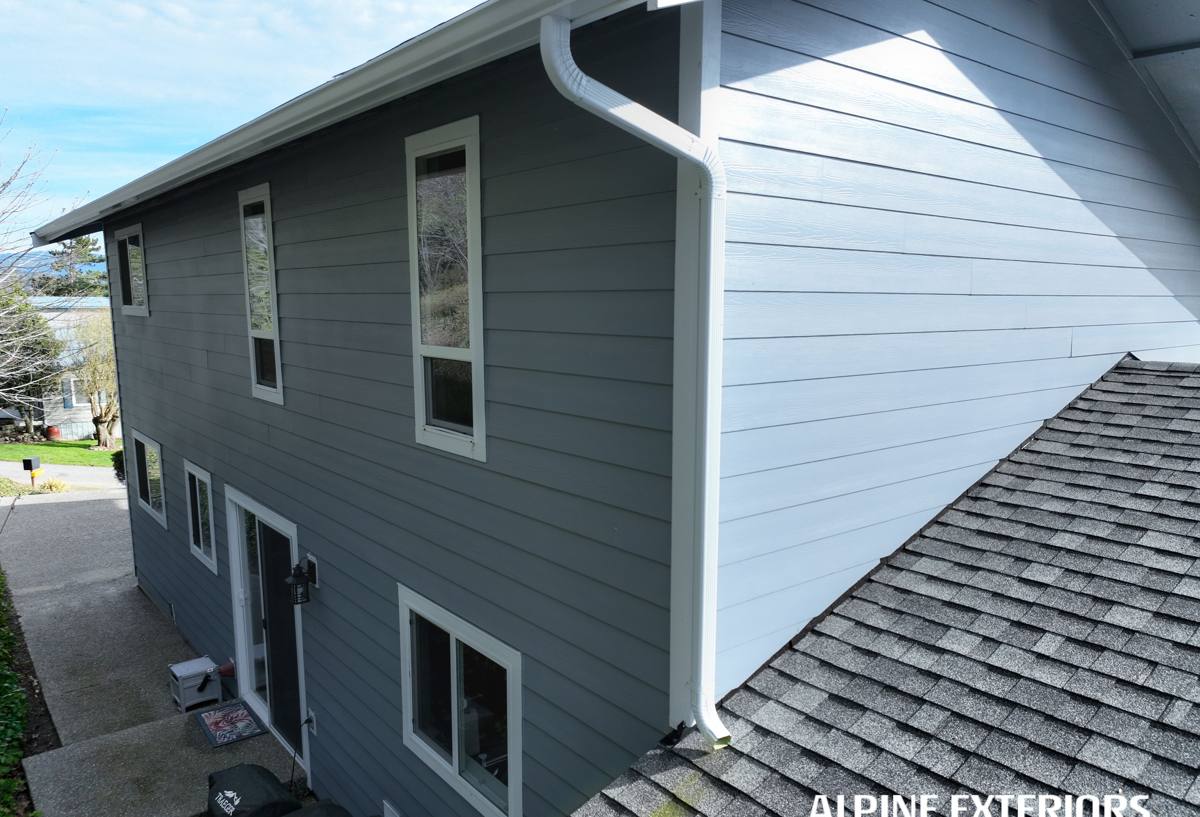
What a Correctly Installed Metal Roof Includes in This Climate
"Metal roofing" covers a wide range of workmanship quality, and the difference between a roof that lasts 40+ years and one that leaks or corrodes early usually comes down to details most homeowners never see once the panels are on.
Underlayment and Deck Prep
In a region with as much annual rainfall as Whatcom County gets, the underlayment matters almost as much as the metal itself. We use a high-temperature synthetic underlayment across the full deck, with self-adhered ice-and-water membrane at eaves, valleys, and any low-slope transitions where wind-driven rain is most likely to find a way in. The deck itself gets inspected and repaired before anything goes down — soft or delaminated sheathing under a new metal roof is a problem that only gets more expensive to fix later.
Fasteners and Flashing
Salt air corrodes ordinary hardware faster than most people expect. We spec fasteners and flashing rated for coastal/marine exposure rather than standard-grade hardware, and we make sure dissimilar metals aren't placed in direct contact where they can set up galvanic corrosion — a real issue when a roofer mixes panel material, flashing, and fastener types without thinking about how they interact chemically over time. Every penetration — vents, chimneys, skylights — gets proper step flashing or a formed boot, not just sealant, because sealant-only fixes are the first thing to fail in a climate this wet.
Choosing Panel Style and Finish for Salt-Air Exposure
Not all metal roofing is equal once you factor in proximity to Bellingham Bay and the Sound. Panel material, coating, and profile all affect how well a roof holds up to salt and moisture over decades rather than years.
| Panel Type | Typical Lifespan | Salt-Air Notes | Maintenance |
|---|---|---|---|
| Standing seam steel (Galvalume + PVDF/Kynar finish) | 40–60 years | Good corrosion resistance with a quality factory finish; concealed fasteners help long-term | Low — periodic rinse and gutter clearing |
| Standing seam aluminum | 40–70 years | Naturally corrosion-resistant, often preferred very close to the water | Low |
| Exposed-fastener corrugated steel | 25–40 years | More affordable, but exposed screws are the first failure point in salt air over time | Moderate — fastener checks every few years |
| Stone-coated steel | 30–50 years | Coating protects the steel, but any coating breach exposes bare metal to moisture | Moderate |
For homes closer to the water or fully exposed to prevailing wind, we generally steer clients toward standing seam with concealed fasteners and a marine-grade finish. It costs more upfront than exposed-fastener panel, but the maintenance burden and corrosion risk over a 30-40 year window make the trade-off worth explaining honestly rather than defaulting to whatever's cheapest to install.
Moss, Shade, and Debris: Designing a Roof That Sheds Rather Than Collects
Bellingham's tree cover and long stretches of overcast, damp weather give moss and algae a real advantage on any roof that traps moisture or debris. Metal roofing has an inherent edge here — it doesn't give moss the porous surface it needs to root the way asphalt shingles or wood shakes do — but that advantage disappears if the roof design itself collects needles, leaves, and standing water.
A few things matter more here than in a drier climate:
- Panel profile and slope should be matched so water and debris actually clear the roof instead of pooling at low points or behind ridge caps
- Valleys need enough width and the right flashing detail to move heavy runoff without backing up under panel edges
- Gutters and downspouts need to be sized for sustained heavy rain, not just light drizzle — undersized gutters overflow and soak fascia and siding
- Overhanging branches near the roofline should be kept back where practical, since shaded, debris-covered sections hold moisture longest and are where algae staining shows up first on painted finishes
None of this is exotic — it's just detailing that has to be intentional in a climate where a roof rarely gets a long stretch to fully dry out.
How We Approach a Bellingham Metal Roofing Project
The process doesn't change dramatically from house to house, but the judgment calls at each step do, based on how exposed the site is to wind and salt air and how much shade and tree debris it deals with.
- Assessment — we look at the existing roof, deck condition, slope, exposure direction, and any signs of past moisture intrusion around penetrations, valleys, and eaves
- Tear-off or overlay decision — metal can sometimes go over an existing roof, but we only recommend that when the deck and existing surface are genuinely sound; papering over a hidden moisture problem just hides it longer
- Deck repair — any soft, rotted, or delaminated sheathing gets replaced before underlayment goes down
- Underlayment and ice/water membrane — full synthetic underlayment plus self-adhered membrane at vulnerable points
- Panel installation — set to the manufacturer's fastening spec, with attention to expansion/contraction allowances so panels aren't installed rigid in a way that stresses seams over time
- Flashing, trim, and ventilation — proper step flashing, ridge venting where the attic design calls for it, and drip edge detailing built for sideways rain, not just vertical
- Final walkthrough — checking fastener torque, seam alignment, and cleanup before we call the job done
Metal Roofing Compared to Other Options in This Climate
We install and repair siding and roofing on plenty of homes around Whatcom County, and homeowners often ask how metal stacks up against asphalt shingles or cedar in a wet, salt-influenced climate. The honest answer is that each has real trade-offs — metal isn't automatically "better," it's a different maintenance and cost profile.
Asphalt shingles cost less to install and are easy to repair in sections, but they have a shorter service life in a climate this wet and are more hospitable to moss growth, which means more frequent cleaning and eventual granule loss. Cedar shakes look good and are traditional in the Pacific Northwest, but they need ongoing treatment and are more moisture- and moss-sensitive than either asphalt or metal, which raises long-term maintenance demands. Metal's upfront cost is higher, but the combination of longevity, moss resistance, and lower long-term maintenance is why we see more homeowners here choosing it for full replacements rather than another asphalt cycle.
Keeping a Metal Roof Performing: Maintenance Checklist
Metal roofing is genuinely low-maintenance compared to other materials, but "low-maintenance" doesn't mean "no maintenance," especially this close to the water.
- Clear gutters and valleys of needles and leaves at least twice a year, more often if the property has heavy tree cover
- Do a visual check after major windstorms for lifted panel edges, loose trim, or fastener backing out
- Rinse off accumulated salt film and debris periodically, especially on roofs with direct exposure to wind off the water
- Watch for algae or moss staining in shaded, low-airflow sections and address it before it spreads rather than after
- Have penetrations (vents, chimney flashing, skylights) checked every few years — these are the most common source of a slow leak on an otherwise sound metal roof
Why a Blaine-Based Crew That Works Bellingham Regularly Makes a Difference
We're based in Blaine, and Bellingham is core territory for us — not an occasional job we drive in for. That matters for a few practical reasons. We already know how differently a roof needs to be detailed depending on how exposed a lot is to wind off the water versus a more sheltered, tree-covered site a few miles inland, and we've seen how Whatcom County's rain and moss season plays out on roofs over multiple seasons, not just at installation. As a contractor that also does siding, we pay close attention to how roof flashing ties into wall systems — a lot of moisture problems on older homes here actually originate at that junction, not on the roof field itself, and treating the two as connected systems rather than separate trades catches issues a roofing-only crew can miss.
Being local also means faster response if a storm causes damage and a straightforward relationship if something needs a warranty check years down the road — you're not chasing down a company that only worked in the area for one job.
If you're weighing metal roofing for a home in Bellingham, we're happy to take a look and walk through what your specific site needs — exposure, tree cover, existing roof condition — and give you a straight answer, no pressure. Use the form below to request a free estimate.