 Blaine Siding
 Bellingham's Marine Climate Is Hard on Outdoor Decking
Bellingham sits right on Bellingham Bay, and that proximity to salt water shapes everything about how an outdoor deck ages here. Salt-laden air corrodes exposed metal fasteners faster than it would inland, driving rain off the Sound finds its way into any gap in a poorly flashed ledger board, and the tree cover common in Whatcom County neighborhoods keeps decks shaded and damp long after a storm has passed. Add in a moss season that can stretch from fall through spring, and you have a climate that punishes decking materials and installation shortcuts alike.
None of this means a deck can't last for decades in Bellingham. It means the material choice and the build details matter more here than they would in a drier climate. That's the lens we bring to every composite decking project we take on in this area.
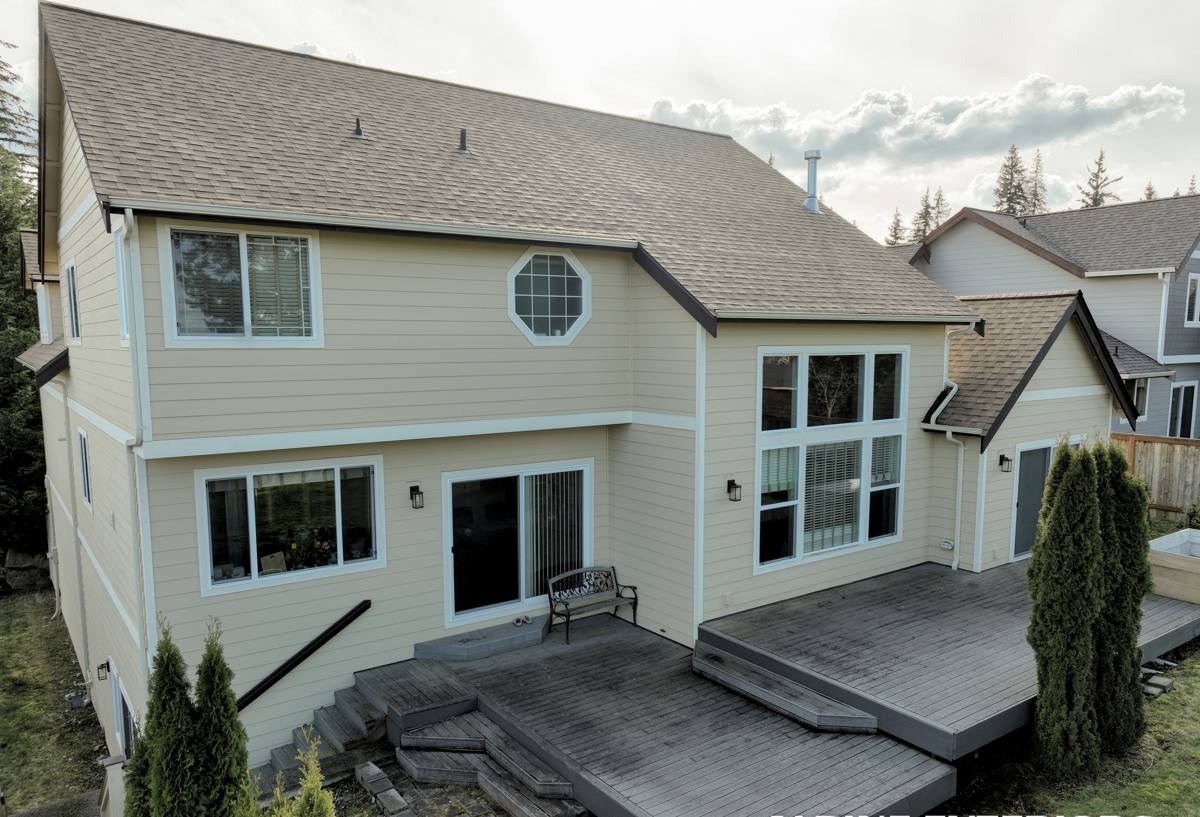
Why Composite Decking Holds Up Where Wood Struggles
Moisture and Rot
Wood decking is a renewable, workable material, but it's also organic — and organic material in a wet marine climate is food for rot fungus. Even pressure-treated lumber only resists decay for so long once it's absorbing rain week after week without a real chance to dry out. Composite decking boards are engineered from a blend of wood fiber and plastic (and in capped products, wrapped in a protective polymer shell), which means they don't absorb water the way solid wood does and won't rot from the inside out.
Moss and Algae Growth
Moss doesn't care what your deck is made of — it will colonize any damp, shaded surface given enough time. But the surface texture matters. Smooth-capped composite boards give moss and algae spores far less to grip onto than the open grain of wood, and they don't develop the soft, spongy pockets where organic growth can really take hold. That makes routine cleaning more effective and less frequent.
Fading and Cracking
Bellingham doesn't get brutal summer sun compared to inland climates, but UV exposure adds up over years, and temperature swings between damp mornings and warm afternoons cause repeated expansion and contraction. Quality capped composite is formulated to resist fading and won't crack, splinter, or cup the way wood can once it's been through a few wet-dry cycles.
Capped Composite vs. Uncapped vs. PVC — What We Recommend and Why
Not all composite decking is built the same, and the differences matter most in a climate like this one. Here's how the main options compare for a Bellingham install:
| Material | Moisture Performance | Moss/Algae Resistance | Maintenance | Our Take |
|---|---|---|---|---|
| Uncapped composite | Fair — can absorb moisture at cut ends and edges | Moderate | Occasional cleaning, edge sealing at cuts | Budget option; needs careful detailing at every cut |
| Capped composite | Strong — polymer shell sheds water | Good — smooth surface resists buildup | Periodic rinse/scrub | Our standard recommendation for most Bellingham homes |
| PVC decking | Excellent — no wood fiber content | Very good | Low | Best for shaded, high-moisture, or waterfront-adjacent lots |
| Pressure-treated wood | Requires ongoing sealing to perform | Poor without treatment | Annual sealing/staining | Lower upfront cost, but highest long-term labor in this climate |
We don't push one brand over another as a matter of loyalty — we spec the product that matches the specific deck's sun exposure, drainage situation, and the homeowner's appetite for maintenance. A deck tucked under fir trees on a north-facing lot gets a different recommendation than one that sits in open sun most of the day.
What a Correctly Built Composite Deck Requires Beneath the Boards
The boards get all the attention, but most deck failures we get called out to inspect started underneath them. A composite deck is only as good as the structure and detailing it's built on:
- Ledger flashing: Where the deck attaches to the house, proper flashing keeps water from tracking behind the siding — a detail that's especially critical given how much rain this region sees.
- Joist tape: A protective membrane over the tops of joists keeps standing water from working into the framing lumber, which is still solid wood even on a composite deck.
- Proper spacing and airflow: Gaps between boards and adequate clearance beneath the deck let air circulate, which is one of the best defenses against the trapped moisture that feeds moss and mildew.
- Corrosion-resistant fasteners: Standard hardware corrodes faster in salt-influenced air. We use fasteners rated for coastal exposure, not just whatever is cheapest at the yard.
- Drainage slope: A deck surface with the right slight pitch sheds rain instead of pooling it, which matters more in a climate that sees frequent, sustained rainfall rather than occasional downpours.
Skip any one of these and the composite boards on top can be flawless while the structure underneath quietly deteriorates.
Railings, Fascia, and Finish Details That Matter in This Climate
Railings and fascia boards take even more direct weather exposure than the deck surface, since they're vertical and catch driving rain at an angle. We match railing systems and fascia trim to the same performance standard as the decking itself — composite or aluminum components where wood would demand constant upkeep, and fastening details that don't leave end grain or cut edges exposed to standing water. A deck that looks finished from a distance but has raw, unsealed cuts at the rail posts or stair stringers is one of the more common shortcuts we see, and it's usually where problems start first.
Maintenance Bellingham Homeowners Should Actually Expect
Composite decking is often marketed as "maintenance-free," which isn't quite honest for this climate. It's maintenance-light compared to wood, but a Bellingham deck under tree cover still needs attention:
- A seasonal rinse and soft-bristle scrub to clear moss spores and organic debris before they establish, typically once or twice through the wet months
- Keeping gutters and downspouts near the deck clear so runoff isn't dumping directly onto the surface or substructure
- Clearing leaves and needles out of board gaps, where trapped organic matter holds moisture longest
- A periodic check of railing connections and stair hardware for any early corrosion
This is a fraction of what a wood deck demands in sanding, sealing, and staining, but it's not zero. We tell homeowners this upfront rather than overselling a "set it and forget it" story.
Our Process, Start to Finish
- On-site assessment: We look at sun exposure, drainage, existing structure (if it's a rebuild), and how the deck ties into the house.
- Material and layout recommendation: Based on that assessment, we recommend a decking product and layout suited to the specific lot, not a one-size-fits-all package.
- Written estimate: A clear scope and price before any work begins, with the reasoning behind material choices explained plainly.
- Structural build: Framing, ledger flashing, joist protection, and footings done to code and to the standard this climate demands.
- Decking, railing, and finish work: Boards, fascia, and railings installed with attention to fastening, spacing, and edge detailing.
- Final walkthrough: We go over the finished deck with the homeowner, including what maintenance to expect and when.
What to Check Before You Hire a Composite Decking Contractor
- Do they ask about sun exposure and shade before recommending a specific decking product?
- Do they explain how they'll flash and protect the ledger board and joists, not just what boards they'll install?
- Do they use fasteners and hardware rated for coastal or marine-influenced conditions?
- Can they speak specifically to how the deck will handle Whatcom County's rain and moss season, rather than giving a generic pitch?
- Is the estimate itemized enough that you understand what's structural versus cosmetic?
Why Hire a Crew That Already Works Bellingham
A lot of decking problems we're asked to fix trace back to a build that would have been fine in a drier, sunnier climate but wasn't detailed for this one. Contractors who mostly work inland or in less coastal-influenced areas don't always think about salt-air corrosion on fasteners, moss-prone shade patterns under Pacific Northwest tree cover, or how much sustained rain — not just occasional storms — a drainage detail needs to handle. We work in Blaine and throughout Whatcom County, including Bellingham, and we build every deck assuming it has to survive this specific climate, not a national-average one.
If you're planning a new composite deck or replacing a wood deck that's showing its age, we're happy to take a look and talk through what makes sense for your home. Reach out for a free, no-pressure estimate using the form below.