 Blaine Siding
 Board & Batten Siding, Done Right for Custer
Custer sits inland just enough from Semiahmoo Bay and the Salish Sea to feel like it should be sheltered from coastal weather — but it isn't. The same wind-driven rain and salt-laden air that hits Blaine's shoreline carries across this part of Whatcom County, and the mature tree cover common on rural Custer properties adds its own problem: shade, moisture retention, and a moss season that runs longer than most homeowners expect. Board and batten siding is a popular choice out here because it fits the rural, farmhouse, and agricultural character of the area. But the style only holds up if the system behind it is built for this climate, not just installed to look good on day one.
This page is about that one service — board and batten siding — for that one area. It's not a general siding overview. It's what we've learned about installing this specific profile correctly on Custer homes, why the wrong install fails faster here than it would somewhere drier, and why we only do it with one material system.
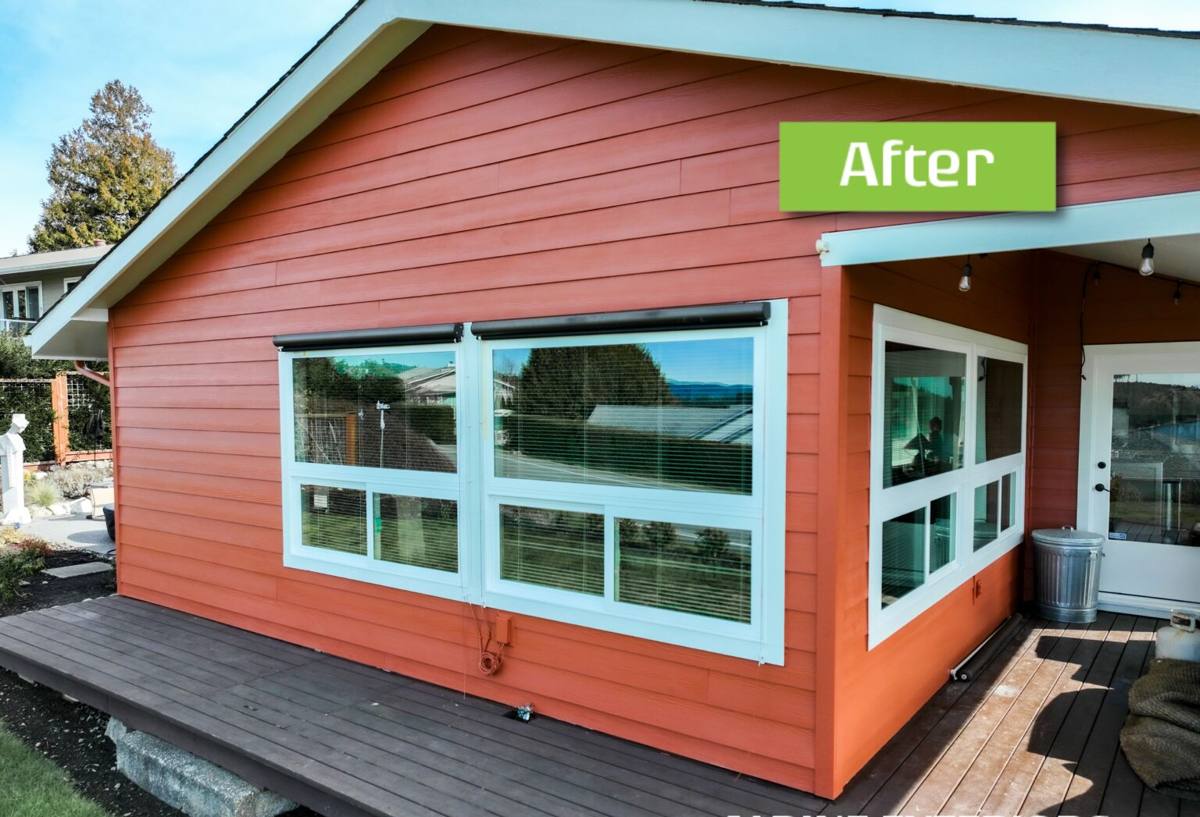
What Board and Batten Siding Actually Is
Board and batten is a vertical siding profile: wide flat panels or boards installed vertically, with narrow strips (battens) covering the seams between them. It's one of the oldest siding styles in American building, originally used on barns and outbuildings because it was fast to install and shed water reasonably well when the boards were left to move with the weather. Modern board and batten borrows the look but needs to perform like a real exterior envelope — sealed seams, controlled drainage, and a finish that survives decades of sun and rain rather than just one season.
The appeal is mostly aesthetic: strong vertical lines, a clean farmhouse or modern-rustic look, and good visual texture on larger wall sections or gable ends. It also pairs well with horizontal lap siding as an accent, which we see requested often on Custer homes that want board and batten on a porch gable, dormer, or shop building while keeping lap siding on the main walls.
Why It Reads Differently Here Than in a Subdivision
On a tightly packed suburban lot, board and batten is mostly a style statement. On the larger, more exposed lots typical of Custer — often backed by fields, tree lines, or open drainage — the same siding is doing more physical work. Longer wall runs mean more seams and more battens, which means more places for water to find a way in in if the install isn't sealed correctly. It's the same product, but the margin for error is smaller.
What Custer's Climate Does to This Siding Style
Salt Air and Fastener Corrosion
Board and batten depends on a lot of exposed fastener points — battens are nailed directly through to the panel and framing below. In a marine-influenced climate like this stretch of Whatcom County, standard fasteners corrode faster than homeowners expect, and a corroding fastener under a batten is invisible until the batten itself starts to stain, streak, or work loose. Correct installs use fasteners rated for coastal exposure; this is not an area where you cut that corner.
Driving Rain and Seam Failure
Vertical siding channels water downward along the battens by design, which is fine when the seams are properly lapped, caulked, and flashed — and a real problem when they aren't. Wind-driven rain off the water pushes moisture sideways into seams that a calmer climate would never test. A board and batten wall with a weak seam detail in Custer will show it within a wet season or two, not years down the road.
The Moss Season Problem
Shaded, north-facing walls under tree cover — common on wooded Custer lots — stay damp far longer than sun-exposed walls. That's exactly the condition moss needs. On a flat lap siding wall, moss growth is mostly cosmetic. On board and batten, moss gets a foothold in the batten seams themselves, and once it's rooted against the substrate, ordinary washing doesn't fully clear it. Material choice and detailing at those seams matters more here than on almost any other siding style.
Where Board and Batten Installations Go Wrong
Most of the board and batten failures we get called out to inspect trace back to the same handful of mistakes, and they're rarely visible until the siding has been up for a year or two:
- No drainage gap behind the panel. Panels fastened flush to the wall with no rainscreen trap moisture against the sheathing instead of letting it drain and dry.
- Battens fastened only into the panel, not the framing. This looks fine initially but leads to loose battens and open seams within a few years.
- Butt joints without proper flashing. Horizontal joints on long wall runs need real flashing detail, not just caulk, which is the first thing to fail under UV and rain cycling.
- Field-cut edges left unsealed. Any cut edge on fiber cement needs to be sealed before installation — an easy step to skip and an easy one to regret.
- Fastener spacing that's too wide or inconsistent, which lets panels move, crack at fastener points, or telegraph waviness along the batten lines.
None of these are exotic problems. They're all the result of installers treating board and batten like a quick vertical version of lap siding, when it's actually a different system with different rules.
What a Correct Installation Involves
A board and batten job that's built for this climate follows a specific sequence, and skipping steps is exactly how the failures above happen. Here's what we consider non-negotiable on every Custer install:
- Full tear-off and inspection of the existing wall sheathing for hidden rot or moisture damage before anything new goes up
- A weather-resistant barrier installed and lapped correctly, shingle-style, so water sheds outward at every layer
- A true rainscreen gap behind the panels so any moisture that gets past the outer layer can drain and the wall can dry
- Corrosion-resistant fasteners throughout — not just at eye level, but at every batten and panel edge
- Properly flashed horizontal joints on any wall run too long for a single panel
- Sealed and primed field-cut edges before the panel goes on the wall, not after
- Consistent fastener spacing set to the manufacturer's engineering spec, not "close enough"
This is the same checklist whether the wall is 12 feet or 120 feet — the difference in Custer is that longer, more exposed wall runs give a shortcut installer more places to fail and less chance anyone notices until the damage is already behind the siding.
James Hardie Board and Batten: The Only System We Install
We install James Hardie fiber cement exclusively — no vinyl board and batten, no LP SmartSide, no primed plywood or cedar boards standing in for the real thing. For a siding style that lives or dies on seam and fastener performance, that's not a brand preference, it's a practical decision.
Hardie's vertical siding system pairs fiber cement panels with matching HardieTrim battens, engineered as one system rather than mismatched parts from different suppliers. The panels are non-combustible, dimensionally stable across our wet winters and dry summer stretches, and available with Hardie's factory-applied ColorPlus finish, which resists the fading and touch-up mismatch that field-painted siding runs into after a few Pacific Northwest winters. Hardie's HZ5 product line is engineered specifically for climates like ours — freeze-thaw cycling, sustained moisture, and coastal exposure — which matters more for board and batten than for almost any other profile, given how many seams and fastener points the style has.
The warranty is also structured around correct installation, which is part of why we follow the sequence above without shortcuts. A board and batten wall installed to spec is backed by Hardie's manufacturer warranty; one installed without a rainscreen gap or with the wrong fasteners generally isn't, regardless of what the sales pitch promised.
Comparing Board and Batten Material Options
| Material | Moisture Behavior | Fastener Corrosion Risk | Moss/Seam Vulnerability | Typical Lifespan |
|---|---|---|---|---|
| James Hardie Fiber Cement | Dimensionally stable, engineered rainscreen compatible | Low with correct coastal-rated fasteners | Low when sealed and finished correctly | 30+ years with proper install |
| Plywood / T1-11 Board & Batten | Absorbs moisture at seams and edges, prone to swelling | Moderate to high over time | High — raw or painted wood seams trap moss | 10-20 years, often less in shaded areas |
| Vinyl Board & Batten | Sheds water but traps condensation behind panel | Low, but panel warping is a separate issue | Moderate — moss grows on the surface, not into the material | 15-25 years, fades and becomes brittle sooner near the coast |
Vinyl avoids some of fiber cement's fastener concerns but introduces its own problems — coastal sun and wind cycling tends to warp and fade vinyl panels faster than manufacturers advertise, and it can't take the factory finish durability Hardie's ColorPlus system offers. Plywood and other wood-based board and batten look right at first but are the most vulnerable of the three to exactly the conditions Custer produces: sustained dampness, shade, and salt-influenced air.
Our Process, Start to Finish
- On-site assessment. We look at wall exposure, tree cover, drainage patterns, and existing sheathing condition before quoting anything.
- Tear-off and sheathing inspection. Any hidden rot or moisture damage gets addressed before new siding goes up — covering a problem never fixes it.
- Weather barrier and rainscreen installation. This is the layer that actually protects the wall long-term, even though it's invisible once the job is done.
- Panel and batten installation to Hardie's engineered fastener spacing and flashing details, adjusted for your specific wall exposure.
- Final inspection and walkthrough so you understand what was done and why, not just that it's finished.
Why a Crew That Already Works Custer Matters
Board and batten siding punishes generic installation more than almost any other style, and that's truer in Custer than in a lot of Whatcom County. Rural lots here often mean longer wall runs, more tree-shaded exposures, well and septic systems that affect where equipment and staging can go, and sometimes outbuildings or shop structures that need matching treatment alongside the main house. A crew that hasn't worked this specific area tends to install board and batten the way they would in a dry inland climate — flush to the wall, standard fasteners, minimal flashing — because it's faster and it looks identical on installation day. The difference only shows up two or three winters later, after the crew is gone.
We size up every Custer job for its actual sun exposure, tree cover, and wind direction, because those factors change the flashing and fastener decisions on a wall-by-wall basis, not just a house-by-house one. That's the difference between board and batten siding that still looks sharp in ten years and siding that needs seam repairs before the warranty period is even halfway through.
If you're weighing board and batten for a Custer home — a full exterior, a gable accent, or a detached structure — we're happy to walk the property, look at your specific exposure, and give you a straight, no-pressure estimate on what a correctly built system would actually involve.