 Blaine Siding
 Why Sandy Point's Waterfront Exposure Changes the Siding Equation
Sandy Point sits close enough to the water that homes here take a different kind of weather beating than siding a few miles inland in Blaine. Salt-laden air off the water accelerates corrosion on fasteners, trim, and any siding product that isn't engineered to shed moisture aggressively. Add Whatcom County's long stretch of driving rain and the shaded, damp conditions that let moss and algae take hold on north- and west-facing walls, and you have an exposure profile that punishes shortcuts. A siding job that would hold up fine in a drier, more sheltered part of the county can start showing problems within a few seasons out here.
This isn't a reason to over-build or panic-spec a home. It's a reason to be precise about material choice, water management details, and fastening — the parts of a siding job that don't show up in a photo but decide whether the wall assembly is still sound in fifteen years.
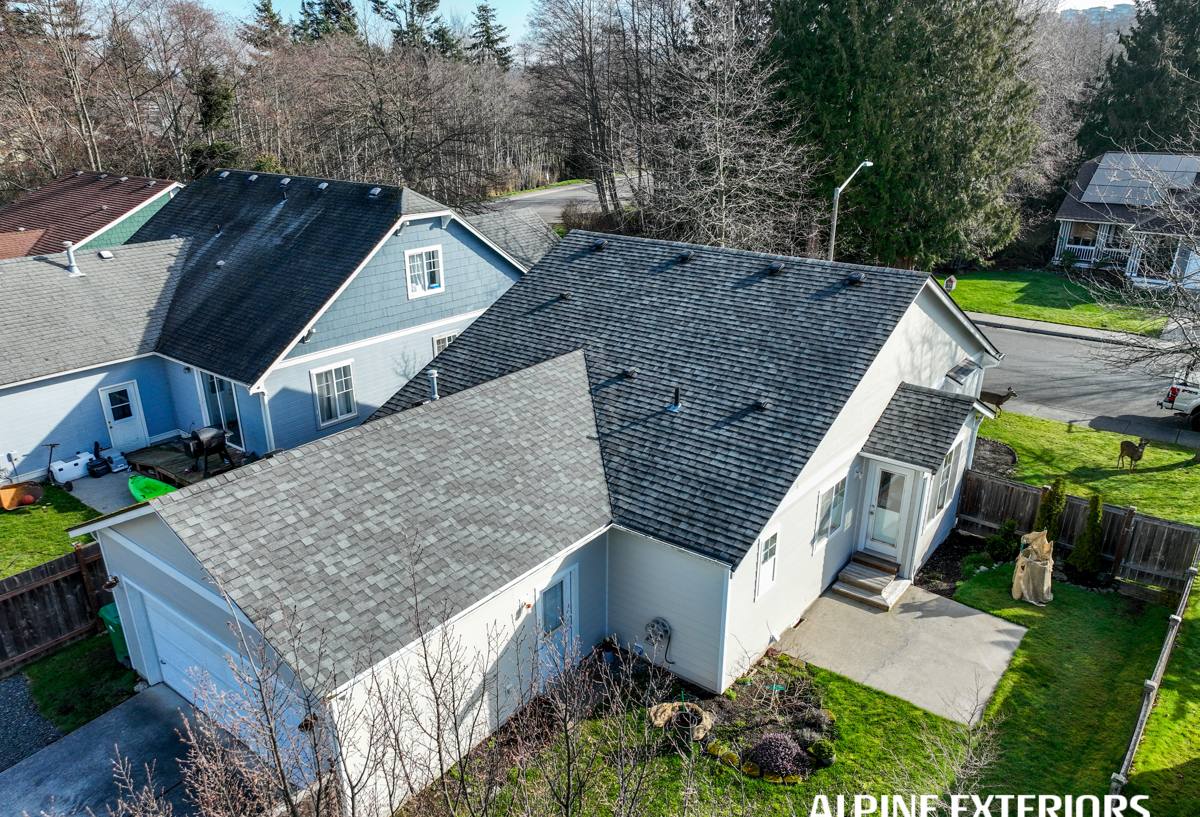
What Salt Air, Rain, and Moss Actually Do to Siding
Salt air
Airborne salt is corrosive to exposed metal — nail heads, flashing seams, trim fasteners — and it accelerates the breakdown of finishes that aren't formulated to resist it. Over time, unprotected fasteners can bleed rust streaks through paint, and cheaper coil-coated trim can chalk and fade faster near open water than the same product would a few miles inland.
Driving rain
Wind-driven rain off the water doesn't just hit a wall — it gets pushed sideways and upward into laps, seams, and penetrations that would stay dry in a calm rain. That makes lap coverage, caulk joints, and flashing at windows, doors, and utility penetrations far more important than on a sheltered inland elevation.
Moss and algae season
Whatcom County's wet, mild winters give moss and algae a long growing window on shaded, moisture-retentive surfaces. Siding that absorbs water or has a porous factory finish gives moss more to grab onto; siding that sheds water and has a hard, consistent finish gives it far less.
Why We Install James Hardie Fiber Cement — And Nothing Else
We standardized on James Hardie for every siding job we do, including Sandy Point, for reasons that matter more here than in a lot of other neighborhoods:
- Non-combustible core: fiber cement doesn't feed a fire the way wood-based siding products can.
- Climate-engineered HZ product lines: Hardie manufactures HZ5 boards specifically for the wetter, more moisture-exposed climate zones the Pacific Northwest falls into, rather than a single one-size-fits-all formulation.
- ColorPlus factory finish: a baked-on finish applied under factory conditions holds color and resists the fading, chalking, and moisture absorption that field-applied paint struggles with over time — a real advantage against salt air and constant damp.
- Dense, low-porosity surface: fiber cement doesn't give moss and algae the same organic, absorbent surface that wood or wood-composite products do, which matters directly in a moss-heavy climate like this one.
- Strong transferable warranty: backed by a manufacturer that has decades of field performance data specific to coastal and wet climates, not just marketing claims.
We don't install LP SmartSide, vinyl, Cemplank, Allura, primed spruce, or cedar. Some of those products perform fine in the right setting, and we're happy to talk through the honest trade-offs of each. But for a waterfront exposure like Sandy Point, we've made James Hardie our standard because it's the product we're confident holding up our own workmanship warranty behind.
What a Correct Installation Actually Involves
Fiber cement siding is only as good as the water-management system installed underneath it. This is where most siding failures — on any brand — actually originate.
Drainage plane and rainscreen gap
A proper weather-resistive barrier, correctly lapped and taped at seams, goes on before the siding. In an exposure like Sandy Point's, we build in a drainage gap behind the siding so that any moisture that does get past the surface has somewhere to go instead of sitting against the sheathing.
Flashing at every penetration
Windows, doors, hose bibs, light fixtures, and vents all need proper flashing and kick-out flashing at roof-wall intersections. In driving rain off the water, a missing kick-out flashing is one of the most common ways water ends up inside a wall cavity.
Fastening and clearances
Hardie specifies fastener type, spacing, and embedment for a reason — get it wrong and you undermine both the warranty and the product's wind and moisture performance. We also hold the manufacturer-specified clearance between the bottom of the siding and grade, decks, and roof lines, which keeps splash-back and standing moisture away from the board's cut edges.
Caulking and joint treatment
Cut edges and field joints get properly sealed or back-primed per Hardie's specifications. Skipping this step is invisible on install day and shows up as a moisture problem two or three winters later.
Fiber Cement Product Line Comparison
| Product line | Best suited for | Relevant advantage in Sandy Point conditions |
|---|---|---|
| Hardie HZ5 | Wetter, cooler Pacific Northwest climate zones | Engineered moisture and freeze-thaw resistance for this region |
| ColorPlus factory finish | Homes wanting long-term color retention with less upkeep | Resists fading and moisture absorption better than field-applied paint |
| Primed for field paint | Homeowners wanting a fully custom color | More maintenance exposure — repaint cycles needed sooner near salt air |
| Panel vs. lap profiles | Depends on architectural style | Both perform equally well when flashed and fastened correctly |
Our Process for a Sandy Point Project
- On-site assessment: we walk the exterior, check current siding and sheathing condition, and look specifically for moisture-related damage around penetrations and low-clearance areas.
- Moisture and substrate check: before any new siding goes on, we confirm the sheathing underneath is sound. Covering up rot or trapped moisture is how a good-looking siding job turns into an expensive problem later.
- Tear-off vs. overlay decision: in most cases on a coastal, moisture-exposed home, a full tear-off to bare sheathing is the right call so the drainage plane can be installed correctly — we'll walk you through why if your home is a candidate for either approach.
- Installation to Hardie spec: drainage gap, flashing, fastening, and finish work done to manufacturer specification, not shortcuts that happen to look fine from the curb.
- Site cleanup and walkthrough: a final walk of the completed job with you before we consider it done.
We already work in and around Sandy Point, and that matters for logistics as much as it does for technical knowledge — many waterfront communities in this area have gate access, HOA exterior guidelines, or delivery constraints that a crew unfamiliar with the neighborhood has to figure out on the fly. We show up already knowing how to work efficiently within those conditions.
Maintaining Fiber Cement Siding in a Salt-Air, Moss-Prone Climate
James Hardie siding is low-maintenance compared to wood, but "low-maintenance" isn't "no-maintenance" — especially this close to the water. A simple annual routine goes a long way:
- Rinse the exterior annually with a garden hose and soft brush — avoid high-pressure washing directly into laps and seams.
- Check and clear gutters and downspouts before the fall rains so water isn't overflowing onto siding below.
- Inspect caulk joints around windows, doors, and trim yearly and have any cracked or missing caulk redone before winter.
- Trim back vegetation and tree cover that keeps shaded wall sections damp and encourages moss growth.
- Address any moss or algae growth early with a gentle cleaning rather than letting it establish and hold moisture against the surface.
- Watch for any rust streaking at fastener heads or trim, which can signal it's time to have a section checked.
What Drives the Cost of a Sandy Point Siding Project
| Factor | Why it matters here |
|---|---|
| Tear-off vs. overlay | Full tear-off costs more upfront but is often the right call given coastal moisture exposure |
| Sheathing/substrate repair | Salt air and driving rain increase the odds of hidden moisture damage needing repair before new siding goes on |
| Product line and finish | ColorPlus factory finish carries a premium over field-primed board but reduces long-term maintenance costs |
| Home size and architectural detail | Trim-heavy homes and multiple penetrations require more flashing and labor time |
| Site access | Waterfront lots and gated-community access can affect crew logistics and scheduling |
We're straightforward about costs during the estimate — general ranges based on your home's size and condition, not a lowball number designed to get a signature and change later.
Why Local Experience in Sandy Point Matters
Anyone can install fiber cement siding on paper. Installing it correctly on a home that sits directly in salt air and driving rain requires knowing where these homes typically fail, how the specific microclimate around Sandy Point behaves compared to inland Blaine or other parts of Whatcom County, and how to sequence a project around the neighborhood's access and weather windows. That's the kind of knowledge that comes from doing the work here repeatedly, not from a general contractor's spec sheet.
If you're weighing a siding replacement or repair on a Sandy Point home, we'd be glad to come take a look and give you a straightforward, no-pressure estimate — including an honest read on your current siding's condition and what correct James Hardie installation would involve for your specific home.