 Blaine Siding
 Why Point Roberts Siding Takes a Different Kind of Beating
Point Roberts sits on its own point of land surrounded by Boundary Bay and the Strait of Georgia, which means almost every home there faces some amount of direct water exposure on at least one side. Salt-laden air moves off the water and settles on exterior surfaces day after day, year after year. Combine that with the driving rain that comes through this part of Whatcom County in the fall and winter, plus a long moss season where shaded, north-facing walls stay damp for months at a stretch, and you get a set of conditions that will find every weakness in a siding system faster than almost anywhere else in the region.
This isn't a reason to panic about siding choice — it's a reason to be deliberate about it. Some siding materials tolerate this combination of salt, moisture, and organic growth reasonably well. Others hold onto moisture, degrade at the surface, or need constant upkeep to keep looking and performing the way they should. The material and the installation both matter, and on a peninsula like this, cutting corners on either one shows up sooner rather than later.
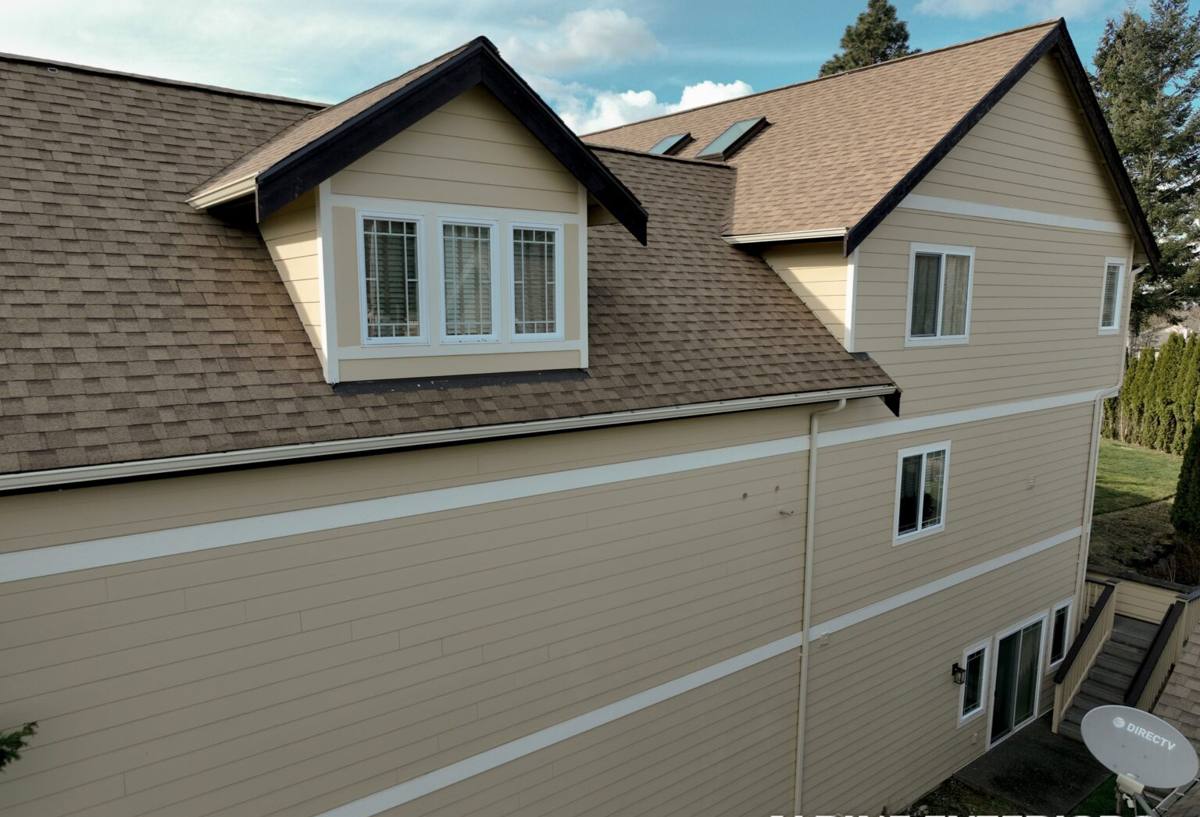
What Point Roberts Homes Actually Need From Their Siding
Strip away the marketing language and a home in this exposure needs a siding system that does four things well:
- Resists moisture absorption at the material level, not just at the paint surface
- Holds its finish and color under constant UV and salt exposure without chalking or fading unevenly
- Doesn't provide an organic surface that moss and algae can colonize easily in shaded, damp areas
- Is non-combustible, which matters given how dry the region can get in late summer between rain systems
This is exactly why our company only installs James Hardie fiber cement siding. We don't carry LP SmartSide, vinyl, Cemplank, Allura, primed spruce, or cedar, and we're upfront about why: each of those products asks a homeowner to accept a real trade-off — added maintenance, moisture sensitivity, appearance drift over time, or a warranty structure that doesn't hold up the way Hardie's does. In an exposure like Point Roberts, those trade-offs get magnified. We'd rather install one product correctly, to spec, than offer a menu of options where some of them are a bad match for this specific coastline.
How James Hardie's System Responds to This Climate
James Hardie's fiber cement is engineered from cement, sand, and cellulose fibers, which gives it a dimensionally stable base that doesn't swell, rot, or delaminate the way wood-based products can when they take on repeated moisture. Hardie also builds region-specific product lines under its HZ5 and HZ10 engineering standards, calibrating the formulation and finish for the climate zone a home sits in. For the Pacific Northwest, that means a product built with sustained rain and marine humidity in mind, not a one-size-fits-all board.
The factory-applied ColorPlus finish is baked on under controlled conditions before the boards ever reach a job site, which gives it far more UV and fade resistance than a field-applied paint job. That matters directly here — salt air accelerates finish breakdown on a lot of exterior materials, and a factory finish holds up to that in a way site-applied coatings typically don't.
What a Correct Installation Involves
Material choice is half the equation. The other half is installation discipline, and this is where a lot of siding jobs — regardless of brand — go wrong. A correct James Hardie install on a Point Roberts home should include:
- A proper drainage plane and rain screen gap behind the siding, so any moisture that does get past the cladding has somewhere to go instead of sitting against the sheathing
- Correct fastener selection and placement — Hardie specifies fastener type, spacing, and embedment depth, and getting this wrong is one of the most common causes of premature cracking or board movement
- Proper flashing at every penetration and transition — windows, doors, roof-to-wall junctions, and any deck or porch attachment points are where water intrusion actually starts on most homes
- Correct joint treatment and caulking practice — Hardie's own installation guidelines specify which joints get caulked, which get flashed, and which should be left as a shadow gap; mixing this up traps moisture instead of shedding it
- Clearance from grade, decks, and roof lines — siding installed too close to the ground or to a roof surface stays damp longer and is more exposed to splash-back and debris buildup, both of which accelerate moss and algae growth
None of this is exotic. It's documented in Hardie's own installation manuals. But it takes discipline to follow it step by step on every wall of a house, especially on the sides that face prevailing wind and rain. Skipping steps doesn't usually show up as a failure in year one — it shows up two, five, or ten years later, and by then it's a repair job instead of a maintenance item.
Climate Exposure vs. What the Siding System Needs to Handle It
| Exposure Factor in Point Roberts | What Happens Without the Right Response | How a Correct Hardie Installation Addresses It |
|---|---|---|
| Salt-laden marine air | Accelerated finish breakdown, chalking, uneven fading | Factory-applied ColorPlus finish resists UV and salt-driven degradation |
| Driving, wind-blown rain | Water forced behind poorly flashed joints and penetrations | Rain screen gap, drainage plane, and correct flashing at every transition |
| Long moss/algae season on shaded walls | Organic growth colonizes porous or absorbent surfaces | Non-porous fiber cement surface with proper grade and roofline clearance |
| Dry late-summer stretches between storms | Increased fire risk for combustible claddings | Non-combustible fiber cement composition |
Signs a Point Roberts Home's Siding Needs Attention
Because this exposure accelerates problems, it's worth knowing what to watch for before a small issue becomes a bigger repair:
- Dark green or black staining concentrated on north-facing or shaded walls
- Soft spots, bubbling, or visible swelling anywhere near ground level or under decks
- Cracked or failing caulk lines at window and door trim
- Paint or finish that looks noticeably more faded on the water-facing side of the house than elsewhere
- Visible gaps or separation at butt joints and corners
Any one of these on its own isn't necessarily an emergency, but they're worth a professional look, especially if more than one shows up on the same wall.
Why a Crew That Already Works Point Roberts Matters Here
Point Roberts is a U.S. exclave — the only road access is through Canada, and that has real, practical implications for a construction project. Material deliveries, crew scheduling, and even simple things like a mid-job supply run all take longer and require more planning than they would for a job five miles away on the mainland side of Blaine. A crew that hasn't worked there before tends to underestimate this, which shows up as delays, rushed work to make up time, or corners cut on the parts of the job that are hardest to inspect after the fact, like flashing and drainage details hidden behind the finished siding.
We're based in Blaine and already work in Point Roberts regularly, so the logistics of getting there, staging material, and running an efficient job are already worked out before your project starts. That means the crew's attention goes into the installation itself — the flashing, the fastening, the drainage details — instead of into solving problems that a Point Roberts job creates for a crew showing up for the first time.
Our Process for a Point Roberts Siding Project
We start with an on-site inspection of the existing siding, the wall assembly where it's accessible, and the specific exposure conditions on each side of the home — the water-facing walls and the shaded walls get evaluated differently because they fail differently. From there we scope the tear-off, confirm the drainage and moisture barrier approach for the walls being resided, and plan the Hardie product line and color that fits the home and its exposure. Installation follows Hardie's published fastening, flashing, and joint-treatment specifications wall by wall, with particular attention to the sides taking the most direct wind and rain. We clean up thoroughly at the end of each work day, which matters more on a job with limited easy resupply access.
Maintenance After Installation
Correctly installed James Hardie siding is low-maintenance compared to wood or vinyl alternatives, but "low-maintenance" isn't "no-maintenance" in an exposure like this one. A simple annual routine goes a long way:
| Task | Why It Matters Here |
|---|---|
| Rinse salt residue off exterior walls | Reduces long-term finish wear from accumulated salt film |
| Check and clear gutters before the fall rains | Prevents overflow water from running down and saturating siding |
| Inspect caulk lines at trim and penetrations | Failed caulk is the most common entry point for water intrusion |
| Trim back vegetation and clear debris from shaded walls | Reduces the damp, low-light conditions moss needs to establish |
Getting an Honest Look at Your Home
Every Point Roberts home sits a little differently relative to the water, the wind, and the shade, and that affects what a siding job actually needs — which walls need the most attention, how the drainage plane should be detailed, and where past moisture damage might be hiding under old cladding. We're happy to come take a look and give you a straight assessment of what your home needs, with no pressure to move forward. If you'd like an estimate, the form below on this page is the easiest way to reach us.