 Blaine Siding
 Building New in Sumas: What the Climate Asks of Your Windows
When a home is going up from framing, the windows aren't just a finish item — they're part of the water management system for the whole building envelope. In Sumas and the rest of our Blaine service area, that system has to deal with driving rain off the Strait, salt-laden air moving in from Semiahmoo and Drayton Harbor, and a long, damp moss season that keeps exterior surfaces wet for months at a stretch. A window opening that's flashed correctly on day one will shed that moisture for decades. One that's flashed wrong — even slightly wrong — tends to show it as rot in the framing long before the window itself fails.
New construction is actually the best time to get this right, because the wall is open and every layer is accessible. There's no siding to work around, no old caulk to strip, no guessing what's behind the trim. We treat that access as the whole point of the job: get the water management layers built in the correct order, on a house that's going to sit in a wet, salty coastal climate for the next 50-plus years.
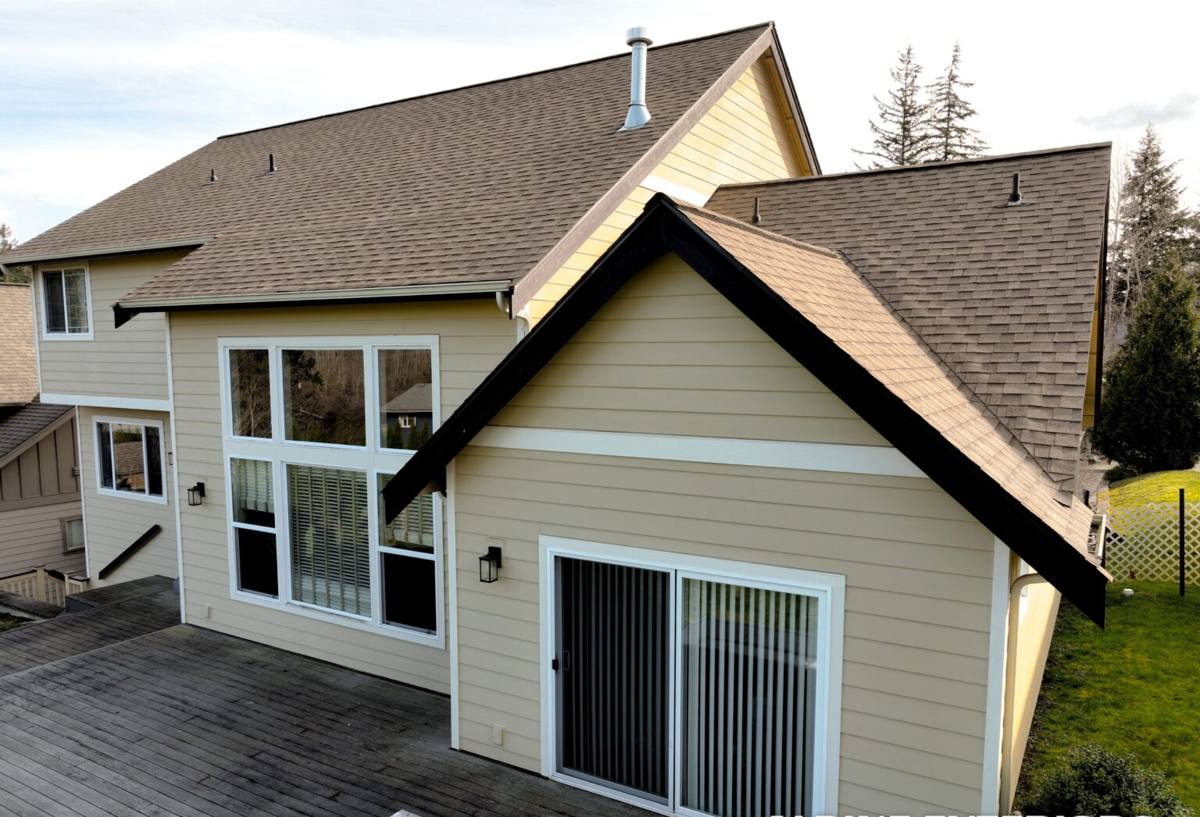
New-Construction vs. Replacement: Why the Distinction Matters
Homeowners sometimes assume "new-construction window" just means a new window in a new house. It actually refers to how the window attaches to the structure. A new-construction window has a nailing fin around its perimeter that gets fastened directly to the wall sheathing, then integrated into the weather-resistive barrier (WRB) and flashing system before siding goes on. A replacement or pocket window, by contrast, is designed to fit inside an existing frame without disturbing the surrounding wall — it trades some of that flashing integration for speed and less demolition.
For a house being built from the ground up, new-construction units are almost always the right call. They let us flash the rough opening properly instead of relying on the window's own frame to keep water out, which matters a great deal in a climate where wind-driven rain hits the wall assembly directly rather than just running down the glass.
Why This Distinction Gets Missed
On a lot of production-built homes, window installation gets rushed to keep the framing-to-drywall schedule moving. Flashing steps get shortened or skipped because nobody's going to see them once the siding is up. That's exactly the kind of shortcut that shows up as a stained wall cavity five or ten years later — usually nowhere near where the actual leak started, since water tends to travel down inside the wall before it becomes visible.
Whatcom County Weather Factors That Actually Affect the Install
Three things about our local climate change how we approach every new-construction window install in Sumas:
- Driving rain: Storms off the Strait of Georgia and the Strait of Juan de Fuca push rain sideways into walls, not just straight down. That means flashing has to work under wind pressure, not just gravity — laps and seals matter more here than in a drier, calmer climate.
- Salt air: Proximity to saltwater accelerates corrosion on fasteners, flashing metal, and hardware that isn't rated for it. Material choices that would be fine 50 miles inland can pit or discolor faster out here.
- Moss and prolonged dampness: Our wet season runs long, and north- and shade-facing walls can stay damp for weeks. Any gap in the water barrier gives moss, algae, and mildew a foothold, and sustained moisture is what eventually breaks down sealants and framing.
None of these factors changes the window product itself so much as they change how much margin for error the installation can tolerate. This is a climate where "close enough" flashing eventually fails; precise flashing doesn't.
What a Correct New-Construction Install Actually Involves
There's a specific order of operations that keeps water moving out and down, never in and behind. Skipping or reordering any of these steps is where most window-related water damage originates.
1. Rough Opening Prep
We check the opening is square, level, and sized correctly before the window ever shows up on site. Framing tolerances get corrected here — not with shims after the fact.
2. Sill Pan Flashing
A sloped, sealed sill pan goes in first, so any water that does get past the window has a dedicated path back outside instead of pooling on bare sheathing. This is one of the most commonly skipped steps on production builds, and it's one of the most important in a driving-rain climate.
3. Window-to-WRB Integration
The window's nailing fin gets sealed and taped into the weather-resistive barrier using a shingle-lap sequence — side flashing first, then head flashing lapped over the top, so water always sheds downward and outward over the layer below it, never up and under.
4. Shimming and Fastening
The window is shimmed plumb, level, and square at the fastening points specified by the manufacturer, then fastened without over-driving screws, which can bow the frame and cause the sash to bind or the seals to fail early.
5. Insulation and Air Sealing
The gap between the window frame and the rough opening gets filled with a low-expansion, window-rated foam or backer rod and sealant — never standard high-expansion foam, which can bow the frame from the inside.
6. Interior and Exterior Sealant
Exterior sealant closes the trim-to-siding joint once siding is installed; interior sealant and trim close out the room side. Both use products rated for this climate's temperature and moisture swings.
Choosing Frame Materials for a Sumas Build
Frame material affects how a window holds up to salt air and constant moisture exposure over time. There's no single "best" choice for every project — it depends on budget, exposure, and how the rest of the exterior is being built.
| Frame Material | Typical Cost Position | Coastal / Salt-Air Performance | Maintenance |
|---|---|---|---|
| Vinyl | Lower to mid | Good — won't corrode or rot; performance depends on quality of the extrusion and welds | Low — occasional cleaning |
| Fiberglass | Mid to higher | Very good — dimensionally stable, resists warping and doesn't corrode | Low |
| Wood-clad | Higher | Good exterior protection from cladding, but any breach exposes wood beneath to moisture | Higher — cladding seams need periodic inspection |
| Aluminum | Varies | Prone to pitting and corrosion in salt air unless marine-grade and properly finished | Higher in this climate |
For most Sumas-area new construction, we steer clients toward vinyl or fiberglass for the balance of upfront cost and long-term resistance to this climate's moisture and salt exposure. Wood-clad still has a place where the design calls for it, but we're upfront that it asks for more attention over its life out here.
Glass Package Considerations
Dual-pane, low-E glass with argon gas fill is the standard baseline for new construction in this climate — it manages both our cooler, wetter winters and the condensation risk that comes with warm interior air meeting a cold, damp exterior wall. Beyond that baseline, the main decision points are U-factor and solar heat gain coefficient, which should be matched to the wall's orientation rather than picked as a single spec for the whole house.
How Our Process Works on a New-Construction Job
We work directly with builders and homeowners in Sumas and the surrounding Blaine area, and we coordinate around the framing and siding schedule rather than treating window install as an isolated task.
- Plan review and rough opening check: We confirm window sizes against the plans and verify rough openings before units are ordered, catching framing discrepancies early.
- Sequencing with the WRB and siding trades: We time our install so the WRB, flashing, and window integration all happen in the right order relative to the siding crew — not as separate, disconnected steps.
- Install and flashing per the sequence above: Sill pan, side flashing, head flashing, fastening, insulation, sealant — same order, every window, every house.
- Documentation at key stages: We note flashing and sealant details at rough-in, before they're covered by siding, so there's a record of what was done and how.
- Final check after siding and trim: Operation, seals, and trim lines get a final pass once the exterior is closed up.
Common Mistakes We Find on New-Construction Jobs
Most of what we correct or avoid on new builds falls into a short list of recurring issues:
- Head flashing installed under the WRB instead of lapped over it, which sends water behind the barrier instead of over it
- Missing or flat (non-sloped) sill pans that let water pool instead of drain
- High-expansion foam used around the frame, bowing it and causing the sash to stick
- Sealant applied to the wrong joint, or a continuous bead where a weep gap needs to stay open
- Fasteners not rated for coastal exposure, leading to early corrosion and staining
None of these are visible once the siding goes on — which is exactly why they tend to go unnoticed until there's a stain on drywall or a soft spot in trim years later.
After Move-In: What Keeps New Windows Performing
A correctly installed new-construction window shouldn't need much attention, but a little seasonal care goes a long way in a climate this wet and salty.
| Task | Frequency | Why It Matters Here |
|---|---|---|
| Clear weep holes and tracks | 2x per year | Prevents pooled water and moss buildup at the sill |
| Rinse salt film from exterior frames | Seasonally, more near open water | Reduces long-term corrosion and finish breakdown |
| Inspect exterior sealant joints | Annually | Sealant is a wear item; catching a failed bead early avoids water intrusion |
| Check for moss or algae at sills and trim | Ongoing during wet season | Sustained dampness accelerates material breakdown over time |
Why a Crew That Already Works Sumas Matters
Whatcom County's building climate isn't uniform — an inland job and a job closer to open water can face different exposure levels, and a crew that only occasionally works this corner of the state doesn't always build in that difference by default. Working regularly in Sumas and the greater Blaine area means we're not guessing at how driving rain and salt air behave against a wall assembly here; we've flashed openings on this coastline in this weather, repeatedly, and we build every new install around what actually holds up in it. That's less about brand loyalty to any one product and more about sequencing, materials, and details that match the conditions the house will actually sit in.
If you're framing a new home in Sumas or planning window selection for an upcoming build, we're happy to walk the plans with you and talk through options — no pressure, no obligation. Use the form below to request a free estimate and we'll get back to you to schedule a look at your project.