 Blaine Siding
 Why California Creek Puts Extra Stress on Siding
California Creek sits close enough to Semiahmoo Bay and the open water of the Strait of Georgia that homes here deal with a version of the coastal Whatcom County climate that's harder on building materials than most homeowners realize. Salt-laden air rides in on the marine wind, driving rain arrives sideways during winter storms, and the tree cover along the creek corridor keeps a lot of siding in shade for long stretches of the year. That shade is great for privacy and cooling, but it also means slower drying times after every rain event — which is exactly the condition moss, algae, and mildew need to take hold.
Add in the freeze-thaw swings that show up most winters, plus the humidity that never really disappears even in the drier months, and you've got a climate that punishes any siding material with a weak moisture strategy. Paint film fails faster than it would inland. Wood substrates swell, split, and rot at the fastener lines. Seams and laps that aren't detailed correctly become the entry point for water that then has nowhere to go because the wall behind it never fully dries out.
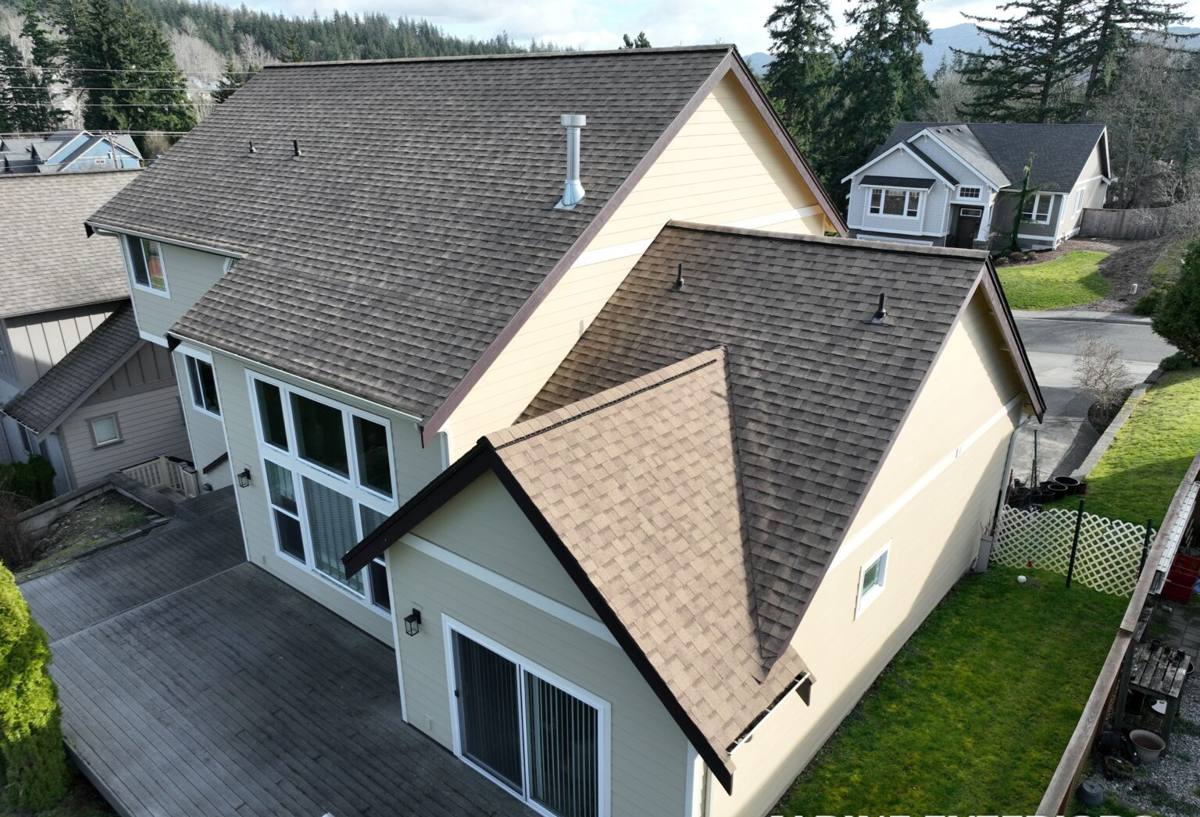
What This Means for a Siding Choice
None of this is a reason to panic about your home's exterior — it's a reason to be deliberate about what goes on the wall and how it's installed. A siding product that performs fine in a drier inland climate can underperform here simply because California Creek gets more wetting cycles and slower drying between them. The material needs to resist moisture intrusion at the surface, hold its finish under salt exposure, and be installed with details that assume it will get rained on sideways more than once a year.
This is the specific reason we only install James Hardie fiber cement siding. We're not going to pretend every other siding product on the market is unusable — vinyl, LP SmartSide, and cedar all have legitimate uses. But for this climate, on this stretch of coastline, we've made a professional call: Hardie's fiber cement composition and factory-applied finish system handle the salt air, the driving rain, and the long moss season better than the alternatives, and we'd rather stand behind one product we trust completely than offer several we have reservations about.
Where Fiber Cement Wins Here Specifically
- Non-combustible core — relevant for wooded California Creek lots near brush and trees, and increasingly a factor in insurance underwriting.
- Dimensionally stable — fiber cement doesn't swell and shrink with moisture the way wood-based products can, which matters when a wall stays damp for days at a time.
- Factory-cured ColorPlus finish — baked on under controlled conditions, so it resists the fading and chalking that salt air accelerates on field-applied paint.
- Rot-resistant composition — cement, sand, and cellulose fiber don't feed fungal growth the way untreated or lightly primed wood substrates do.
James Hardie Product Lines and Why the Match Matters
James Hardie engineers its siding by climate zone, and that's not marketing — it changes what's actually in the product. HZ5 formulations are built for regions with more freeze-thaw cycling and moisture exposure, which describes Whatcom County's coastal belt well. Getting the right HZ designation specified for a California Creek home isn't optional; it's the difference between siding engineered for this exact weather pattern and siding that's just "fiber cement" in a generic sense.
| Product Line | Best Use | What It Offers |
|---|---|---|
| HardiePlank Lap Siding | Most home styles | Traditional lap profile, widest color and texture selection |
| HardieShingle | Accent areas, gables | Cedar-shake look without the moisture upkeep of real shingle |
| HardiePanel | Modern or board-and-batten styles | Vertical panel system for contemporary exteriors |
| HardieTrim | Corners, fascia, window trim | Matches siding durability at the joints most prone to water intrusion |
ColorPlus Technology is worth understanding on its own. It's a multi-coat finish applied and cured at the factory rather than sprayed or brushed on site, which gives it better adhesion and UV resistance than field-applied paint typically achieves. In a salt-air environment, that finish durability is one of the biggest reasons Hardie siding still looks good on year ten instead of needing a repaint by year five.
What a Correct Installation Actually Involves
Fiber cement is only as good as the installation behind it. Hardie's own warranty terms are explicit that improper installation voids coverage, and in a wet climate like this, the details that get rushed are exactly the ones that fail first.
The Non-Negotiables
- Correct fastener spacing and placement — over-driven or under-driven nails compromise the water-shedding lap
- Proper starter strip and flashing at the foundation line, windows, and doors
- Minimum clearance gaps at grade, roof lines, and decks so the siding never sits in standing water
- Rain screen or drainage plane behind the siding where the wall assembly calls for it
- Caulking only where Hardie specifies it — over-caulking traps moisture instead of shedding it
- Butt joints and seams treated per manufacturer detail, not just butted and painted over
On a shaded, damp lot like much of California Creek, we also pay close attention to ventilation behind the siding plane and to keeping the bottom clearance clean of soil, mulch, or landscaping that creeps up over time and holds moisture against the bottom course — a small thing that causes a disproportionate share of the rot and moss problems we get called out to fix on other installs.
Our Process on a California Creek Job
1. Site Walk and Assessment
We look at sun exposure, tree cover, drainage patterns, and existing moisture damage before we talk product selection. A shaded, creek-adjacent lot gets a different ventilation and clearance plan than an open, wind-exposed one even a half-mile away.
2. Tear-Off and Substrate Check
Old siding comes off and we inspect the sheathing underneath. This is where hidden rot or water damage from a prior installation's weak points typically shows up, and it needs to be addressed before anything new goes on the wall.
3. Weather Barrier and Flashing
House wrap, flashing, and any rain screen components go in correctly the first time — this layer does as much work as the siding itself when it comes to keeping driving rain out of the wall assembly.
4. Hardie Installation to Spec
Manufacturer fastening patterns, clearances, and joint treatment, applied consistently across the whole home — not just on the elevations that are easy to see from the street.
5. Final Walkthrough
We check clearances, caulking, and trim details together with the homeowner before calling the job done.
Cost Factors Homeowners Should Understand
Every California Creek property is a little different, so we won't quote a number without seeing the home, but these are the variables that actually move the price:
| Factor | Why It Matters |
|---|---|
| Tear-off scope | Removing old wood, vinyl, or a prior fiber cement job adds labor and disposal cost |
| Substrate repair | Rotted sheathing found during tear-off needs replacement before new siding goes on |
| Product line and profile | Lap, shingle, and panel systems have different material and labor costs |
| Trim and detail work | Homes with more corners, windows, and rooflines take more time per square foot |
| Site access | Wooded or sloped California Creek lots can add setup and staging time |
Choosing a Contractor for This Job
James Hardie certifies installers, but certification alone doesn't guarantee a crew has handled the specific conditions your home faces. Before hiring anyone for a fiber cement job in this area, it's worth asking a few direct questions.
- Do you install Hardie's HZ5 product line and can you explain why it's specified here?
- How do you handle clearance and drainage on shaded or wooded lots?
- What's your fastening and joint-treatment process, specifically?
- Will you show me the manufacturer installation instructions you're following?
- Do you carry both liability insurance and workers' comp coverage?
- Can you walk me through how the Hardie warranty transfers and what voids it?
A contractor who's worked on other homes in and around California Creek already knows how the salt air, shade, and rainfall pattern here behave against a wall — that's not something you can fully substitute with general experience from a drier or more inland market.
Why We Only Install James Hardie
We've made the decision to install one siding system, done correctly, rather than offer several options and let installation quality vary by product. James Hardie's non-combustible composition, climate-matched HZ engineering, factory-cured finish, and transferable warranty give us a product we can stand behind fully in a climate that doesn't forgive shortcuts. That's the whole reason behind the standardization — not brand loyalty, but a professional judgment call about what actually holds up on California Creek homes over the long run.
If you're weighing a siding replacement or repair and want to know what it would actually take — and cost — on your specific home, we're glad to come take a look. The estimate is free, there's no pressure, and you'll get a straight answer about what your home needs.