 Blaine Siding
 Siding Repair in Ferndale: Matching the Fix to the Climate
Ferndale homes take a specific kind of beating over the years. Salt-tinged air drifts in from the Sound, wind pushes rain sideways into wall assemblies instead of straight down, and shaded or north-facing walls stay damp long enough for moss and mildew to take hold most of the year. Individually, none of that is unusual for Whatcom County. Together, over a decade or two, it's exactly the combination that turns small siding problems into bigger ones if repairs aren't done with the local climate in mind.
Siding repair sounds simple from the outside — patch the bad section, repaint, move on. Done poorly, that's also how a lot of Ferndale homes end up with the same repair needed again in a few years, or worse, hidden water damage behind a wall that looked fine from the driveway. We repair siding using James Hardie fiber cement, matched and installed correctly the first time, because a repair is only as good as what it's protecting against.
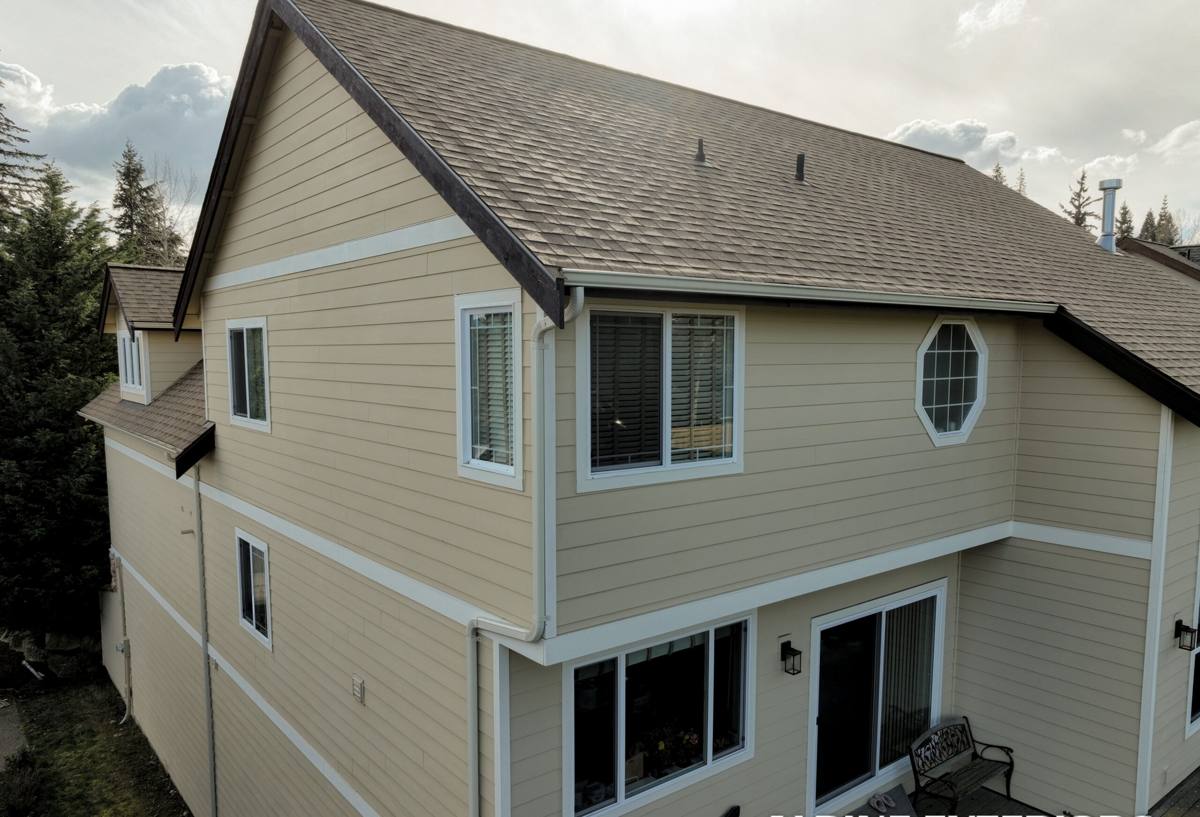
What Ferndale's Climate Does to Siding Over Time
Salt Air and Corrosion
Even homes set back from the immediate shoreline get a steady dose of salt-laden air moving through this part of the county. Salt accelerates corrosion in fasteners, flashing, and trim long before it visibly damages the siding panel itself. A repair that reuses corroded fasteners or skips new flashing at a patched section is a repair that's already counting down to its next failure.
Wind-Driven Rain
Rain in this region rarely falls straight down. Wind drives it sideways into lap joints, corner trim, and anywhere a seam wasn't sealed correctly the first time. This is the single biggest reason a piece of siding fails in one spot rather than uniformly across a wall — water finds the one weak joint and works at it for years before it becomes visible as staining, soft trim, or a section of siding that's started to separate from the wall.
A Long Moss and Mildew Season
Mild temperatures, shade, and consistent moisture add up to a moss and mildew season that runs most of the year across Whatcom County. Any siding material that's even slightly porous becomes a growth surface over time, and moss holds moisture against the wall long after the rain has stopped. On north-facing walls and areas shaded by trees, this is often what actually triggers a repair call — not damage from a single storm, but slow deterioration nobody noticed until the discoloration or soft spot was already there.
Freeze-Thaw and Seasonal Movement
Whatcom County doesn't see extreme cold most winters, but it does see enough freeze-thaw cycling that trapped moisture behind or inside a damaged section of siding can do real damage. Water that gets behind a cracked or gapped panel and then freezes expands, widening the gap and accelerating the exact problem the repair is supposed to fix. This is one of the reasons a repair that only addresses the cosmetic surface, without checking what's happening behind the panel, tends not to last.
Signs a Ferndale Home Needs Siding Repair
Some siding damage is obvious. A lot of it isn't, especially on walls that aren't seen up close every day. Homeowners in Ferndale should watch for:
- Cracked, chipped, or visibly separated siding panels, especially near corners and butt joints
- Soft or spongy trim boards, particularly around windows, doors, and roof lines
- Persistent moss or dark streaking that keeps returning to the same section of wall
- Bubbling, peeling, or discolored paint that suggests moisture is trapped underneath
- Gaps opening up at seams, corner boards, or where siding meets trim
- A musty smell or visible staining on an interior wall that backs onto exterior siding
- Fastener heads that have backed out, rusted, or left streaking below them
Any one of these on its own might be minor. Several appearing on the same wall, or showing up repeatedly in the same spot, usually means water has been getting in longer than it looks like from the outside.
Repair or Replace: How We Make the Call
Not every damaged section needs a full re-side, and we don't push a full replacement when a targeted repair will hold. The honest answer depends on how much of the wall is affected, what's happening behind the siding, and how old the existing material is relative to what's failing. The table below is a general guide, not a substitute for an actual look at the wall.
| Situation | Usual Approach | Why |
|---|---|---|
| One or two damaged panels, sound siding elsewhere, no hidden water damage | Targeted repair with matched material | Isolated damage doesn't justify disturbing sound siding around it |
| Recurring moisture or moss in the same location year after year | Repair plus a look at flashing, house wrap, and drainage details | The siding is a symptom; the underlying water path needs fixing too |
| Rot or soft sheathing found once siding is removed | Expanded repair to replace affected sheathing before re-siding | New siding over damaged sheathing just hides the problem again |
| Widespread cracking, fading, or aging across most of the home | Full re-side discussion | Patchwork repairs across an aging, failing system rarely age well together |
| Older material not matched to today's Hardie color and profile lines | Repair with closest match, or a conversation about a phased re-side | Discontinued colors and profiles can make an exact match difficult |
Why We Repair in James Hardie Fiber Cement
We install and repair with James Hardie fiber cement exclusively. We don't patch a damaged wall with vinyl, LP SmartSide, Cemplank, Allura, primed spruce, or cedar, even as a quick fix, because a mismatched repair material creates its own long-term problems: different expansion and contraction rates, different moisture behavior, and a wall that ages unevenly. A handful of reasons this matters specifically for repair work in this climate:
- Non-combustible core: Fiber cement doesn't feed a fire the way wood-based siding can, which matters for both safety and insurance considerations on any section of the home.
- Factory-applied ColorPlus finish: Repaired sections finished with ColorPlus resist fading and moisture damage far longer than a field-painted patch, and they hold their color closer to the surrounding siding over time.
- Climate-engineered HZ formulation: Hardie's HZ5 line is built for regions with heavy moisture exposure and freeze-thaw cycling, which describes coastal Whatcom County well.
- Dimensional stability: Fiber cement doesn't swell, cup, or warp the way engineered wood products can after repeated wet-season moisture cycles, so a repaired section stays flush with the wall around it.
- A repair that matches, not just patches: Hardie's consistent profile and color lines make it realistic to match new material to existing siding, rather than leaving an obvious patch.
Each of the products we don't install has a legitimate place in the market, and plenty of homeowners are satisfied with them. But when it comes to repair work specifically, using a different material than what's already on the wall usually creates a second seam-and-moisture problem on top of the first one. We'd rather do the repair once, in a material built for this climate, than come back to the same wall in a few years.
What a Correct Repair Actually Involves
A good siding repair is not just cutting out a bad piece and nailing in a new one. It involves several steps that determine whether the fix lasts or just delays the next call:
- Diagnosis before demolition. We look at why that section failed, not just what it looks like on the surface, so we're not repeating whatever caused the original damage.
- Checking what's behind the siding. Removing damaged panels means checking the house wrap, flashing, and sheathing underneath for hidden moisture damage before anything new goes back on.
- Correcting the water path, not just the panel. If flashing was missing or a seam wasn't lapped correctly, that gets fixed as part of the repair, not left in place under new siding.
- Matching material and profile. We match the new James Hardie panels to the existing siding's profile and, where possible, color, so the repair blends rather than stands out.
- Correct fastening and clearances. Proper nailing patterns, clearance from grade and roof lines, and lapped, sealed joints are what make the repair perform to spec rather than just look finished.
- Final inspection of the surrounding area. We check the siding immediately around the repair, since damage in one spot is often an early sign of the same issue starting nearby.
Our Repair Process
Repair calls in Ferndale generally follow the same sequence:
- On-site assessment: We walk the affected wall (and the rest of the exterior) to see the full scope, not just the spot that prompted the call.
- Honest scope discussion: We tell you plainly whether this is a targeted repair, an expanded repair that needs to address hidden damage, or a case where a full re-side makes more sense long-term.
- Written estimate: A clear, itemized estimate before any work starts, so there are no surprises about scope or cost.
- Repair work: Damaged material removed, underlying issues corrected, new James Hardie siding installed to spec and matched to the surrounding wall.
- Cleanup and walkthrough: We clean the work area and walk the finished repair with you before we consider the job done.
Cost Factors for Siding Repair in Ferndale
Repair costs vary enough from house to house that we won't quote a number without seeing the wall, but the factors that drive cost are consistent:
| Factor | How It Affects Cost |
|---|---|
| Size of the damaged area | A single panel costs far less than a section spanning multiple courses |
| Hidden damage behind the siding | Rotted sheathing or damaged house wrap adds labor and material beyond the visible patch |
| Wall height and access | Second-story or hard-to-access walls take more time and equipment than ground-level work |
| Color and profile matching | Matching older or discontinued siding can take more sourcing effort than a straightforward match |
| Flashing and drainage corrections | Fixing an underlying water path adds scope but prevents the same repair recurring |
Why Hiring a Crew That Already Works Ferndale Matters
Siding repair looks straightforward from a photo, but the causes of damage in this part of Whatcom County are specific enough that experience here actually changes the outcome. A crew that repairs siding across drier, more sheltered climates may not think to check flashing details the way they need to be checked on a wall that takes direct wind-driven rain off the water. A crew that hasn't seen how moss builds behind panels in this region might replace the visible damage and miss the moisture that caused it.
Working in Ferndale and the surrounding area regularly means we've seen what actually fails here, not just what fails in general. That shapes how we diagnose a repair call, what we check before we start cutting into a wall, and what we recommend when a homeowner is deciding between a targeted fix and a broader re-side. It's a small thing until it's the reason a repair holds up through the next decade of Whatcom County winters instead of failing again in three years.
Maintaining a Repaired Wall
Once a repair is done correctly, keeping it that way doesn't take much:
- Rinse siding periodically to clear salt residue and organic buildup, especially on shaded or north-facing walls
- Keep gutters clear so overflow isn't running down the wall next to a repaired section
- Trim back vegetation that's shading a wall and keeping it damp longer than it needs to be
- Have caulking and sealant at trim and seams checked periodically, since these are the first place a new leak tends to start
- Address small issues promptly — a hairline gap or small soft spot is a much smaller repair than the same problem left for another wet season
If you're seeing damage, staining, or persistent moss on your Ferndale home's siding, we're happy to take a look and give you a straight answer about what it needs. Reach out for a free, no-pressure estimate — there's a form below to get started.