 Blaine Siding
 Birch Point Sits Right at the Edge of the Weather
Birch Point is one of those spots where the marine layer isn't a once-in-a-while thing — it's the default. Homes out here take the full brunt of what comes off the water: salt-laden air that finds its way into every seam and fastener, driving rain that hits siding and decking sideways more often than straight down, and a stretch from late fall through spring where surfaces barely dry out between storms. That combination is hard on wood decking in particular, and it's a big part of why so many homeowners in this part of Whatcom County have moved to composite.
None of that means composite decking is maintenance-free here — nothing is, this close to the water. It means the material and the build have to be matched to the conditions, not just picked off a showroom sample. That's the whole point of this page: what Birch Point's climate actually does to a deck, what a correct composite installation looks like in response, and why the details matter more here than they would twenty miles inland.
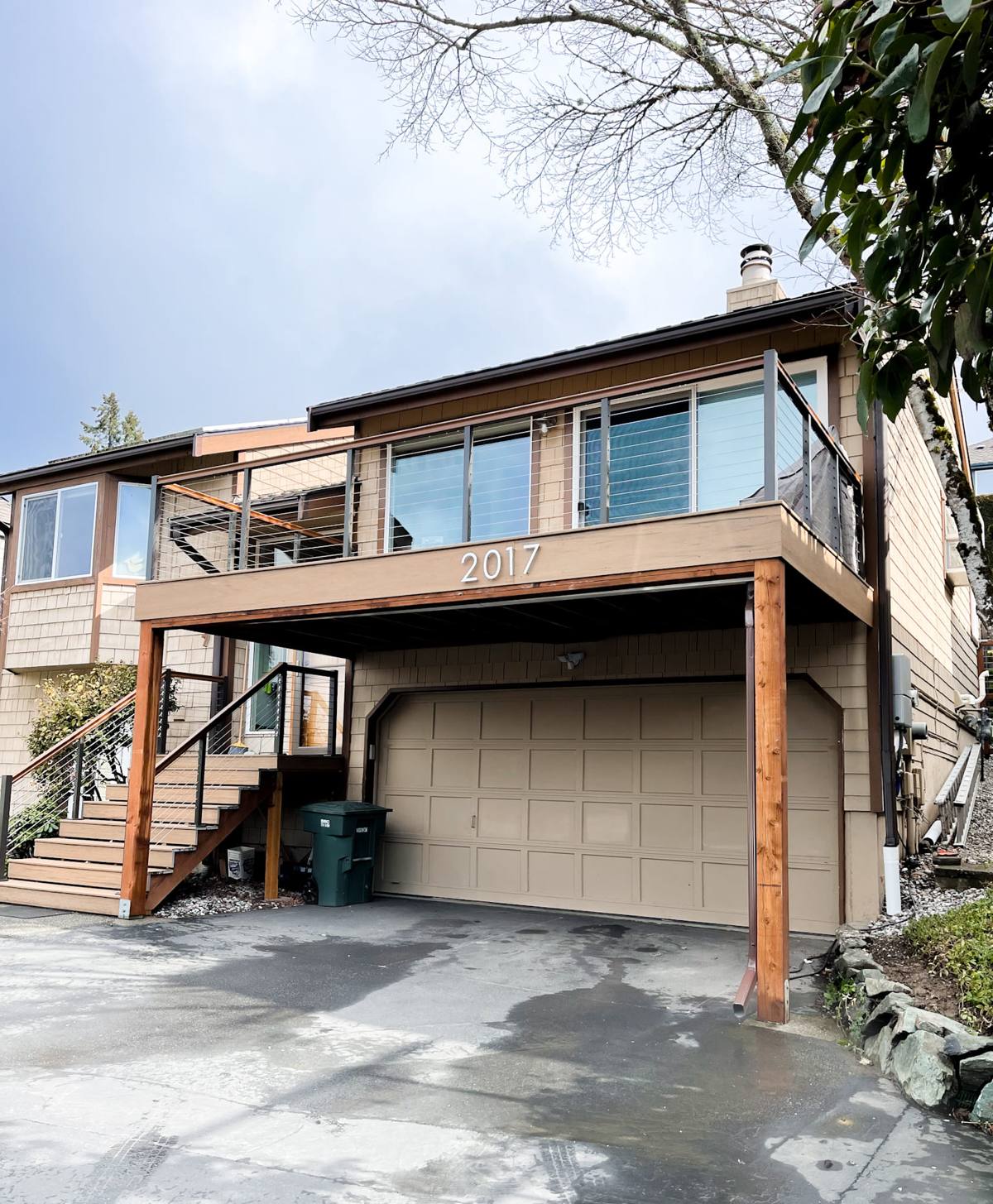
What Salt Air, Rain, and Moss Actually Do to a Deck
Three things drive almost every deck problem we see near Blaine's coastline:
Salt Air and Metal Fasteners
Airborne salt accelerates corrosion on anything metal — screws, joist hangers, ledger flashing, railing hardware. A deck built with standard-grade fasteners can show rust streaking and weakened connections years before an identical deck built a few miles inland. This is a fastener and hardware spec issue as much as it's a decking material issue.
Driving Rain and Water Intrusion
Wind-driven rain doesn't just fall on a deck — it gets pushed into gaps, under boards, and against the house at the ledger connection. If flashing and the water path behind the decking aren't handled correctly, that moisture ends up in the framing, the rim joist, or the wall assembly behind the ledger, which is a much bigger repair than anything happening at the surface.
Moss, Algae, and a Long Damp Season
With extended stretches of overcast, damp weather, any deck surface that stays wet for days at a time becomes a place for moss and algae to establish — especially in shaded corners, under furniture, and wherever debris collects in board grooves. On wood, that growth holds moisture against the surface and speeds up rot. On composite, it's mostly a grip and appearance issue, but it still needs to be planned for in the board choice and the layout.
Why Composite Makes Sense for This Specific Location
Composite decking isn't automatically the right call everywhere, but for a shoreline-adjacent property in this climate, the case is straightforward:
- No annual sanding, staining, or sealing cycle to keep ahead of a wet climate — composite doesn't need a protective coating to shed water.
- Capped composite boards resist moisture absorption at the surface, so they don't swell, cup, or splinter the way wood decking does after repeated wet-dry cycles.
- Consistent color and density mean no soft spots, no hidden rot pockets, and no surprise repairs five years in.
- Better footing when wet — most composite lines now use textured, embossed surfaces that hold up better underfoot than smooth or weathered wood.
The trade-off is upfront cost and the fact that composite still needs periodic cleaning — it's low-maintenance, not no-maintenance, and anyone who tells a Birch Point homeowner otherwise isn't being straight with them.
What a Correct Composite Deck Build Involves Here
The decking material only performs as well as what's underneath it. In a wet, salty environment, the framing and fastening details are where decks either hold up for decades or start causing problems in five to seven years.
Framing and Moisture Management
We build the substructure so water moves off and away from the house instead of collecting against it:
- Ledger board flashed correctly at the house connection, with a clear drainage path so water can't sit against the rim joist
- Joist tape or another moisture barrier on top of framing members, since composite decking traps more heat and moisture against the joists than open wood does
- Proper joist spacing for the specific composite board being installed — composite spans differently than wood, and manufacturer spec sheets are specific about this
- Adequate airflow underneath the deck so the structure can actually dry out between storms instead of staying damp for weeks
Fastening and Hardware
Given the corrosion risk from salt air, we spec stainless steel or coated fasteners and hardware rated for coastal exposure, not standard interior-grade hardware. Hidden fastener systems are also worth the extra step here — fewer exposed screw heads means fewer points where water and salt can start attacking metal at the surface.
Board Layout for Drainage and Cleaning
Board direction, gap spacing, and picture-framing details all affect how well a deck sheds water and how easy it is to keep clean. Tight, consistent gaps let water and debris pass through instead of pooling; layout that ignores drainage just creates more spots for moss to take hold.
Comparing Composite Options for a Coastal Property
Not all composite decking is built the same way, and the differences matter more in a wet, salty climate than they would somewhere dry. Here's how the main categories stack up for a property like this:
| Board Type | Moisture Behavior | Best Fit For |
|---|---|---|
| Uncapped composite | Wood fiber content can still absorb moisture at cut edges and surface over time | Lower-budget projects; requires more attention to sealing exposed cuts |
| Capped composite (cap on wear surface only) | Good surface protection; edges still need to be finished carefully | Most mid-range residential decks in wet climates |
| Fully capped composite (cap on all sides) | Best resistance to moisture absorption and staining from any angle | Shoreline-exposed decks, high-splash areas, long-term low-maintenance goals |
| PVC (cellular) decking | No wood content at all — essentially immune to moisture absorption | Homeowners prioritizing maximum moisture resistance over a wood-grain look |
For most Birch Point homes, we steer people toward fully capped composite or PVC for anything close to the shoreline or exposed to direct wind-driven rain, and reserve standard capped composite for more sheltered decks — porches, covered areas, or spots set back from direct exposure.
Cost Factors for a Birch Point Deck Project
Every deck is priced around a handful of factors, and coastal builds add a couple that inland projects don't have to think about as much:
| Factor | Why It Affects Cost |
|---|---|
| Board tier (capped vs. fully capped vs. PVC) | Better moisture protection generally costs more per square foot |
| Deck size and shape | More linear footage of framing, fascia, and board cuts |
| Height and railing requirements | Elevated decks need engineered structural support and code-compliant railing |
| Fastener and hardware spec | Corrosion-resistant hardware for coastal exposure costs more than standard-grade |
| Ledger and flashing complexity | Older homes or unusual wall assemblies can require extra flashing work at the house connection |
| Substructure condition | Replacing an existing deck may reveal framing or ledger damage that needs repair first |
We give straight, itemized estimates broken down by these factors so a homeowner can see exactly what's driving the number — not a flat per-square-foot quote that hides where the money's going.
How Our Process Works
- On-site visit. We walk the property, look at drainage, sun and shade exposure, and how the deck will connect to the house.
- Design and material selection. We talk through board tier, color, and layout based on the site's actual exposure — not a one-size-fits-all recommendation.
- Permitting. Depending on the deck's height and how it attaches to the house, a permit through the applicable local jurisdiction may be required. We handle that paperwork as part of the project.
- Build. Framing first, with moisture barriers and correctly spec'd hardware, then decking, fascia, and railing.
- Final walkthrough. We go over the finished deck together, including basic care so it stays looking right through the wet season.
Living With a Composite Deck in This Climate
Composite cuts the maintenance load dramatically compared to wood, but a Birch Point deck still needs a little seasonal attention to stay ahead of moss and salt buildup:
- Rinse or sweep the deck regularly during the wet months to keep organic debris from building up in board grooves
- Scrub shaded or low-airflow areas periodically with a soft-bristle brush and mild soap to stop moss before it establishes
- Keep gutters and downspouts near the deck clear so runoff isn't dumping extra water onto the surface
- Rinse salt spray off railings and hardware after major storms, especially on decks with more direct water exposure
- Check railing and fastener hardware annually for early signs of corrosion, particularly on older or partially exposed connections
Why Hiring a Crew That Already Works Birch Point Matters
A deck contractor who mostly works inland can still build a technically fine deck — but they may not think about salt-rated hardware, drainage behind the ledger, or moss-prone layout as first-order decisions, because those aren't problems they deal with every day. A crew that regularly works this stretch of Whatcom County coastline treats those details as standard practice, not an afterthought, because we've seen what happens when they're skipped.
That local familiarity also shows up in smaller ways: knowing how exposed a given lot is likely to be based on its position relative to the water and prevailing wind, having a realistic sense of how a deck in this area will actually weather over time, and being straightforward about which board tier is worth the extra cost for a specific site versus which is overkill.
Get an Estimate
If you're planning a new composite deck or replacing an aging wood deck at your Birch Point property, we're happy to take a look and put together a straightforward, no-pressure estimate. Use the form below to get started.