 Blaine Siding
 Why Birch Bay Roofs Wear Differently Than Roofs Inland
Birch Bay sits right on the water, and that changes how a roof ages. Salt-laden air moves in off the bay and settles on every exposed surface, including your shingles, flashing, and fasteners. Combine that with the wind-driven rain that comes through Whatcom County in the fall and winter, and you've got a roof that's under more constant stress than a similar home fifteen miles inland. Add a long, damp moss season that runs from late fall through spring, and it's easy to see why roofs in this part of the county often show their age faster than homeowners expect.
None of this means a roof here can't last its full service life. It means the installation has to account for these conditions from the start — the right underlayment, the right fastener metal, the right ventilation, and flashing detail that doesn't leave gaps for driving rain to find. A roof installed the same way you'd install one in a dry inland climate is a roof that's going to need attention sooner than it should.
Signs a Birch Bay Home Needs a New Roof, Not Another Repair
Repairs make sense for isolated damage — a section of missing shingles after a windstorm, a cracked flashing seal, a small leak around a vent pipe. A full replacement becomes the honest answer when the roof's underlying materials have aged out, even if it still looks okay from the ground.
- Granules collecting in gutters or at downspout outlets, showing the shingle surface is breaking down
- Shingles that are curling, cupping, or losing their flat profile
- Persistent moss growth that keeps returning within a season or two of cleaning
- Soft spots or sagging when walked on, which points to deck or structural moisture damage
- Multiple leak points in different areas rather than one isolated spot
- A roof that's approaching or past the manufacturer's expected lifespan for its material
If you're seeing two or more of these at once, it's usually cheaper long-term to replace than to keep patching. Repeated repairs on a roof that's structurally past its prime tend to cost more over a few years than a single well-done replacement.
What a Correct New Roof Installation Actually Involves
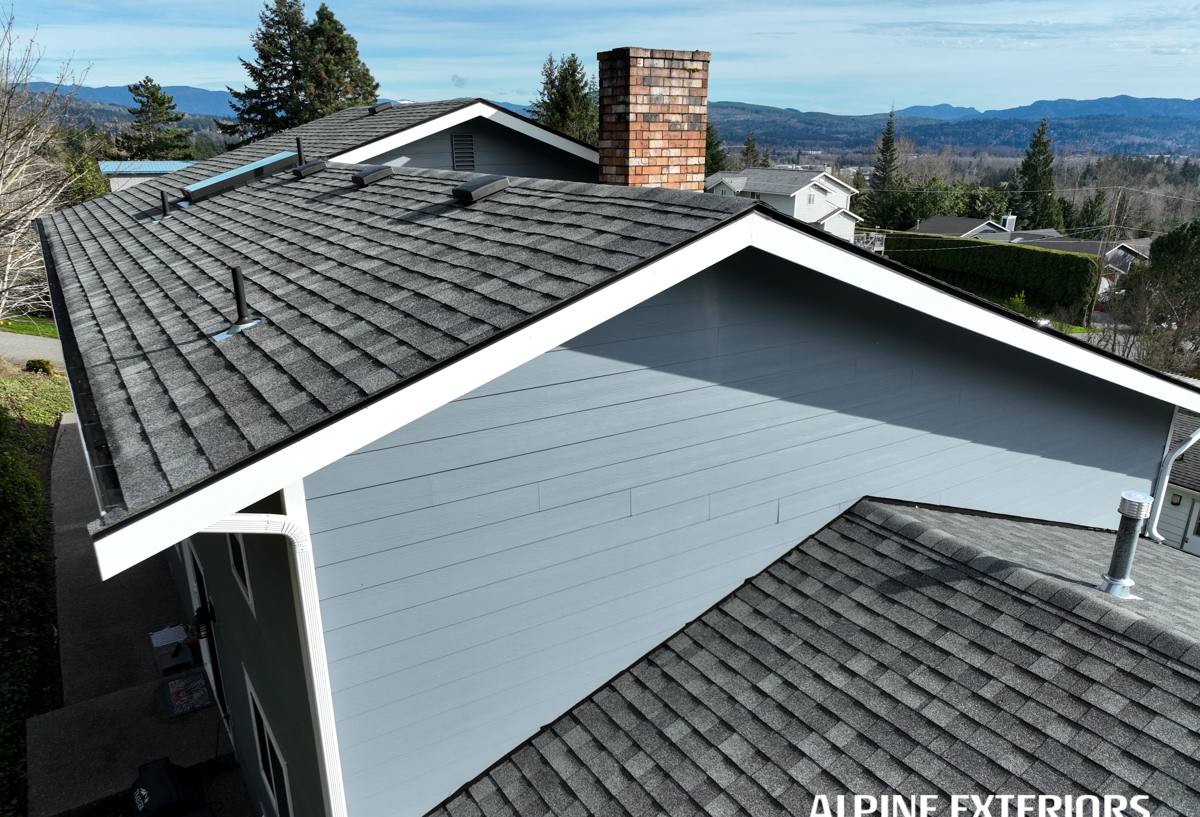
A new roof is more than laying new shingles over what's there. Done right, it's a full system, and each layer matters for a coastal property like Birch Bay:
Tear-Off and Deck Inspection
We remove the old roofing down to the deck. This is the only point in the project where we can actually see the condition of the plywood or OSB underneath. Water damage, soft spots, or rot get replaced before anything new goes down — covering over a compromised deck just hides a problem that will resurface.
Underlayment
This is the roof's second line of defense against wind-driven rain, and it matters more here than in drier parts of the state. We use synthetic or ice-and-water underlayment in valleys, eaves, and other vulnerable spots where rain can be pushed uphill under shingles during a storm.
Flashing
Flashing around chimneys, vent pipes, skylights, and roof-to-wall transitions is where most leaks actually start — not in the field of the shingles themselves. We use corrosion-resistant metal appropriate for salt air exposure and make sure every transition is properly lapped and sealed.
Ventilation
Proper intake and exhaust ventilation keeps moisture from building up in the attic, which protects the new deck and shingles from the underside. It also helps prevent the ice-dam-adjacent moisture problems that come with our wet, cool winters.
Fasteners and Hardware
In a coastal environment, standard fasteners corrode faster. We use hardware rated for the exposure so nail pops and rust streaks aren't showing up in a few years.
Choosing Materials That Hold Up to Coastal Exposure
There's no single "best" roofing material — it depends on your home, your budget, and how much maintenance you want to take on. Here's an honest comparison for a property in a salt-air, high-moisture environment like Birch Bay:
| Material | Coastal/Salt Air Durability | Moss Resistance | Typical Lifespan | Maintenance Load |
|---|---|---|---|---|
| Architectural asphalt shingle | Good, with corrosion-resistant fasteners and flashing | Moderate; benefits from algae-resistant granules | 25–30 years | Low to moderate |
| Standing seam metal | Very good with proper coating and fastener spec | High — sheds moisture quickly, little for moss to grip | 40–50+ years | Low |
| Cedar shake | Fair; needs regular treatment near salt air | Low without ongoing maintenance | 20–30 years with upkeep | High |
| Synthetic composite shake/slate | Good | Moderate to high depending on product | 30–50 years | Low |
For most Birch Bay homes, an algae-resistant architectural shingle or a standing seam metal roof gives the best balance of upfront cost and long-term performance against this specific climate. Cedar shake can look great, but we're straightforward with clients about the maintenance commitment it takes to keep it performing well this close to the water — that's a trade-off decision, not a knock on the material itself.
Our Installation Process, Start to Finish
- On-site assessment — we walk the roof, check the deck condition where visible, and talk through what your home actually needs versus what's optional.
- Written estimate — clear scope, materials, and price before anything is scheduled.
- Material delivery and site prep — protecting landscaping, siding, and walkways around the work area.
- Tear-off — full removal of old roofing, with the deck inspected as it's exposed.
- Deck repair — any damaged sheathing replaced before underlayment goes down.
- Underlayment, flashing, and ventilation installation — the system that does the real work of keeping water out.
- Roofing material installation — installed to manufacturer spec, which matters for warranty coverage.
- Cleanup and magnetic nail sweep — debris and stray fasteners cleared from the property.
- Final walkthrough — we go over the finished roof with you before calling the job done.
Permits, Timing, and What to Expect During the Project
A residential re-roof in Whatcom County typically requires a building permit, and we handle that process as part of the job. Most straightforward single-family re-roofs take one to three days on-site once work begins, though weather can push that out — this is a project best scheduled around drier stretches, since a roof deck exposed to driving rain mid-tear-off is a real problem, not just an inconvenience.
We plan around the forecast rather than working through it. If a storm system is moving in, we'd rather adjust the schedule than rush a step that protects your home for the next few decades.
Building Moss Resistance Into the New Roof
Moss doesn't just grow on old, worn shingles — it takes hold anywhere shade, moisture, and organic debris sit long enough, and Birch Bay's tree cover and damp winters give it plenty of opportunity. A new roof installation is the best time to get ahead of it:
- Algae- and moss-resistant shingle products where the budget allows
- Proper attic ventilation to reduce the moisture that feeds growth from underneath
- Clean roof-to-gutter transitions so debris doesn't accumulate and hold moisture against the shingles
- Zinc or copper strips near the ridge on request, which release trace metals that discourage moss over time
None of this makes a roof moss-proof forever — this climate is simply too wet and shaded in places for that. But it meaningfully extends the time between cleanings and slows the kind of moss growth that lifts shingles and shortens a roof's life.
Why a Crew That Already Works Birch Bay Matters
Roofing crews that mostly work drier, inland areas sometimes install roofs the same way regardless of location — and that shows up later as leaks around flashing, premature granule loss, or moss that comes back every year. Working this coastline regularly means we already know which details matter here: the fastener spec that holds up to salt air, the underlayment placement that handles wind-driven rain, the ventilation setup that keeps moisture from building up in a damp, mild winter.
It also means we're a local call if something comes up after the job is done — not a crew that's an hour away and booked out for weeks. For a project as significant as a full roof replacement, that kind of accountability is worth something.
Questions Worth Asking Before You Sign a Contract
- Is the estimate a firm price or subject to change once tear-off begins?
- What's included in the underlayment and flashing spec, specifically?
- Who pulls the building permit — you or the contractor?
- What warranty covers the materials, and what warranty covers the labor separately?
- How is the crew protecting my landscaping, siding, and gutters during tear-off?
- What happens if hidden deck damage is found once the old roofing comes off?
- Is the company licensed and insured to work in Washington State?
A contractor who answers these clearly and in writing, without hedging, is one worth trusting with a project this size.
If your roof is showing its age or you're just not sure whether it's a repair or a replacement, we're happy to take a look and give you a straight answer. Fill out the form below for a free, no-pressure estimate on your Birch Bay home.