 Blaine Siding
 Siding Replacement in Sumas: A Valley Climate That Doesn't Forgive Shortcuts
Sumas sits at the far northeastern edge of Whatcom County, in the Nooksack River valley with Sumas Mountain rising to the south and the Canadian border just to the north. It's not a waterfront town, but a full siding job here still has to hold up against a demanding mix of driving rain, valley humidity, and a moss season that runs most of the year. Even this far inland, homes in Sumas sit under the same Pacific weather systems that push salt-tinged marine air and heavy moisture into Whatcom County from the coast, and that moisture doesn't lose much strength by the time it reaches the valley floor. When siding on a Sumas home has reached the point where patching and spot repair no longer make sense, a full replacement is the only way to actually reset the clock.
This page is specifically about full siding replacement for Sumas homes — not a repair, not a general overview of exterior work, but what's involved when the existing siding has to come off and be replaced from the sheathing out. We install James Hardie fiber cement exclusively on every replacement job, and we've worked Sumas long enough to know how this particular valley treats a house differently than towns closer to open water or higher, more exposed ground.
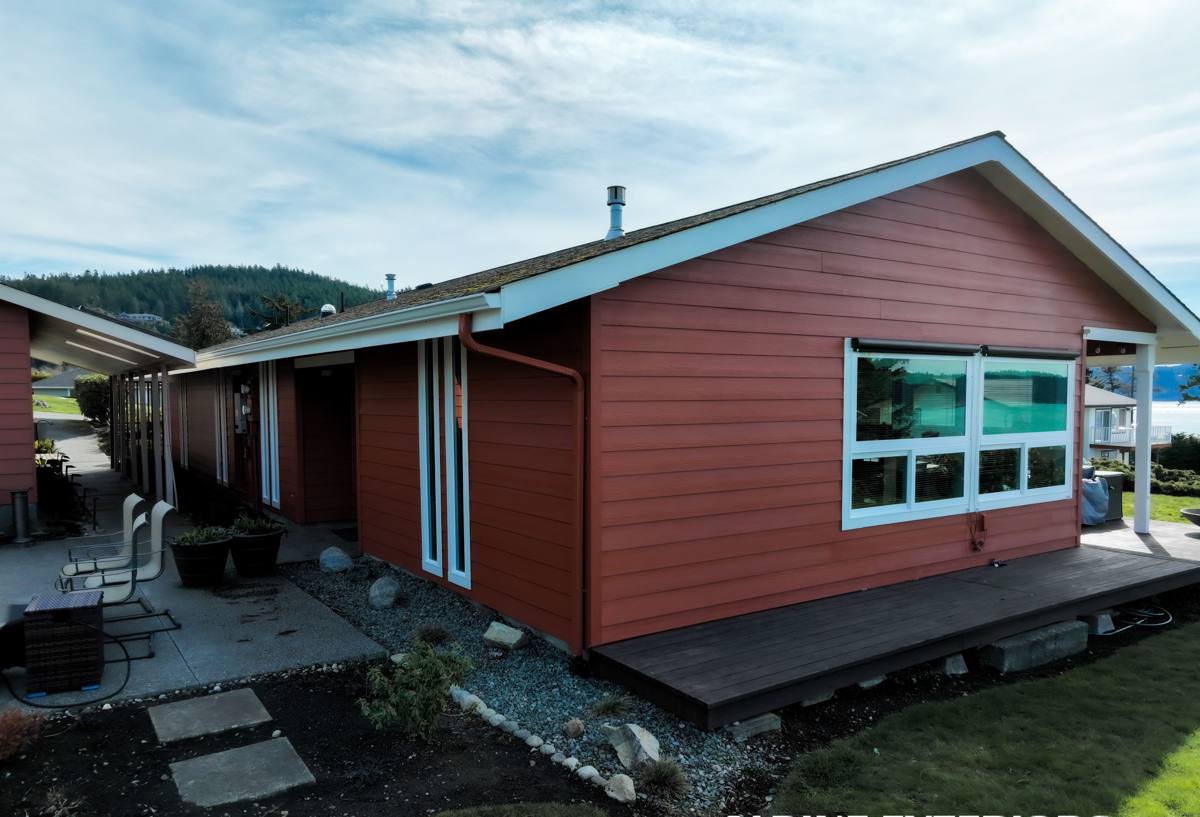
Signs a Sumas Home Needs Full Replacement, Not Just Repair
Not every siding problem calls for tearing the whole wall down to the studs. But there's a point where patch repairs stop solving the actual problem and start just delaying it, and that point comes faster in a wet valley climate like Sumas than it does in drier parts of the state.
- Soft, spongy, or crumbling siding in more than one or two isolated spots
- Moss or dark staining that returns quickly after cleaning, especially on shaded or north-facing walls
- Visible warping, cupping, or delaminating boards, common on older wood-based or engineered wood products
- Paint that won't hold anymore, peeling or bubbling within a year or two of a fresh coat
- Water staining or soft sheathing found once even a small section of siding is pulled back
- Siding that's original to a home 20-30+ years old and was never a fiber cement product
- Repeated repair visits to the same wall sections over consecutive years
The table below is a general guide, not a diagnosis for any specific house. A real assessment means getting up close to the siding and, in most cases, pulling a section to see what's happening underneath.
| Situation | Repair Often Enough | Full Replacement Usually Needed |
|---|---|---|
| Damage location | Isolated, one or two boards | Spread across multiple walls or elevations |
| Underlying sheathing | Dry, sound | Soft, stained, or showing rot |
| Existing material | Fiber cement, still within its service life | Wood, older engineered wood, or failing vinyl |
| Moisture pattern | Single known source, already fixed | Recurring or unclear entry points |
| Age of siding | Under 15-20 years, well maintained | Original to an older home, past its practical life |
What a Correct Siding Replacement Actually Involves
It Starts Underneath the Old Siding
A siding replacement is as much about what's underneath as what goes back on top. Once the old material comes off, the sheathing, framing, and existing weather-resistive barrier all get inspected before anything new goes up. In a valley climate that holds moisture as long as Sumas does, it's common to find soft sheathing or compromised barrier material in spots that looked fine from the outside. Skipping this step and just re-siding over a damaged wall assembly is one of the most common ways a siding job fails early.
Flashing and Water Management Come First
Windows, doors, and any roof-to-wall transitions need flashing details done correctly before the new siding goes on, not patched in around it afterward. Sumas gets wind-driven rain that pushes moisture sideways into these transitions rather than just straight down, so flashing that's slightly off, or house wrap that isn't lapped correctly, tends to show up as a problem within a few wet seasons rather than staying hidden for decades.
Then the Siding Itself, Installed to Spec
James Hardie siding only performs the way it's engineered to when it's installed to the manufacturer's specifications, and in a wet valley climate, the details that get overlooked most often are exactly the ones that matter most: correct fastener type and spacing, proper clearance at grade and roof lines, gapped and caulked joints where Hardie specifies them, and butt joints that shed water instead of collecting it. None of that is visible once the job is finished, which is exactly why it has to be done right the first time.
Why We Install James Hardie HZ5 on Every Replacement
We used to work with a broader range of siding products. We narrowed to James Hardie fiber cement exclusively after seeing, on tear-offs across Whatcom County, which materials actually held up in this kind of sustained wet climate and which ones quietly failed underneath a fine-looking surface.
- Non-combustible core: Fiber cement doesn't feed a fire the way wood-based siding products can, a real factor for both safety and insurance.
- HZ5 formulation: Hardie's HZ product lines are engineered by climate zone, and the HZ5 formulation used in this region is built for sustained moisture and freeze-thaw cycling, both of which describe a Nooksack valley winter.
- Factory-applied ColorPlus finish: Color and finish are baked on under controlled conditions rather than brushed on at the job site, so it resists fading and moisture-related wear longer than field-applied paint.
- Dimensional stability: Fiber cement doesn't swell, cup, or warp the way engineered wood siding can after repeated wet-dry cycling.
- Strong transferable warranty: Hardie backs the product with a solid warranty structure, provided the installation follows their published spec.
We won't install LP SmartSide, vinyl siding, Cemplank, Allura, primed spruce, or cedar. Every one of those products has homeowners who are satisfied with them, and none of them is a bad product on its own terms. But a full siding replacement is a once-a-generation project for most homeowners, and in a valley climate that stays damp as long as this one does, we'd rather install one system we fully stand behind than offer something cheaper that shifts maintenance risk back onto the homeowner a few years down the road.
Our Replacement Process, Start to Finish
- On-site assessment: We walk the property, look at the existing siding up close, and pull a test section if there's any question about what's underneath.
- Written scope and estimate: A clear breakdown of what's being removed, what's being repaired or replaced underneath, and what goes back on, before any work starts.
- Tear-off: Old siding comes off and is disposed of, exposing the sheathing and existing barrier for inspection.
- Substrate repair: Any soft sheathing, damaged framing, or compromised weather barrier gets addressed before new material goes up.
- Weather barrier and flashing: A new or repaired moisture barrier goes on, with flashing detailed correctly at every window, door, and roof-to-wall transition.
- Hardie installation to spec: Siding, trim, and accessories installed following James Hardie's fastening, clearance, and joint requirements.
- Final walkthrough: A completed job gets reviewed with the homeowner before we consider it done.
Cost Factors for a Sumas Siding Replacement
| Factor | Why It Matters |
|---|---|
| Home size and wall complexity | More square footage and more corners, gables, and trim details mean more labor and material |
| Condition of the sheathing underneath | Rot or moisture damage found during tear-off adds repair scope that can't be known until the old siding is off |
| Siding profile chosen | Lap, board and batten, and shingle-style Hardie profiles each price and install differently |
| Trim and accessory scope | Corner boards, window trim, and fascia work add to labor time and material cost |
| Access and site conditions | Tree cover, tight setbacks, and multi-story walls affect scaffolding and staging time |
These are general cost drivers, not a quote. Two homes of similar size in Sumas can land at very different price points once tear-off reveals what's actually underneath the old siding, which is exactly why we walk the property and, where needed, open up a test section before putting a real number on the job.
Timing a Replacement Around Sumas's Weather
Sumas sits low in the Nooksack valley, and valley floors like this hold fog and humidity longer than higher or more exposed ground nearby, which slows how quickly surfaces dry between rain events. Winter also brings the added factor of cold, wind-driven air funneling down from the Fraser Valley to the north, which can make for harsher working conditions than towns farther south in the county see at the same time of year. Spring and summer generally offer the driest, most stable stretch for a full siding replacement, since sheathing, weather barrier, and fiber cement all perform better when they're installed and allowed to set up under dry conditions rather than between storm systems. That said, a wall with active water intrusion is worth addressing on its own timeline rather than waiting out the season, since the damage underneath doesn't pause for better weather.
Why a Local Crew That Already Works Sumas Matters
A full siding replacement is not a project most homeowners go through more than once or twice in a lifetime, which makes the contractor's actual field experience in this specific valley climate worth more than a generic sales pitch. A crew that regularly works Sumas and the surrounding Whatcom County area has already seen how long moisture sits in this valley, which wall orientations stay damp the longest, and where a little extra attention to flashing or fastening pays off over the following decade instead of showing up as a callback. That's a different kind of knowledge than reading a spec sheet, and it shapes real decisions on the job site rather than staying theoretical.
If your Sumas home's siding has reached the point where repair isn't enough anymore, we're glad to take a look and give you a straightforward, honest assessment of what full replacement would involve. Reach out using the form below to schedule a free, no-pressure estimate.