 Blaine Siding
 Sumas Sits in a Tougher Microclimate Than Most Homeowners Realize
Sumas doesn't get talked about the way the coastline does, but the homes out here take a real beating. The Nooksack River valley holds moisture close to the ground longer than the hillsides around it, tree cover keeps north- and east-facing walls shaded and damp for most of the year, and the valley floor collects cold air in a way that coastal Whatcom County doesn't. Add in the Sumas Gap — the low pass that lets cold outflow air spill down from the Fraser Valley in British Columbia during winter cold snaps — and you get a siding environment that cycles between soaked and frozen more often than it gets a clean, dry stretch to recover in.
That combination is exactly what wears out the wrong siding fastest: constant dampness feeds moss and mildew, freeze-thaw cycling stresses seams and caulk lines, and wind-driven rain finds every gap in flashing that wasn't detailed correctly the first time. We're based out of Blaine, where salt air and driving rain off the water do their own version of this damage, and the lesson carries over directly — siding in this part of Whatcom County has to be chosen and installed for moisture, not just for looks.
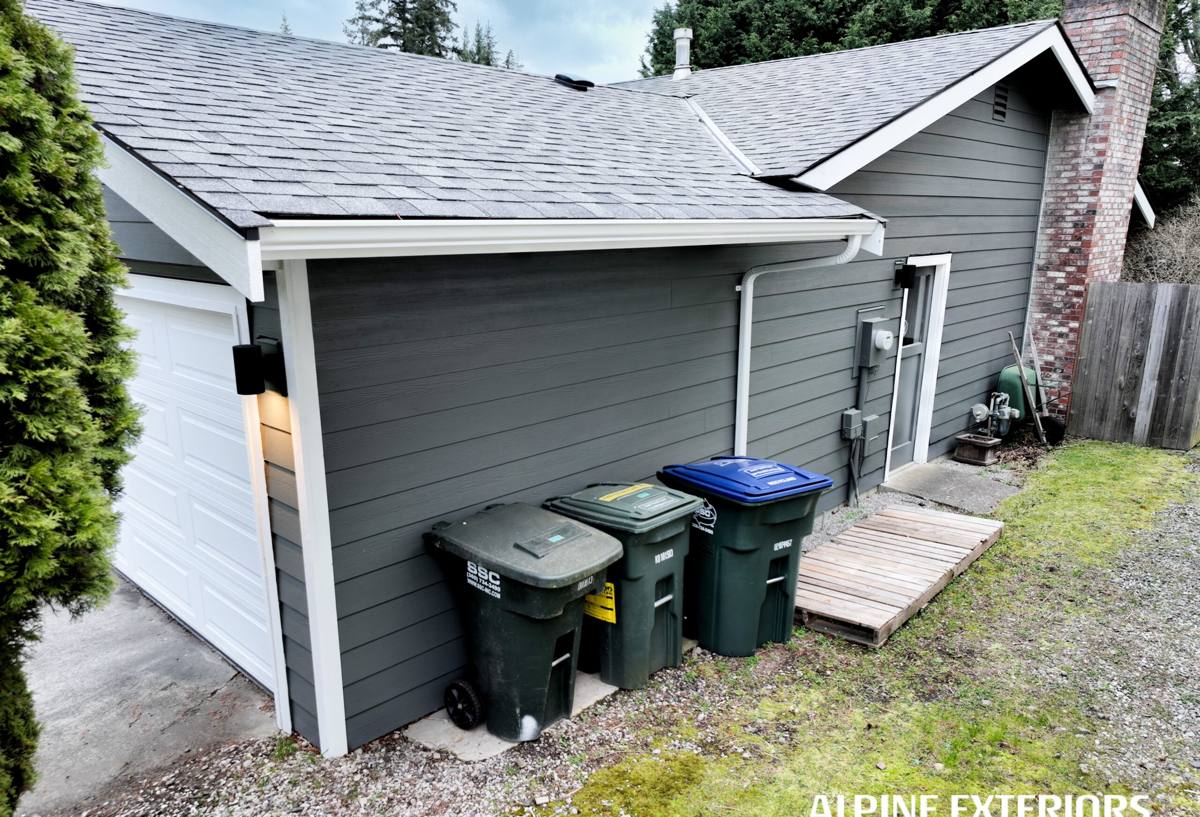
Why We Only Put James Hardie on Sumas Homes
We don't install vinyl, LP SmartSide, Cemplank, Allura, or bare cedar and spruce, and Sumas is one of the clearest reasons why. Vinyl expands and contracts hard across the wide daily temperature swings a valley floor produces, which opens gaps at the seams over time. Engineered wood products depend entirely on an intact factory coating to keep moisture out — one missed touch-up spot on a shaded, damp wall and the substrate underneath starts to swell. Cedar and primed spruce need a maintenance schedule most homeowners don't actually keep up with, and in a spot that stays wet as long as Sumas does, that gap between "should repaint every few years" and "actually got repainted" is where rot gets started.
James Hardie fiber cement doesn't solve every siding problem, and we're upfront about its trade-offs on our general Hardie pages — it's heavier, it requires proper fastening and gapping to perform, and it costs more up front than vinyl. But it doesn't rot, it's non-combustible, it holds its ColorPlus factory finish for decades without repainting, and it's engineered specifically for climates like this one through Hardie's HZ product zoning. For a valley that stays damp most of the year and freezes hard a few weeks of it, that's the trade-off worth making.
HZ5 vs. HZ10: Getting the Right Product for the Valley
James Hardie manufactures its siding in different HardieZone formulations for different climates. Most of western Washington, including Sumas, falls in the HZ5 zone, engineered for moisture and moderate freeze-thaw exposure rather than the deep-freeze conditions HZ10 is built for. Using the correct zone product matters more than most homeowners are told — it affects how the board handles moisture cycling over the long run, and it's part of what keeps Hardie's warranty valid.
What a Correct Hardie Install Actually Involves
The siding itself is only half the job. Most of the failures we get called out to inspect on other contractors' work trace back to installation shortcuts, not the product. A correct install on a Sumas home includes:
- A weather-resistive barrier and rainscreen gap behind the siding, so any moisture that does get past the cladding can drain and dry instead of sitting against the sheathing
- Proper fastener placement and spacing — hand-nailed or pneumatic to Hardie's exact schedule, not "close enough"
- Correct clearance at the ground, decks, and roof lines so splash-back and snowmelt don't wick into the bottom course
- Kick-out flashing at every roof-to-wall intersection, which is one of the most commonly skipped details and one of the most common sources of hidden rot
- Factory-primed or ColorPlus-finished cut edges sealed before installation, not left raw
- Caulk only where Hardie's install guide actually calls for it — over-caulking traps moisture just as badly as under-caulking lets it in
None of this is exotic. It's the manufacturer's published installation standard. The problem is that it takes longer to do than to skip, and on a product that hides its mistakes behind paint for a year or two before they show up as staining or soft spots, skipped details are easy for a homeowner to miss until the damage is already done.
Choosing a Hardie Product Line for a Sumas Home
James Hardie makes several siding profiles, and the right one depends on the home's style and exposure more than personal taste alone. Here's how the main options compare for a valley property like the ones around Sumas:
| Product Line | Look | Best Fit For |
|---|---|---|
| HardiePlank Lap Siding | Traditional horizontal lap, several width and texture options | Most single-family homes; the default choice for damp, shaded lots because of its clean drainage plane |
| HardiePanel Vertical Siding | Smooth or textured vertical panels | Gables, accent walls, farmhouse and modern styles common on larger valley lots |
| HardieShingle / Artisan | Staggered or straight-edge shingle profile | Craftsman and cottage-style homes wanting a shingle look without cedar's upkeep |
| HardieTrim | Fascia, corner boards, and window trim | Pairs with any line above; keeps trim from becoming the weak point once the field siding is upgraded |
Color matters here too. ColorPlus factory-applied finish is baked on and warranted separately from the substrate — it holds up better against the valley's moisture and UV cycling than field-applied paint, and it means no repainting on the schedule you'd otherwise be stuck with.
Our Process on a Sumas Project
We run the same process on every home, and it's built around catching problems before they get covered up:
- On-site assessment — we look at the existing siding, check for soft sheathing or existing moisture damage, and note anything the shade, slope, or drainage on the lot will affect
- Written estimate — product line, HZ-appropriate material, color, and a clear scope of what's included, with no vague allowances
- Tear-off and sheathing check — this is the point where hidden rot from old siding shows up, and it gets addressed before anything new goes on, not sealed over
- Weather barrier and rainscreen installation — the drainage layer that does the real long-term work
- Hardie installation to manufacturer spec — fastening, gapping, flashing, and trim done to the published standard, not shortcuts
- Final walkthrough — we go over caulk lines, clearances, and finish with the homeowner before calling the job done
What Drives Cost on a Sumas Siding Job
Every home is different, but the same handful of factors move the number more than anything else:
| Factor | Why It Matters |
|---|---|
| Existing siding removal | Vinyl and aluminum tear off fast; multiple layers or asbestos-era siding take longer and cost more to remove and dispose of properly |
| Sheathing condition | Rot found at tear-off has to be replaced before new siding goes on — this is the most common source of a mid-project change order |
| Home size and wall complexity | Dormers, gables, and multiple roof lines mean more cutting, more flashing details, and more labor hours |
| Product line and finish | Panel and shingle profiles generally run more than standard lap; ColorPlus finish costs more than primed board but skips repainting entirely |
| Site access | Tight lots, fencing, or landscaping close to the walls slow staging and cleanup |
We'll walk through where a specific home lands on each of these during the estimate — there's no reason to guess at a number before someone's actually looked at the walls.
Living With Hardie Siding in a Moss-Prone Valley
Fiber cement doesn't feed moss and algae the way bare wood does, but nothing stops organic growth from landing on a wall in a shaded, damp spot like this and building up over time. A short annual maintenance routine keeps it from becoming a problem:
- Rinse siding with a garden hose and soft brush once a year, more often on north-facing or heavily shaded walls
- Keep gutters clear so overflow doesn't run down the siding face during heavy rain
- Trim back shrubs and trees so foliage isn't holding moisture against the wall
- Check caulk lines at trim and penetrations annually and re-caulk any that have cracked or pulled away
- Watch the bottom courses near grade and decks for staining, which usually means water is splashing back or draining wrong
None of this is heavy maintenance compared to what wood or engineered-wood siding demands — it's closer to the upkeep a homeowner would do anyway, just not skippable in a spot that stays wet this long.
Why Hiring a Crew That Already Works Sumas Matters
A lot of siding crews treat every job the same regardless of where it sits. That works fine in a mild, dry climate. It doesn't work as well in a valley that combines shade, standing moisture, and outflow-wind freeze cycles the way Sumas does. Knowing to check for kick-out flashing at every roof intersection, knowing which walls need extra attention because they never fully dry between rains, and knowing that HZ5 product is the right call here rather than assuming one formulation fits the whole region — that's the difference between a siding job that looks right for a year and one that actually holds up through a decade of valley winters. We work this part of Whatcom County regularly out of our Blaine base, and we bring the same standard to every home whether it's on the coast or out toward the border.
If you're weighing a siding replacement on a Sumas home, we're happy to take a look, walk the exterior with you, and give you a straight answer on what it needs — no pressure, no obligation. Use the form below to request a free estimate.