 Blaine Siding
 Cherry Point Roofs Take a Different Kind of Beating
Cherry Point sits right up against the Strait of Georgia, and that location shapes everything about how a roof ages out here. Homes closer to the water get hit with wind-driven rain that doesn't just fall on a roof, it gets pushed sideways and up under edges, flashing, and shingle tabs that were never designed to handle water moving in that direction. Add in the salt-laden air coming off the water and you've got metal fasteners, flashing, and vent components corroding faster than they would a few miles inland in Blaine or elsewhere in Whatcom County.
Then there's moss. Whatcom County's long wet season, combined with the shade from mature evergreens common on rural and semi-rural lots around Cherry Point, gives moss months to establish itself on north-facing slopes and anywhere debris collects. Moss holds moisture against shingles and roof decking far longer than open sun would allow, and it works its way under tab edges and around fasteners over a single season. None of this is dramatic on its own, but stacked together — salt air, driving storms, and moss — it means a Cherry Point roof can develop real damage well before a homeowner sees an obvious leak.
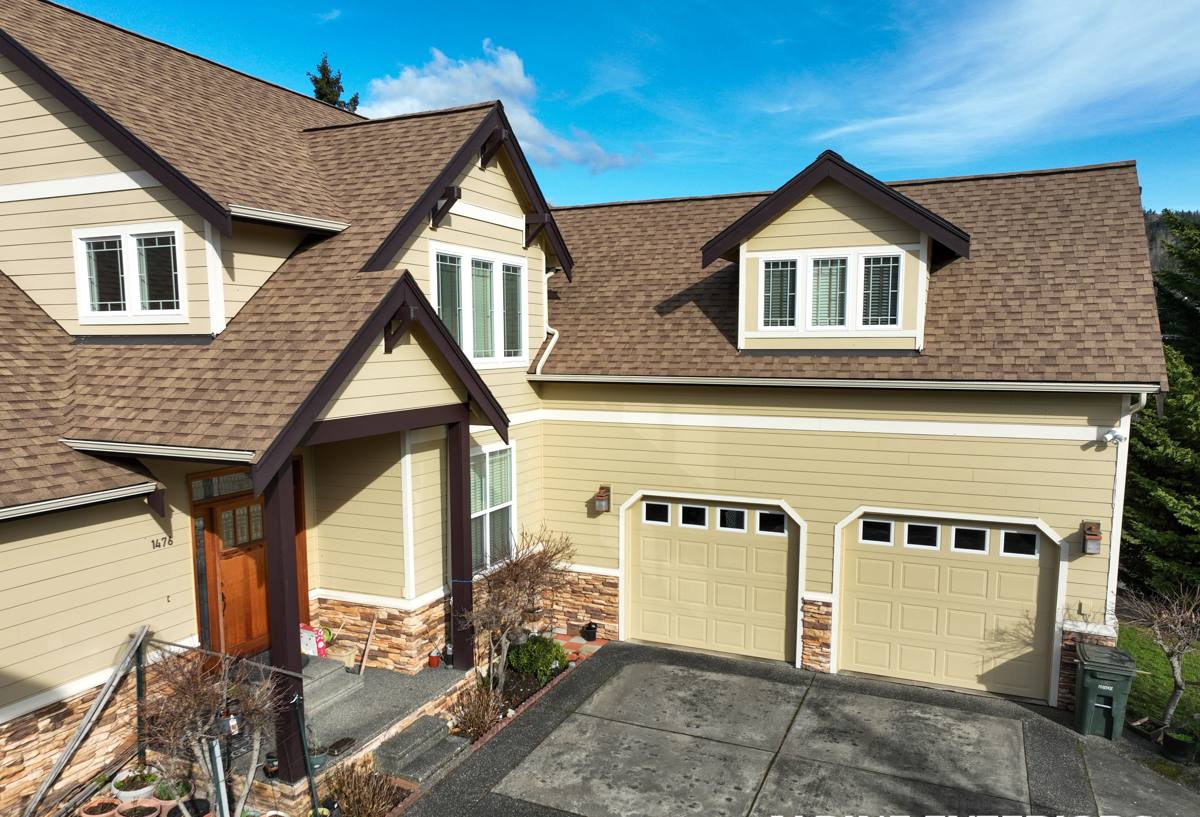
What Actually Counts as Storm Damage Here
"Storm damage" covers more than a hole punched through by a falling branch. In this area, the damage that causes the most long-term harm is usually the kind that's hard to spot from the ground:
- Shingles lifted or creased by wind gusts, breaking the seal strip without tearing the shingle off entirely
- Flashing around chimneys, vents, and roof-to-wall transitions pried loose or bent by wind pressure
- Granule loss from wind-driven rain and hail, which thins the shingle's UV and weather protection even when the shingle looks intact
- Fastener backout, where repeated flexing during a storm works nails or screws partway out of the decking
- Moss-softened decking or underlayment discovered only once a repair is opened up
- Debris impact damage from tree limbs, common on wooded and semi-rural lots in this area
The problem with most of this list is that it doesn't announce itself with a leak right away. Water can travel along the underlayment or decking for weeks before it shows up as a stain on a ceiling, by which point the repair is bigger than it needed to be.
What a Correct Storm Repair Actually Involves
Assessment Before Any Repair
A repair that's done right starts with actually getting eyes on the damage — not just the obvious spot, but the surrounding field of the roof. Wind and rain damage rarely stays confined to one shingle or one section. We check the decking underneath any area we open up, because a soft or delaminated spot in the plywood changes the scope of the job from a shingle swap to a decking repair.
Matching, Not Just Patching
Shingles fade and granules wear unevenly over time, so a patch using mismatched material stands out and can also create a weak seam if the profiles don't align. Where an exact match isn't available, we talk through the honest trade-offs with the homeowner rather than gluing down whatever's closest.
Flashing and Underlayment Get the Same Attention as Shingles
A lot of storm-related leaks trace back to flashing, not shingles. Any repair we do includes checking the condition of flashing at penetrations and transitions nearby, since bent or corroded flashing left in place will just cause the same leak again in the next storm.
Our Process, Start to Finish
- Initial contact and scheduling — we get basic details about the damage and get a technician out, prioritizing active leaks and exposed decking.
- On-site inspection — full visual and, where safe, walked inspection of the affected area and the surrounding roof field, plus attic access if available to check for water intrusion signs.
- Documentation — photos and a written scope of the damage, useful for the homeowner's own records regardless of how repairs are paid for.
- Temporary protection if needed — if there's an active leak or exposed decking and full repair can't happen immediately, we secure the area to keep water out in the meantime.
- Repair — the actual work: removing damaged material, checking and replacing decking as needed, correcting flashing, and installing matched roofing material.
- Final walk-through — we review the completed repair with the homeowner before considering the job done.
Repair Approach Comparison
Not every storm-damaged roof needs the same scope of work. The table below lays out how the common approaches differ, so a homeowner has a realistic sense of what drives cost up or down.
| Approach | When It's Appropriate | Cost Factor |
|---|---|---|
| Spot shingle repair | Isolated wind lift or a handful of damaged shingles, decking sound | Lowest — limited materials and labor |
| Flashing repair/replacement | Leak traced to chimney, vent, or wall flashing rather than the shingle field | Low to moderate — depends on flashing type and accessibility |
| Section decking replacement | Water intrusion has softened plywood beneath the damaged area | Moderate to higher — added material and labor to remove and rebuild decking |
| Moss-related remediation | Long-term moss growth has degraded shingles or underlayment beyond the storm event itself | Varies widely depending on extent of the affected slope |
| Full re-roof | Storm damage compounds pre-existing wear across most of the roof's service life | Highest — but sometimes more cost-effective than repeated repairs on an aging roof |
We'll always recommend the smallest scope that actually solves the problem. A full re-roof is not our default answer to a storm call — it's only the right call when the roof's overall condition makes patch repairs a short-term fix at best.
Insurance Considerations
Many storm repairs in this area involve a homeowner's insurance claim, and we work with that process rather than around it. Our documentation — photos, notes on cause and extent of damage — is written to give an honest, accurate record of what we found, not to inflate a claim. We're glad to walk a homeowner or their adjuster through what we saw and why we're recommending a given scope of repair. What we won't do is characterize routine wear as storm damage, or the reverse, since that only creates problems for the homeowner down the line.
What to Do Before We Arrive
If a storm has just come through and you're waiting on an inspection, there are a few things worth doing and a few worth avoiding:
- Do move furniture or belongings away from any active ceiling leak and place a container to catch drips
- Do take your own photos of visible exterior damage and interior water stains for your records
- Do clear obvious debris (small branches, loose gutter material) from ground level only — don't get on the roof yourself
- Don't attempt to tarp or patch the roof yourself in wet or windy conditions
- Don't delay reporting an active leak — even a slow one can saturate decking and insulation over a few days
- Don't assume a roof "looks fine" from the ground rules out damage — wind and moss damage are often only visible up close
Why a Crew That Already Works Cherry Point Matters
Cherry Point's mix of rural access, tree cover, and shoreline exposure isn't the same as repairing a roof in a dense subdivision closer to town. Tree-lined driveways, longer setbacks, and in some cases limited turnaround room affect how we stage equipment and materials. Familiarity with how homes in this area are built — the roof pitches, ventilation setups, and the kind of moss buildup patterns common to shaded, moisture-heavy lots near the water — means less time spent figuring out the property and more time on the actual repair. A crew that already understands Whatcom County's wet-season timeline also knows not to leave a temporary repair in place through an entire winter and call it done.
Reducing Repeat Storm Damage
A repair fixes the immediate problem, but a few ongoing habits reduce how often storms cause damage in the first place:
- Keep gutters and valleys clear so wind-driven rain has somewhere to go instead of backing up under shingle edges
- Address moss buildup before it spreads across a full slope, rather than after shingles start lifting
- Trim back tree limbs that overhang the roofline, since Cherry Point's tree cover is a real contributor to both debris impact and prolonged shade that feeds moss
- Have flashing checked periodically, since it corrodes and loosens well before shingles show obvious wear in a salt-air environment
None of this eliminates storm risk — no maintenance schedule can — but it narrows the gap between minor wind lift and a roof that's actually letting water in.
Get an Honest Look at Your Roof
If a recent storm has you wondering whether your roof took real damage or just cosmetic wear, we're happy to come take a look. The estimate is free, there's no pressure to move forward, and you'll get a straight answer about what we found and what it would take to fix it — use the form below to get started.