 Blaine Siding
 Why Siding Fails Faster Near Blaine Harbor
Homes around Blaine Harbor sit closer to open water than almost anywhere else in Whatcom County. That proximity to Semiahmoo Bay and Drayton Harbor means siding here deals with three things at once: salt-laden air, wind-driven rain that hits walls at an angle instead of falling straight down, and a moss and algae season that can run eight months or longer in shaded, north-facing spots. Any one of those would shorten the life of a wall system. Together, they're the reason siding repair calls from this part of Blaine tend to look different from repair calls a few miles inland.
Salt air is corrosive to metal fasteners, flashing, and trim well before it does visible damage to the siding face itself. Driving rain finds every gap in caulking, every under-lapped joint, and every spot where trim wasn't flashed correctly the first time. And moss holds moisture against a wall for weeks at a time, which is a much bigger problem for wood-based products than it is for fiber cement. A repair that only addresses what's visible on the surface, without accounting for these three factors, tends to fail again within a year or two.
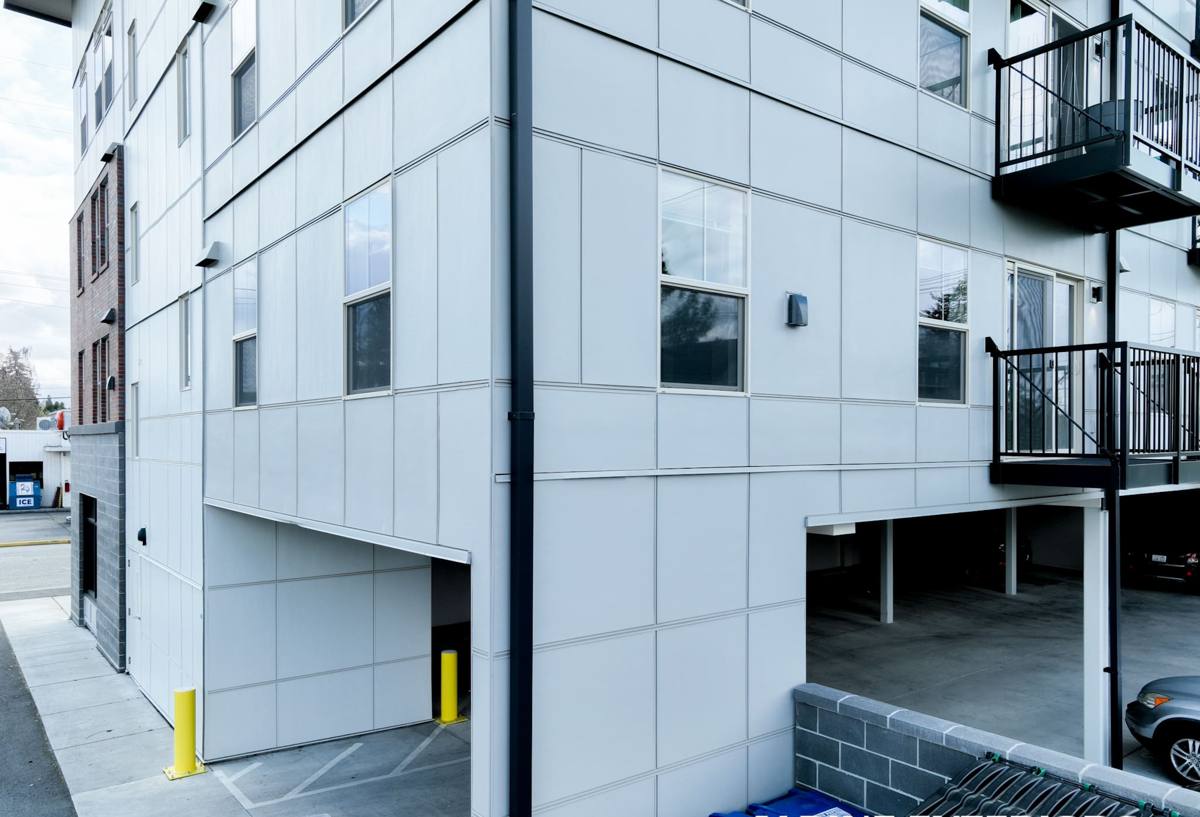
Signs Your Siding Needs a Closer Look
Most homeowners near the harbor notice a problem long before they call anyone about it — they just don't always know whether it's minor or worth addressing right away. Here's what we tell people to watch for:
- Soft or spongy spots when you press on the siding, especially near the bottom courses or around window trim
- Paint that's peeling or bubbling in a localized area rather than across the whole wall
- Dark streaking, staining, or persistent moss/algae growth in one spot that keeps coming back after cleaning
- Visible gaps, cracking, or separation at butt joints, corners, or where siding meets trim
- Fastener heads showing rust or "bleeding" stains running down the siding face
- Warping, cupping, or a board that no longer sits flush against the wall
- Interior signs — a musty smell, discoloration on interior drywall, or a slightly damp feel near an exterior wall
Any one of these on its own might be a small fix. Several of them clustered in the same area, especially on a wall that takes the brunt of weather off the water, usually means moisture has been getting behind the siding for a while.
What a Correct Repair Actually Involves
Diagnosis before demolition
The most common mistake in siding repair isn't a bad patch — it's patching the wrong thing. Surface damage is often a symptom of something happening behind the siding: failed flashing above a window, a caulk joint that gave up years ago, or house wrap that was installed with gaps at the seams. A repair that replaces the damaged board but doesn't fix what let water in will look fine for a season and then fail again in the same spot.
That's why any repair job worth doing starts with pulling back enough siding to actually see the sheathing, house wrap, and flashing underneath — not just eyeballing the outside and swapping a board.
Matching the existing material
If your home's siding is James Hardie fiber cement, repairs should use James Hardie fiber cement — matched by profile, exposure, and color. Mixing in a different product, even one that looks close on the shelf, creates a seam that behaves differently in the weather: different expansion and contraction, different paint absorption, different weathering over time. It also shows. A patch in the wrong material is usually visible within a year, especially once the surrounding siding weathers and the mismatched piece doesn't age the same way.
Sealing and flashing details
Every repair near the water needs attention to the details that don't show once the job is finished: flashing tucked correctly behind house wrap (never just caulked on top of it), butt joints back-primed or sealed per manufacturer spec, and fastener placement that won't split the board or leave a gap for water to track in. These are the details that separate a repair that lasts fifteen years from one that needs revisiting in three.
Repair, Section Replacement, or Full Re-Side?
Not every siding problem calls for the same scope of work. Part of an honest estimate is telling you which category your home actually falls into, rather than defaulting to the most expensive option.
| Approach | When it fits | What's involved |
|---|---|---|
| Spot repair | Isolated damage — one impact point, one failed joint, a small area of rot caught early | Remove and replace individual boards, address the underlying cause, match color and profile |
| Section replacement | Damage concentrated on one wall or elevation, often the side that takes the worst weather off the water | Strip that section back to sheathing, correct flashing and wrap, re-side the full elevation for a consistent look |
| Full re-side | Widespread failure, siding original to an older home, or repair costs approaching a meaningful share of full replacement | Whole-house tear-off and re-install, house wrap and flashing detail redone throughout |
A straight spot repair is usually the right call when the damage is contained and the rest of the wall system is sound. Once we find the same failure pattern on more than one elevation, or the siding is old enough that matching material is a problem, section or full replacement usually saves money over repeatedly repairing the same wall.
Why We Only Repair With James Hardie
We install and repair exclusively with James Hardie fiber cement siding. That's not a brand preference for its own sake — it's a standard we hold because of what we've seen happen with alternatives in exactly this kind of climate. Fiber cement doesn't absorb water the way wood-based products do, which matters directly in a moss-heavy, high-moisture environment like Blaine Harbor. It's non-combustible, holds paint and factory ColorPlus finish far longer than site-applied coatings on other substrates, and it's engineered in HZ product lines specifically for high-moisture regions like the Pacific Northwest.
When we repair a Hardie wall, we're matching into a system that was designed to be repaired this way — consistent profiles, a factory finish that's simple to source and match, and a track record of holding up under the exact conditions this neighborhood deals with. That's a meaningfully different position than trying to patch a wall where the original material has already started breaking down in ways that are hard to reverse.
Our Process for a Blaine Harbor Repair
- Inspection. We look at the damaged area and the surrounding wall, checking behind the siding where needed rather than assuming the problem is only skin-deep.
- Diagnosis and honest scope. We tell you whether you're looking at a spot repair, a section, or something bigger — and why.
- Written estimate. Clear on materials, scope, and price before any work starts.
- Correct the cause, not just the symptom. Flashing, house wrap, and sealing get fixed as part of the repair, not skipped to save time.
- Match and install. James Hardie boards matched to your home's existing profile and color, installed to manufacturer spec.
- Final check. We walk the repair with you before calling it done.
Why It Matters to Hire a Crew That Already Works This Area
Siding repair in a marine environment isn't the same trade as siding repair twenty miles inland, and a crew that mostly works drier, more sheltered parts of Whatcom County can miss things that are obvious to someone who works Blaine's waterfront regularly. Knowing which elevations on a harbor-facing home take the worst weather, recognizing early salt corrosion on fasteners and flashing before it spreads, and understanding how long moss actually sits on a north wall here versus elsewhere — that's knowledge that comes from doing this work in this specific setting, not from a general contracting background.
It also matters for something more practical: color matching. James Hardie's ColorPlus finishes weather slowly and predictably, but a contractor who's worked with the product across many Whatcom County homes has a much better feel for how a specific color has aged in this light and this climate than one seeing it for the first time.
After the Repair: Keeping Moss Season From Undoing the Work
A good repair holds up better with basic upkeep, especially given how long the wet season runs here. A few habits go a long way:
- Keep gutters clear so runoff doesn't sheet down the wall face and hold moisture against a repaired section
- Trim back vegetation or overhangs that keep a wall shaded and slow to dry
- Rinse visible moss or algae growth before it establishes rather than letting it sit through another wet season
- Check caulking at trim and joints annually — it's the first thing to fail in driving rain and the cheapest thing to catch early
None of this requires special equipment or a contractor visit every year — it just keeps the repair doing its job as long as it's designed to.
If you're seeing soft spots, staining, or recurring moss on a wall near Blaine Harbor, it's worth having someone look before it spreads. We offer free, no-pressure estimates — an honest look at what's actually going on and what it would take to fix it right.