 Blaine Siding
 Sumas Sits in a Tough Spot for Exterior Siding
Sumas is tucked into the Nooksack River valley at the base of the foothills, right against the Canadian border. That location matters more than most homeowners realize when it comes to siding. The valley traps moisture — fog sits in low spots on cool mornings, humidity lingers longer than it does on higher, more open ground, and tree cover around many properties keeps north and east-facing walls damp well after the rest of the county has dried out. Add in the same marine weather system that pushes salt-tinged air off the water and across Whatcom County, and you get a climate that's genuinely hard on exterior materials: long stretches of driving rain, humidity that doesn't fully clear for months, and a moss season that can run from fall through spring on shaded walls and rooflines.
None of that is a reason to panic about your siding. It's a reason to be specific about what you install and how it's installed. Products and installation details that work fine in a dry climate fail faster here — not dramatically, just quietly, a little each season, until a homeowner is looking at soft trim, streaked paint, or siding that's swollen at the seams a decade before it should be.
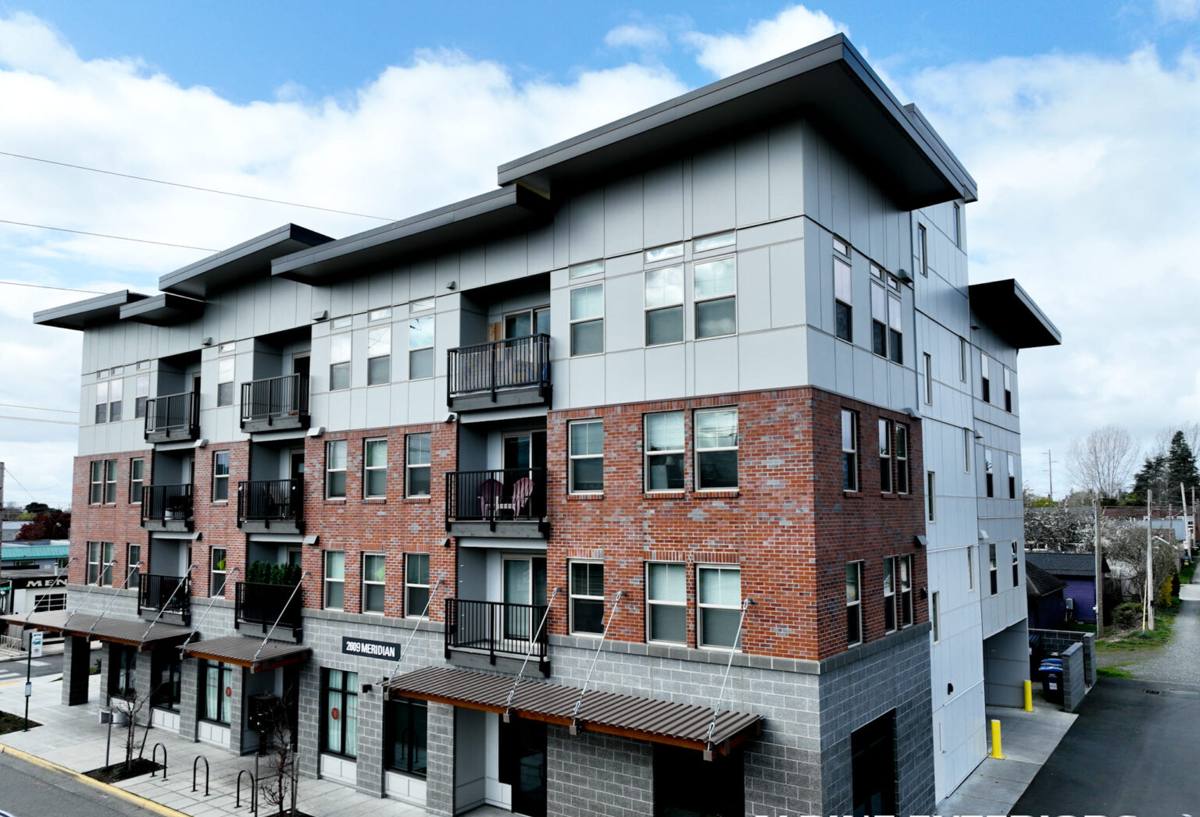
What Sumas Homes Actually Need From Their Siding
Three things matter more here than in drier parts of the state:
- Dimensional stability — siding that doesn't swell, cup, or warp when it takes on repeated moisture cycles through a long wet season.
- A finish that resists moss and mildew staining — or at least doesn't feed it. Porous or absorbent surfaces hold moisture against the substrate and give organic growth something to root into.
- Installation detailing that actually manages water — flashing, house wrap, gaps, and fastening that assume this house will get soaked repeatedly for months, not just occasionally.
That last point is the one homeowners underestimate. A siding product's own resistance to moisture only matters if the installation behind it is done right. Most siding failures we see in this region aren't material failures — they're installation shortcuts that let water get somewhere it shouldn't be.
Why We Standardized on James Hardie Fiber Cement
We install James Hardie fiber cement siding exclusively. We don't install vinyl, LP SmartSide, Cemplank, Allura, or unfinished cedar or primed spruce siding, and we're upfront about why: those products each carry a real trade-off — moisture sensitivity at cut edges, a shorter maintenance-free window, a finish that fades or chalks sooner, or upkeep demands that don't match how long homeowners actually plan to keep their houses. Hardie's fiber cement is non-combustible, dimensionally stable in wet-dry cycling, and comes with a factory-applied ColorPlus finish that's baked on rather than field-painted, which means it holds color and resists the streaking and mildew staining that shows up fast on shaded, moisture-heavy walls like the ones common around Sumas. We're not saying other products can't be installed correctly — we're saying we only want our name on work that holds up in this specific climate for decades, and Hardie is what we've found does that most consistently.
What a Correct Siding Installation Involves
A proper installation on a Sumas home involves the same fundamentals as anywhere, but with less room for error given the moisture load:
- Tear-off and substrate inspection — removing existing siding and checking the sheathing underneath for rot, soft spots, or prior water intrusion before anything new goes up.
- Repair of any compromised sheathing or framing — patching or replacing damaged wood rather than covering it, which is the single most common corner cut on cheap siding jobs.
- Weather-resistive barrier installation — a correctly lapped house wrap that sheds water downward and outward, not one stapled on as an afterthought.
- Flashing at every penetration and transition — windows, doors, roof lines, deck ledgers, and anywhere two planes meet. This is where most leaks originate on older homes in this area.
- Proper fastening and clearances — Hardie siding installed to the manufacturer's specified nailing pattern, gapping, and ground clearance, not "close enough."
- Factory-finished panels installed with minimal field cutting — protecting the factory finish that gives ColorPlus its resistance to moisture and fading.
- Sealed and caulked transitions — using products rated for the exposure, not general-purpose caulk that shrinks and cracks within a couple of seasons.
Skip or rush any one of these steps and the siding itself can be excellent and the wall will still fail early. This is why we treat installation quality, not just product choice, as the core of what we sell.
Common Trouble Spots We See on Homes in This Area
A few patterns show up repeatedly on siding jobs and inspections around Sumas and the surrounding river valley:
- North- and east-facing walls under mature tree cover that stay damp for days after a storm and develop moss and mildew staining faster than sun-exposed walls.
- Older homes with siding installed directly over damaged or under-ventilated sheathing, where the real problem was never visible until the siding came off.
- Trim and corner boards that were painted rather than factory-finished, showing wear years ahead of the field siding around them.
- Caulk joints at windows and butt seams that failed early because they were installed in cold or wet conditions, or with the wrong product for the exposure.
- Gutters and downspouts discharging too close to the foundation, keeping the lower courses of siding wetter than the rest of the wall.
Most of these aren't siding problems — they're moisture-management problems that siding either covers up or corrects, depending on how the job is done.
Our Process for a Sumas Siding Installation
We keep the process straightforward and walk homeowners through each stage before we start:
1. On-site assessment
We look at the existing siding, the condition of the sheathing where visible, drainage around the foundation, and any spots where tree cover or shading is likely to keep walls wet longer. This tells us what to expect once the old siding comes off.
2. Product and color selection
We walk through James Hardie's HZ5 climate-engineered line, panel and plank profiles, and ColorPlus finish options, matching the product to the exposure on each side of the house rather than treating every wall the same.
3. Tear-off and substrate repair
Old siding comes off, sheathing is inspected, and any rot or damage is repaired before we move forward — no covering up a problem that will just resurface later.
4. Weather barrier and flashing
House wrap and flashing go in with attention to every window, door, and roofline transition, since this is the layer that actually keeps water out of the wall assembly.
5. Installation to manufacturer spec
Hardie siding is installed with the correct fastening, gapping, and clearances, protecting both the warranty and the long-term performance of the wall.
6. Final detailing and walkthrough
Caulking, touch-up, and a walkthrough with the homeowner so everyone's clear on what was done and what maintenance, if any, is expected going forward.
What Drives Cost on a Job Like This
| Factor | Why It Matters |
|---|---|
| Sheathing condition | Rot or water damage found during tear-off adds repair work before new siding can go on |
| House size and wall complexity | More corners, dormers, and transitions mean more flashing detail and labor |
| Siding profile and finish | Plank vs. panel, and standard vs. premium ColorPlus finishes, carry different material costs |
| Trim and accessory scope | Full trim replacement costs more than reusing sound existing trim |
| Access and site conditions | Tree cover, tight lot lines, or difficult staging add time |
| Existing siding removal | Multiple layers of old siding or hazardous materials (like old paint) can add disposal costs |
We don't quote from a distance for exactly this reason — two houses of the same square footage in Sumas can price very differently depending on what's underneath the existing siding and how much of the trim needs replacing.
Why Hiring a Crew That Already Works This Area Matters
Siding installed to a generic standard doesn't account for a valley that stays wet longer than the rest of the county, or for the specific way moss and mildew take hold on shaded walls here. A crew that regularly works Whatcom County jobs already knows to flash more carefully on north-facing walls, to expect softer sheathing on older river-valley homes, and to plan around a wet season that runs longer than it does even a short drive away on higher, more open ground. That familiarity shows up in fewer callbacks and siding that still looks and performs correctly a decade in, not just at the final walkthrough.
Simple Maintenance Once the New Siding Is Up
Fiber cement with a factory finish needs very little upkeep, but a little attention goes a long way in this climate:
- Rinse siding annually, focusing on shaded walls where moss and mildew are most likely to accumulate.
- Keep gutters clear so water isn't sheeting down the face of the siding or pooling at the base of walls.
- Trim back tree limbs and brush that keep specific wall sections damp and shaded.
- Re-caulk any joint that shows cracking or separation before it becomes a water entry point.
- Inspect the lower courses near grade periodically, since these stay wettest the longest after storms.
If you're weighing a siding replacement on a home in Sumas, we're happy to take a look and walk you through what we'd recommend and why — no pressure, no obligation. Use the form below to request a free estimate.