 Blaine Siding
 Semiahmoo's Waterfront Climate Puts Decking to the Test
Semiahmoo sits right on the water, and that location is exactly what makes it a hard place to keep a deck looking good. Salt-laden air off Semiahmoo Bay and Drayton Harbor works on metal fasteners and hardware year-round, not just during storms. Add Whatcom County's long stretch of driving rain each fall and winter, and you've got a deck surface that rarely gets a real chance to dry out between weather systems. Shaded sides of homes near the marina and golf course areas stay damp even longer, which is exactly the condition moss and algae need to take hold.
None of this makes composite decking a bad choice for Semiahmoo — it's actually one of the better options for this exposure. But "composite" isn't a single product with one installation method. How it's built underneath, what hardware holds it together, and how it's finished at the edges determines whether a deck handles fifteen years of this climate or starts showing problems in three or four.
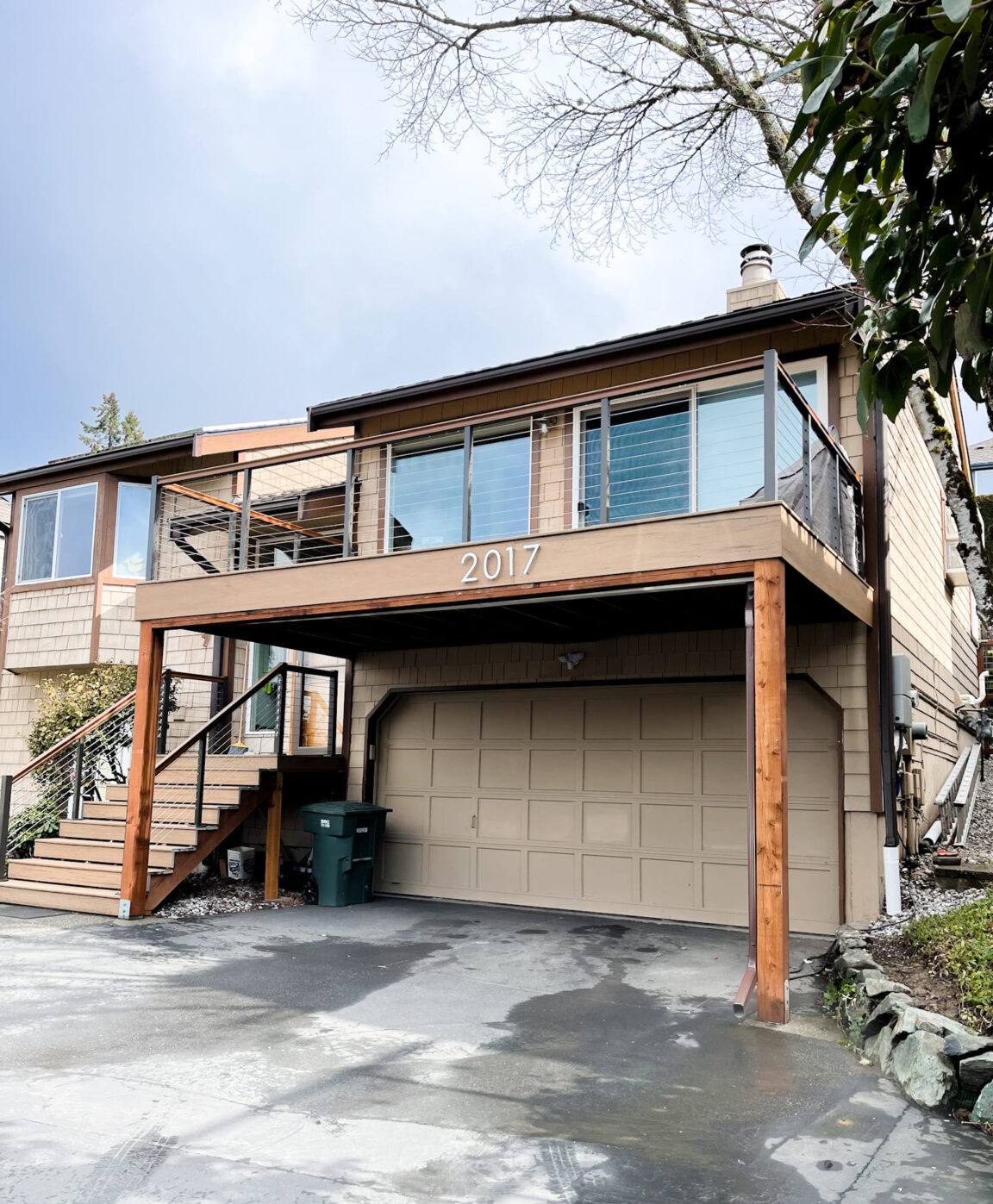
What a Correct Composite Deck Needs in This Environment
Substructure and Fasteners
The board on top is only part of the story. In a salt-air environment, standard galvanized fasteners corrode faster than they would further inland, and once a fastener starts rusting under a composite board, you get staining and eventually a loose connection you can't see until it fails. We use stainless steel or marine-rated coated fasteners and hardware on decks in this area as a matter of standard practice, not an upsell — it's what holds up.
Pressure-treated joists are still the norm under composite decking here, but the treatment level and how the cuts are sealed matters more this close to the water. Every field cut on a joist needs to be resealed, and joist tape over the top of the frame keeps standing moisture from wicking into the lumber where the decking sits on it. Skipping joist tape is one of the most common shortcuts we see on older installs, and it's usually where rot shows up first.
Drainage and Ventilation
A deck that can't breathe underneath will stay wet longer after every rain event, and Blaine gets a lot of rain events. Proper joist spacing, gapping between boards, and keeping the underside of the deck clear of debris all matter more here than in a drier climate. On low decks close to grade — common on some Semiahmoo lots — we pay close attention to ground clearance and drainage paths so water has somewhere to go instead of sitting under the structure.
Choosing the Right Composite Board for Salt Air and Shade
Not all composite boards perform the same way in coastal, shaded, wet conditions. A capped composite board — one with a plastic polymer shell fully wrapping the wood-fiber core — handles moisture exposure and salt air significantly better than an uncapped or lower-grade composite, because the cap is what actually resists moisture absorption and staining. For a property this close to the water, we default to fully capped boards and explain the trade-off honestly: capped composite costs more up front than uncapped composite or basic wood, but it holds color, resists mildew staining, and needs far less attention over the years.
Color and surface texture matter for a different reason here: darker boards on a shaded, north-facing section of a Semiahmoo home can stay damp longer than the same color in full sun, which is a mildew and algae setup. We'll talk through board color and finish relative to where the deck actually sits on your lot — sun exposure varies a lot from the water side of a house to the shaded side, sometimes on the same deck.
Our Installation Process, Start to Finish
- On-site assessment — we look at sun exposure, wind exposure, existing substructure condition (if replacing an old deck), drainage, and how the deck ties into the house.
- Ledger and flashing check — where the deck attaches to the house is the single most common source of hidden water damage on any deck. We confirm or install proper flashing so water is directed away from the wall, not into it.
- Substructure build or repair — treated joists, joist tape, and corrosion-resistant hardware sized correctly for the span and expected load.
- Composite board installation — hidden fastener systems where the board profile allows for it, correct gapping for drainage and thermal movement, and attention to board direction relative to the house.
- Edge, stair, and railing finish work — fascia boards, stair stringers, and railing posts are all places where water intrusion and fastener corrosion tend to start, so we finish these carefully rather than treating them as an afterthought.
- Final walkthrough — we go over basic care with you before we consider the job done.
Cost Factors for a Semiahmoo Composite Deck
Every deck is different, but the factors that move the price are consistent. This is meant as a general guide — a firm number comes from seeing your specific site.
| Factor | Why It Affects Cost |
|---|---|
| Tear-out of an existing deck | Old wood or lower-grade composite decks often need disposal and sometimes substructure repair once opened up |
| Board grade (capped vs. uncapped composite) | Fully capped boards cost more per square foot but need less long-term upkeep in salt air and shade |
| Substructure condition | Rot or corrosion found on an older frame near the water adds repair scope before decking goes down |
| Height and stairs | Multi-level decks and stairs add framing, railing, and code requirements beyond a simple ground-level deck |
| Railing material | Composite, aluminum, and cable railing systems all price differently and hold up differently in salt air |
| Square footage | Straightforward, but larger decks also mean more joints, seams, and fastener points to detail correctly |
As a rough starting point, fully installed composite decking in this region commonly runs somewhere in the $35–$60 per square foot range depending on the factors above — but the only way to know your number is a site visit.
Keeping Moss and Algae Off a Long-Wet-Season Deck
Composite decking doesn't rot, but it can still grow moss and algae on the surface if organic debris and moisture are left to sit, especially on shaded sections common near mature landscaping on Semiahmoo properties. A little seasonal attention keeps a composite deck looking like new for years.
- Sweep leaves, needles, and debris off the deck regularly through fall and winter rather than letting them mat down
- Rinse the deck surface periodically, especially shaded areas, to keep spores from establishing
- Use a soft-bristle brush and a cleaner made for composite decking if you see early moss or algae growth — avoid pressure washing at close range, which can damage the board surface
- Keep gutters and downspouts near the deck clear so runoff isn't dumping extra water onto one section
- Trim back vegetation that shades the deck and slows drying after rain
- Check railing posts and stair connections once a year for any sign of movement or corrosion staining around hardware
Railings, Stairs, and Local Code Considerations
Deck railings and stairs are subject to building code requirements that cover railing height, baluster spacing, and stair geometry, and permitting runs through the City of Blaine or Whatcom County depending on where the property sits. We handle the permitting and inspection process as part of the job so you're not left figuring out requirements on your own. On waterfront lots, wind exposure is also worth factoring into railing choice — some railing systems handle sustained coastal wind loads better than others, and we'll talk through that during the assessment rather than defaulting to whatever's cheapest.
Why a Crew That Already Works Semiahmoo Matters
A lot of deck problems in this area trace back to a job that was built to a generic spec rather than to the site. A crew that hasn't worked waterfront Whatcom County properties before might use standard fasteners instead of corrosion-resistant hardware, skip joist tape because it's "not usually necessary," or pick a board color without accounting for a shaded, damp section of the lot. Those choices don't fail on day one — they fail three or four years in, after the salt air and moss season have had time to work.
We work on homes throughout Blaine and the Semiahmoo area regularly, so decisions about hardware, board selection, and drainage aren't guesswork — they're based on what actually holds up here. That local track record is also why we're comfortable standing behind the work with a straightforward, honest scope up front instead of surprises once the deck is opened up.
Get a Straight Answer for Your Deck
If you're planning a new composite deck or replacing one that hasn't held up to the water and weather here, we're glad to take a look and give you a clear, no-pressure estimate. Use the form below to get started — we'll walk the site, talk through board and hardware options for your specific exposure, and give you honest numbers before any work begins.