 Blaine Siding
 Why Decks in Point Roberts Wear Out Faster
Point Roberts sits on a small peninsula bordered by water on three sides, out past Blaine at the very edge of Whatcom County. That location is a big part of what makes it a beautiful place to have a deck — and also why decks there take more punishment than decks a few miles inland. Salt-laden wind off Boundary Bay and the Strait of Georgia works on exposed metal year-round. Driving rain off the water finds every gap in flashing and fastening that a calmer inland site would never expose. And the long, wet, low-sun stretch of the year turns north-facing boards and shaded rail sections into a moss farm if the deck wasn't built with drainage and airflow in mind.
None of that means a Point Roberts deck can't last decades. It means the build has to account for those three things from the footings up, not patch them in later with a coat of sealer.
Salt Air and Metal
Airborne salt accelerates corrosion on anything metal — nails, screws, joist hangers, post bases, bolts. On a standard inland deck, mid-grade galvanized hardware is often fine. Closer to open water, that same hardware can start showing rust streaks and pitting well before the wood around it shows any wear, and once fasteners weaken, the whole structure is only as sound as its worst screw.
Driving Rain
Rain that comes in sideways off the water doesn't behave like rain falling straight down. It drives up under flashing, into ledger connections, and behind poorly lapped trim. A deck built to a "typical Whatcom County" standard of weatherproofing can still take on water at the house connection in a wind-driven storm if the flashing detail wasn't built for that exposure.
Moss Season
Western Washington's moss season runs long — realistically most of the fall through spring — and Point Roberts' marine humidity stretches it further. Moss doesn't just look bad. It holds moisture against the wood surface, feeds rot in untreated spots, and turns smooth decking into a slip hazard exactly when the weather is already wet.
Building on an Exclave: Why Access Matters Here
Point Roberts is a U.S. exclave — the only way to reach it by land is through Canada, crossing two international border checkpoints along the way (or arriving by water). That's a fact of geography, not an inconvenience we invented, but it has real consequences for a construction project. Lumber, hardware, and equipment all have to make that same crossing. Delivery windows, load restrictions, and border wait times affect scheduling in a way they simply don't for a deck build in Blaine, Ferndale, or Bellingham.
A crew that already works in Point Roberts has that logistics figured out — what to stage ahead of time, how to sequence material orders so a crossing delay doesn't stall the whole job, and how to keep a build on schedule despite the extra travel. A crew building its first Point Roberts deck is learning all of that on your project, on your timeline. That's the practical reason to ask any contractor bidding your job whether they've actually built there before, not just quoted it from across the border.
Decking Material: What Actually Holds Up Here
There's no single "best" decking material for every project — it depends on budget, how exposed the deck is to wind and salt spray, and how much upkeep you want to sign up for. Here's how the common options actually perform in Point Roberts conditions specifically:
| Material | How it handles salt air & rain | Moss/algae behavior | General cost position |
|---|---|---|---|
| Cedar | Naturally rot-resistant but still needs regular sealing near open water; unsealed cedar grays and softens faster in salt spray | Grows moss like any real wood if not cleaned; holds up if maintained on schedule | Mid-range material, higher long-term labor |
| Pressure-treated fir/pine | Treatment resists rot but cut ends and fastener holes need field treatment or they become weak points fast in wet, salty air | Same moss risk as cedar; rough-sawn texture can hold moisture longer | Lowest material cost, ongoing maintenance cost |
| Composite | Doesn't absorb water or salt the way wood does; hardware and framing underneath still need marine-grade attention | Surface algae/moss film still forms and needs periodic washing, but no rot risk from it | Higher material cost, lowest long-term maintenance |
Whatever decking you choose, the framing underneath — joists, beams, posts, and every fastener — matters more than the surface material for how long the deck actually lasts in this climate.
Framing, Flashing, and Hardware Most Homeowners Never See
The parts of a deck that fail first in a coastal, high-rain environment are almost never the parts you can see from your yard. They're the connections.
- Ledger flashing: where the deck attaches to the house needs proper flashing that sheds water outward, not just a bead of caulk — this is the single most common source of hidden rot on decks near open water.
- Joist tape: a self-adhering membrane over the top of each joist keeps fastener holes from becoming entry points for rain that would otherwise sit in the wood.
- Fastener grade: in a marine-influenced environment like Point Roberts, we spec stainless steel or true hot-dip galvanized hardware rated for coastal exposure — not the general-purpose galvanized hardware that's adequate further inland.
- Post bases off the ground: posts should sit on bases that keep end grain off wet soil or concrete, not buried or resting flush where water pools.
- Proper slope and gapping: decking needs a slight slope away from the house and consistent gaps between boards so water actually leaves the surface instead of sitting on it.
Moss, Algae, and Keeping the Surface Safe
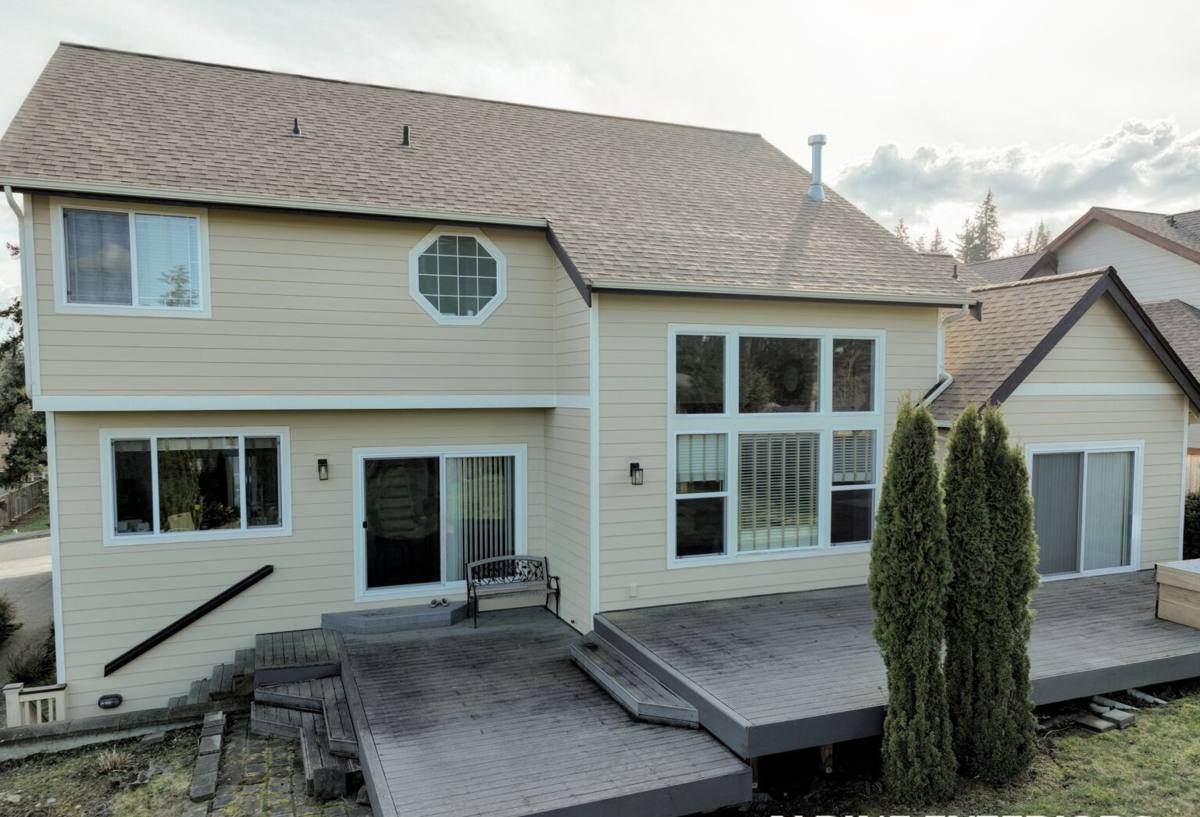
Moss and algae take hold wherever a deck stays damp and shaded longer than it stays dry — which describes a lot of the year here. Build details that reduce that risk include adequate board spacing for airflow, keeping vegetation and structures from choking off sun and wind exposure to the deck, and ventilation underneath the deck surface itself so moisture isn't trapped between the boards and the ground below.
Even a well-built deck needs periodic cleaning during the wetter months — a stiff brush and deck-safe cleaner on the surface, and a check of any shaded rail sections or stair treads where moss tends to establish first. Composite surfaces resist rot but still need this cleaning; skipping it just trades a rot risk for a slip risk.
Permits and Code Requirements in Whatcom County
Most attached decks in Whatcom County require a building permit, and the requirements scale with the deck's size, height, and how it attaches to the house. A few things that come up on nearly every project:
- Decks above a certain height off grade generally need guardrails built to code height and baluster spacing so a small child can't slip through or climb over.
- Elevated decks typically need engineered footings sized for the soil and the load, not just whatever post size "looks right."
- Stairs need consistent rise and run, and handrails where required by code — inconsistent steps are one of the most common inspection failures on deck projects generally.
We handle the permit application and inspection scheduling as part of the build so you're not the one tracking down Whatcom County paperwork on top of everything else.
How We Build a Point Roberts Deck
- On-site assessment: we look at sun and wind exposure, drainage, soil, and how close the deck sits to open water or prevailing weather to inform the framing and hardware spec.
- Design and material selection: we walk through decking, railing, and fastener options honestly, including the maintenance trade-offs of each, so you're choosing based on real information, not a sales pitch.
- Permit handling: we prepare and submit what Whatcom County requires and schedule inspections around the build.
- Material staging: because everything crosses the border to get to Point Roberts, we plan deliveries in advance so the crew isn't waiting on lumber mid-project.
- Build: footings, framing, flashing, decking, and railing, built to the marine-exposure standard rather than a generic inland spec.
- Final walkthrough: we go over the finished deck with you, including what maintenance it needs and roughly when, before we consider the job done.
Maintaining Your Deck Once It's Built
A deck built correctly for this climate still needs some ongoing attention — just less of it, and less urgently, than one that wasn't built with salt air and moss season in mind.
- Sweep debris and standing moss off the surface regularly through fall and winter, especially in shaded areas
- Wash the deck surface with a deck-safe cleaner at least once a year to keep algae and moss film from taking hold
- Check and re-seal wood decking on the schedule the sealant manufacturer recommends — typically more often near open water than the label's general guidance
- Inspect visible hardware annually for rust streaks or corrosion, which show up here before they would further inland
- Keep gutters and downspouts near the deck clear so runoff isn't dumping extra water onto or under the structure
- Trim back vegetation that's shading the deck or blocking airflow across the surface
If you're weighing a new deck or trying to figure out whether an existing one is still sound, we're glad to take a look and give you a straight answer. Reach out for a free, no-pressure estimate using the form below.