 Blaine Siding
 Siding Repair in Sumas: What Local Homes Are Up Against
Sumas sits at the far edge of Whatcom County, tucked against the Nooksack River valley and the Canadian border. It doesn't get the direct salt spray that homes right on Semiahmoo Bay deal with, but it shares the same marine weather system that soaks the rest of the county — long stretches of driving rain, heavy humidity, and a moss season that can run eight months of the year in shaded, north-facing spots. That combination is hard on siding no matter what it's made of, and it's why "repair" in Sumas usually means something more specific than a homeowner patching a hole with caulk and hoping for the best.
When we get called out to a Sumas home, the siding problem in front of us is rarely the whole story. Water doesn't announce itself. By the time paint is peeling, a board is soft underfoot, or a seam has visibly opened up, moisture has usually been working behind the surface for a while. A repair that only addresses what's visible tends to fail again within a season or two. A repair that's done right accounts for what's happening behind the cladding, not just on top of it.
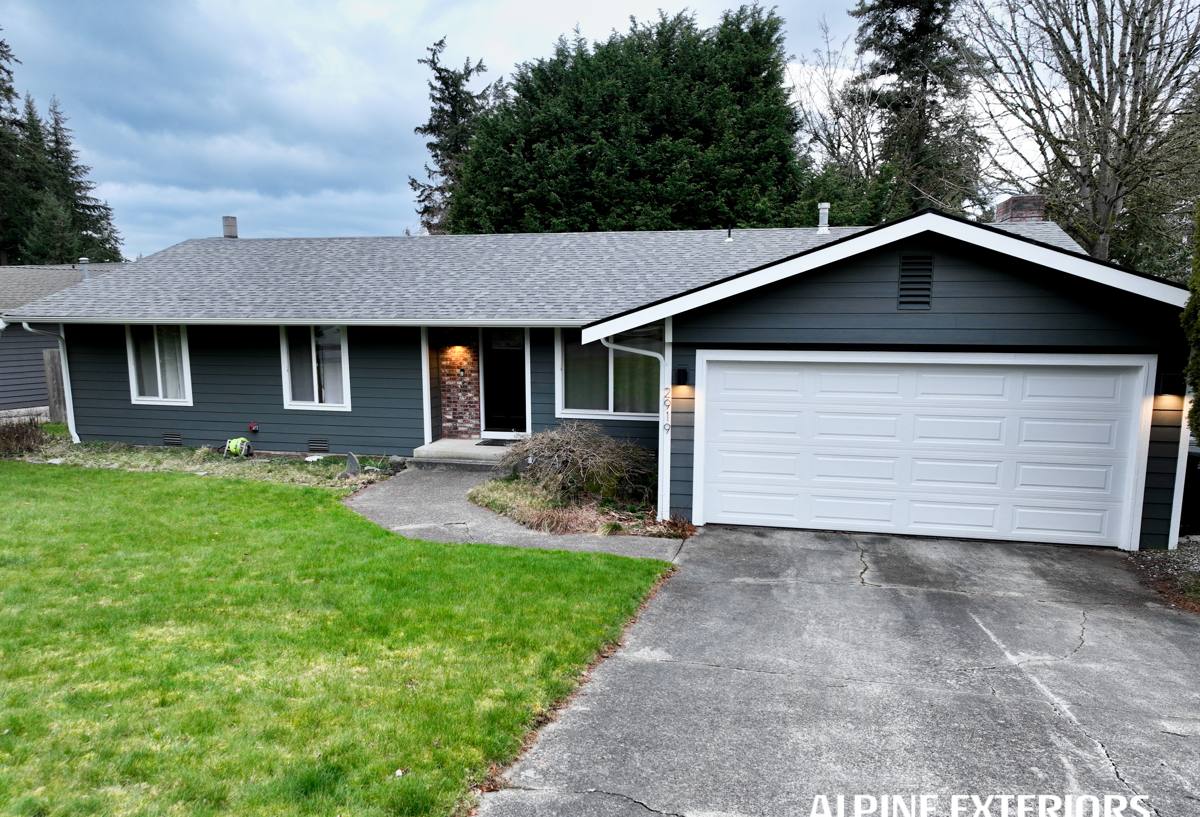
Why Sumas Siding Takes a Beating
A few climate realities specific to this part of Whatcom County drive most of the repair calls we see:
- Driving rain, not just rainfall. Pacific storm systems push wind-driven rain sideways into wall assemblies, forcing water past lap joints, trim, and fastener holes that would stay dry in a calmer climate.
- Extended damp periods. Wood-based and engineered sidings need time to dry out between wet spells to avoid swelling and rot. In this region, that drying window can be short from fall through spring.
- Moss and algae growth. Shaded elevations, tree-lined lots, and north-facing walls stay damp longer, giving moss and mildew a foothold that traps moisture against the siding surface.
- Temperature swings. Freeze-thaw cycles in the colder months stress caulking, fasteners, and any siding material that expands and contracts with moisture content, opening small gaps that widen over time.
None of this is unique to any one house — it's the baseline every home in Sumas is dealing with. The difference between a house that ages gracefully and one that needs repeated repair work usually comes down to the siding material, the quality of the original installation, and how quickly problems get addressed.
Common Siding Damage We See on Sumas Homes
Wood and Cedar Siding
Older Sumas homes often still have cedar or solid wood siding. It looks great when it's maintained, but it's high-upkeep in this climate — repainting or restaining every few years, caulking joints, and watching for soft spots where water has gotten behind a board. Once rot sets in, the damaged boards typically need to be cut out and replaced rather than patched.
Engineered Wood Siding
Engineered wood products are more moisture-resistant than solid wood but are still wood-based at the core. If the factory edge seal gets compromised — from a cut edge left unsealed, a nail driven too hard, or a joint that wasn't caulked — water can wick into the panel and cause swelling, delamination, or a soft, crumbly edge that keeps spreading if it isn't cut back and replaced.
Vinyl Siding
Vinyl doesn't rot, but Whatcom County's temperature swings make it brittle over time, and it's easy to crack on a cold day or warp near a heat source. Wind can also work panels loose from their locking channels during a storm. Repairs are usually straightforward panel swaps, but matching older, sun-faded vinyl to a repair section is often impossible — vinyl fades unevenly and isn't refinished.
Fiber Cement Siding
Fiber cement holds up the best of the group against this climate because it doesn't rot and doesn't absorb moisture the way wood does. Most of the repair calls we get on fiber cement trace back to installation issues rather than the material itself — caulking that failed at a joint, a fastener that missed the stud and backed out, or trim flashing that wasn't lapped correctly. Fixing the actual cause, not just the symptom, is what keeps these repairs from repeating.
What a Correct Repair Actually Involves
A siding repair that's done right isn't just about making a wall look finished again. It should answer three questions: what let water or damage in, what has that exposure already affected behind the surface, and what needs to change so it doesn't happen again.
- Find the entry point. Damage on the siding surface often shows up several feet from where water is actually getting in — gravity and wall cavities move it around. We trace the path back to the source before touching anything.
- Check what's behind it. Once siding is pulled back, we look at the house wrap or building paper, the sheathing, and the framing underneath. If any of that is compromised, replacing the siding alone just covers up a bigger problem.
- Match or transition the material. Where possible, we match existing siding for a seamless repair. Where the existing product is discontinued, badly faded, or simply not something we'll warranty going forward, we'll say so plainly and lay out the honest options — including a defined transition point where a larger section gets addressed properly instead of patched indefinitely.
- Rebuild the water management, not just the surface. Flashing, weather-resistant barrier, and proper caulking joints get restored to spec — not just re-covered with new boards over the same failure point.
Repair or Replace? How We Help You Decide
Not every damaged section needs a full re-side, and not every repair is worth doing in isolation. The right call depends on how widespread the damage is, what's causing it, and how much life is realistically left in the rest of the siding.
| Situation | Repair Usually Makes Sense | Replacement Usually Makes Sense |
|---|---|---|
| Damage location | Isolated to one or two areas (a corner, a section near a downspout) | Recurring damage across multiple walls or elevations |
| Underlying cause | A single identifiable failure point (bad caulk joint, one missed flashing detail) | Systemic issue — original install quality, wrong material for the climate, widespread moisture intrusion |
| Siding age | Siding is well within its expected service life | Siding is at or past the point where matching materials or colors is no longer possible |
| Material condition | Rest of the siding is sound and stable | Rest of the siding is showing early signs of the same failure (soft spots, fading, warping) |
| Cost over time | Repair cost is a fraction of replacement and unlikely to recur | Repeated repairs are starting to add up to a meaningful share of replacement cost |
We'll always tell you honestly which side of that table your house falls on. A lot of contractors default to recommending a full tear-off because it's the bigger job — we'd rather do the smaller, correct repair when that's genuinely the right call, and earn the bigger job later when it's actually needed.
Where We Stand on Materials
We install one siding system: James Hardie fiber cement. When a repair calls for replacing damaged boards on a home that already has Hardie siding, matching is usually clean because the ColorPlus factory finish and product lines are consistent and well-documented. When a repair is on a home with wood, engineered wood, or vinyl siding, we'll do the honest repair work needed to stop the immediate problem — but if that material is reaching the end of what patch repairs can reasonably fix in this climate, we'll tell you that directly, and we'll explain why fiber cement is what we'd put on the house if and when it's time for a full re-side. We're not going to install a product we don't stand behind just to win the smaller job.
Our Process for Sumas Repair Calls
- On-site inspection. We look at the damage in person, not from a photo, and check adjacent areas that are often affected before they show visible signs.
- Plain-language diagnosis. You get a clear explanation of what caused the damage and what's actually needed to fix it — no upsell to a full replacement unless that's genuinely the right answer.
- Written scope and price. You know what's being repaired, what materials are being used, and what it costs before work starts.
- Repair with water management addressed. We fix the cause, not just the symptom — flashing, sealant, and the weather-resistant barrier get corrected as part of the job, not left as-is.
- Cleanup and a final walkthrough. You see the finished repair and understand what was done, in plain terms.
Signs Your Sumas Home Needs a Siding Repair Now
Some siding problems are urgent; others can be scheduled without much risk. Use this list as a rough guide, but when in doubt, get it looked at — small problems are cheap to fix and big ones aren't.
- Soft, spongy, or crumbling siding when pressed
- Visible gaps or separation at seams, corners, or trim joints
- Peeling or bubbling paint, especially in one recurring spot
- Persistent moss or algae buildup that keeps returning after cleaning
- Warped, bowed, or buckled panels or boards
- Water stains or discoloration on interior walls near an exterior wall
- Cracked or missing sections after a windstorm
- Higher-than-usual heating bills with no other obvious cause
Why Local Experience in Sumas Matters
Whatcom County's weather isn't uniform — a home a few miles from the border river valley can dry out at a different rate than one closer to the coast, and shaded lots hold moisture longer than open ones regardless of address. A crew that regularly works this specific area has already seen how local lot orientation, tree cover, and seasonal fog patterns play out on real houses, which means less guesswork diagnosing your specific problem and fewer surprises once the siding comes off. It also means someone who's still local and reachable if a repair needs a follow-up visit, rather than a crew that's already moved on to a different region.
If you're seeing damage, a soft spot, or a section of siding that just doesn't look right anymore, we're happy to take a look and give you a straight answer about what's going on and what it'll take to fix it — no pressure, no automatic upsell to a full replacement. Reach out for a free estimate and we'll get you a clear plan for your home.