 Blaine Siding
 Nooksack's Climate Puts Real Stress on Siding
Homes around Nooksack sit in one of the more demanding exterior environments in Whatcom County. You're close enough to the Salish Sea and Boundary Bay to pick up salt-laden air, you're squarely in the path of the driving, wind-pushed rain that rolls through this part of northwest Washington, and you get a long, gray moss season that can run from early fall through late spring. None of these things individually is unusual for a Pacific Northwest property. Together, on the same wall, over years, they add up to a workload most siding materials weren't built to handle.
Salt air is corrosive to unprotected metal fasteners and trim, and it accelerates the breakdown of paint films and caulking. Driving rain doesn't just wet a wall's surface — wind pressure pushes water sideways and upward, past laps and seams that would stay dry in a calmer climate, which means the water management behind the siding matters as much as the siding itself. And moss doesn't just grow on roofs. Given constant dampness, shade from mature trees, and low winter sun angles common around Nooksack, moss and algae will colonize any siding material that holds moisture at its surface or in its joints.
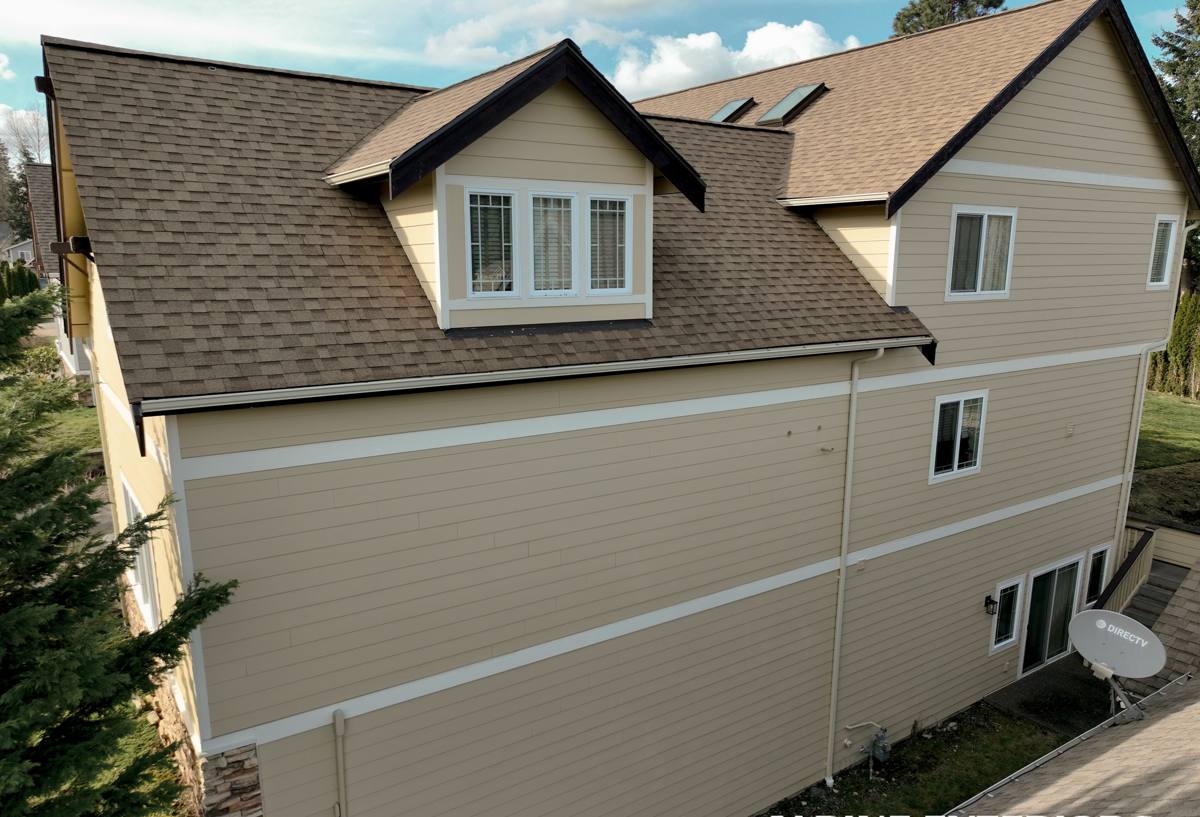
What a Nooksack Home Actually Needs From Its Siding
Dimensional Stability in Constant Moisture Swings
Siding here spends much of the year damp, then dries out in short bursts between rain systems. A material that swells and shrinks with that cycle will eventually loosen fasteners, open joints, and crack paint at the seams — even if nothing looks wrong the first few years.
Fastener and Trim Corrosion Resistance
Anything within a few miles of the water is exposed to airborne salt. Fasteners, flashing, and trim details need to be specified for that exposure, not just for a generic Pacific Northwest install. This is a detail that gets skipped more often than it should.
A Surface That Doesn't Feed Moss and Mildew
Porous or fibrous surfaces give moss spores something to grip and hold moisture against. A dense, factory-finished surface sheds water and gives organic growth far less to hold onto, which matters enormously during a moss season that can stretch most of the year.
Why We Install Only James Hardie Fiber Cement
We get asked fairly often why we don't offer vinyl, LP SmartSide, cedar, primed spruce, or other fiber cement brands like Allura or Cemplank. Each of those products has a legitimate place in the market, and none of them are "bad" products in the abstract. But we've made a professional decision to install one system, and it's worth explaining honestly why.
- Vinyl is affordable and low-maintenance, but it's a thin, flexible material that can warp in heat, crack in cold impacts, and fade over time — and in a climate with this much wind-driven rain, the water-management details behind vinyl (not the panel itself) are where problems tend to start.
- LP SmartSide is engineered wood. It performs well when detailed and maintained correctly, but wood-based siding is inherently more sensitive to sustained moisture exposure than cement-based siding, and a Nooksack-length wet season doesn't give it much of a break.
- Cedar and primed spruce look great and age with real character, but they require an ongoing maintenance commitment — refinishing, caulk renewal, moisture monitoring — that most homeowners underestimate until year five or six.
- Other fiber cement brands (Allura, Cemplank) are chemically similar to James Hardie, but we've standardized on one manufacturer so our crews install one spec, one fastening schedule, and one finish system to the letter, every time — instead of switching install details brand to brand.
James Hardie's fiber cement is non-combustible, dimensionally stable across our wet-dry cycles, engineered specifically for regional climates through its HZ product zoning, and finished at the factory rather than in the field — which is the piece that matters most for a salt-air, high-moss environment. We stand behind it with a transferable manufacturer warranty, and we install it to spec so that warranty actually means something if you ever need it.
The James Hardie Lines and Finishes We Use in Nooksack
Not every Hardie product is right for every wall. Part of our job is matching the right line and profile to your home's exposure, style, and roofline.
| Product Line | Best Used For | Why It Fits This Area |
|---|---|---|
| HardiePlank Lap Siding | Most wall areas, traditional and modern homes | Widest color range in ColorPlus finish; handles driving rain well when lapped and flashed correctly |
| HardiePanel Vertical Siding | Accent walls, gables, modern facades | Fewer horizontal joints for water to work into, useful on high-exposure elevations |
| HardieShingle | Gable accents, Craftsman and cottage-style homes | Traditional look without the moisture upkeep of real cedar shingle |
| HardieTrim | Corner boards, window and door trim, fascia | Matches expansion behavior of the field siding so trim joints don't open up over time |
Where the budget and design allow, we push for ColorPlus factory finish over field-applied paint. The factory process bakes on a finish under controlled conditions, which resists fading and chalking far better than paint applied on-site in variable weather — a real advantage when your siding is fighting salt air and UV on top of everything else.
What a Correct Installation Involves
Fiber cement siding is only as good as the installation behind it. Most of the failures we get called out to inspect on other contractors' work trace back to a handful of shortcuts, not the material itself.
- Weather-resistive barrier installed and lapped correctly before any siding goes up, with attention to how it integrates with window and door flashing
- Flashing at every horizontal joint, window head, and roof-to-wall transition — the details that stop wind-driven rain from getting behind the cladding
- Fasteners driven to manufacturer spec: correct type, length, and placement, not just "close enough"
- Proper gapping and sealant at butt joints and trim, sized for the material's expansion and contraction
- Minimum clearance maintained from grade, roofing, and decks so the bottom edge of the siding isn't sitting in standing moisture
- Field-cut edges primed or sealed before installation so the factory finish isn't compromised at every cut
- Corner and trim details that shed water outward rather than channeling it into the wall assembly
Skip any one of these and the siding can still look fine for a year or two — the problems show up later, as trapped moisture, rot in the sheathing, or moss and staining concentrated at the joints that weren't detailed correctly.
Our Process, Start to Finish
- On-site inspection and estimate. We walk the exterior, check the condition of the existing wall assembly, and talk through what your home's exposure actually needs — not a generic package.
- Material selection. We help you choose the right Hardie line, profile, and ColorPlus color for your home and its sun/wind exposure.
- Tear-off and substrate check. Old siding comes off and we inspect sheathing for rot or moisture damage before anything new goes on — this step gets skipped by rushed crews and it's where hidden problems live.
- Weather barrier and flashing. Correctly lapped house wrap and flashing go in before a single piece of siding is hung.
- Installation to manufacturer spec. Fastening, gapping, and trim work follow James Hardie's published installation instructions, which is also what keeps the warranty valid.
- Final walkthrough. We review the finished work with you and address anything before we call the job done.
What Affects Cost on a Nooksack Fiber Cement Project
We won't quote a number here without seeing the home, but these are the factors that actually move a fiber cement estimate up or down:
| Factor | Effect on Cost |
|---|---|
| Home size and number of stories | More surface area and taller walls increase material and labor time |
| Existing wall condition | Rot repair or sheathing replacement adds cost beyond the siding itself |
| Siding profile mix | Combining lap, panel, and shingle accents costs more than a single profile |
| Trim complexity | Detailed corners, window surrounds, and gables add labor time |
| Accessibility | Steep sites, limited staging area, or tall gables add setup time |
| Color and finish | ColorPlus factory finishes vary in price by color selection |
Living With Fiber Cement in a Salt Air, Moss-Prone Climate
Fiber cement is genuinely low-maintenance compared to wood, but "low-maintenance" doesn't mean "no maintenance" — especially this close to salt water and under this much shade and moisture. A yearly rinse-down knocks back the salt film and any early moss growth before it gets established. Keeping gutters clear and downspouts directed away from the wall prevents the concentrated moisture exposure that causes localized staining. Trimming back vegetation that shades a wall or blocks airflow gives siding a chance to dry between rain events instead of staying damp for weeks. And an occasional check of the caulking at trim joints and penetrations catches small gaps before they become a path for water intrusion.
Why a Crew That Already Works Nooksack Matters
Installation instructions are the same on paper everywhere Hardie is sold. What changes is how those instructions get applied to a specific home's exposure. A crew that regularly works this part of Whatcom County knows which elevations take the worst of the wind-driven rain, which walls stay shaded and damp long enough to need extra attention at the joints, and how to sequence a project around a weather pattern that doesn't always cooperate. That local pattern recognition is the difference between a siding job that looks right on installation day and one that's still performing correctly a decade later.
If you're weighing a siding replacement or new construction project in the Nooksack area, we'll walk your property, look at what your home's specific exposure demands, and put together a straightforward estimate — no pressure, no generic package. Use the form below to get started.