 Blaine Siding
 Why Grandview Homes Go Through Siding Faster
Grandview sits close enough to the water and the Canadian border that its homes take a different kind of weather beating than siding was designed for on paper. Whatcom County gets a steady diet of wind-driven rain off the Strait of Georgia, salt-laden air that corrodes fasteners and dulls finishes, and long stretches of grey, damp months where moss and algae get a real foothold on north- and west-facing walls. None of that is exotic or unusual for this part of Washington — it's just relentless, month after month, year after year. Siding that would hold up fine in a drier climate can start showing real problems here in half the time.
The practical result is that a lot of the siding decisions homeowners make elsewhere in the country don't translate cleanly to Grandview. A product's national warranty rating doesn't tell you how it handles saturated wind-driven rain hitting a wall at an angle for six months straight, or how it looks after a decade of salt air and moss cycles. That's the lens we use every time we talk to a homeowner here about replacing siding — not just "does this material exist," but "does it actually perform on this street, in this weather, for the next 30 years."
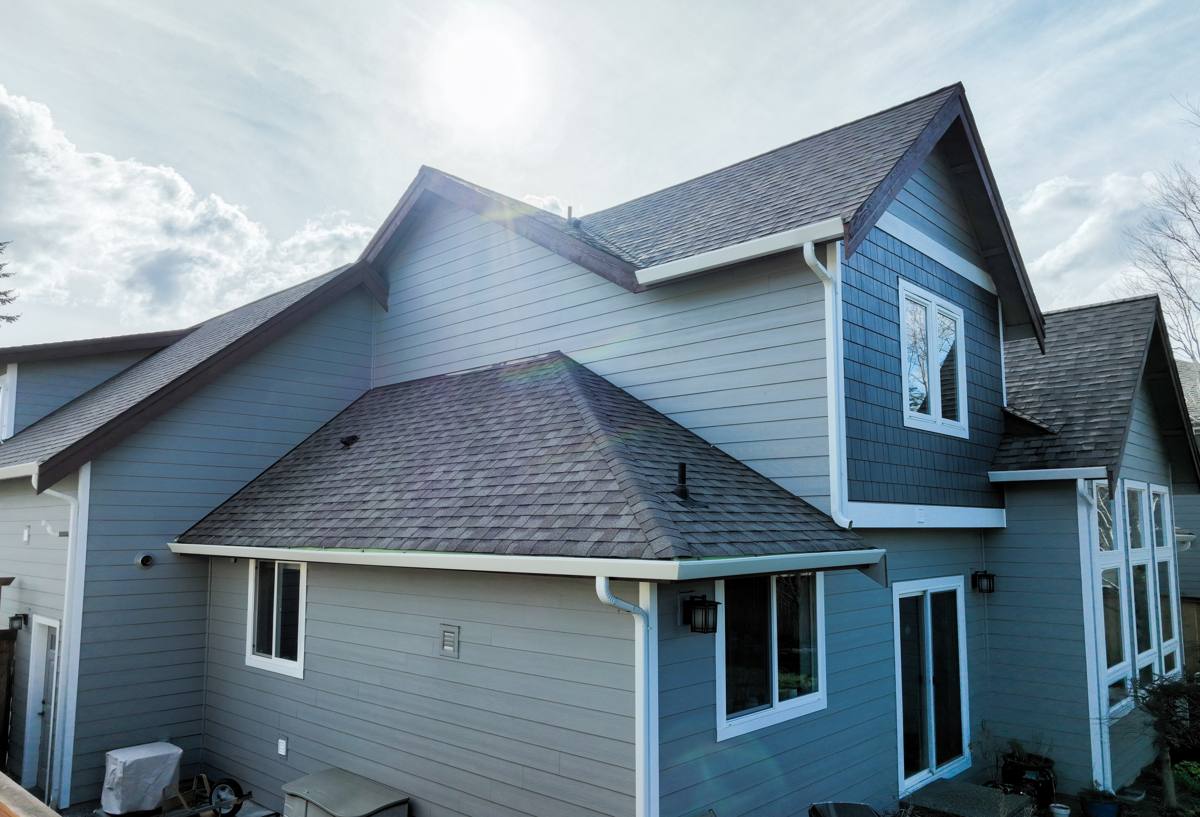
Signs a Grandview Home Actually Needs Replacement, Not Just Repair
Not every siding problem means a full tear-off. But in a climate like this, some symptoms are worth taking seriously rather than patching over, because they usually point to moisture that's already gotten past the surface.
- Soft, spongy, or crumbling spots when you press on the siding, especially near the bottom courses and around windows
- Paint that keeps failing in the same spots within a year or two of repainting
- Persistent moss or black streaking that comes right back after cleaning
- Visible gaps, cupping, or warping in board siding, or cracking and buckling in older panel products
- Musty smell or discoloration on interior walls that back up to exterior siding
- Siding that's original to a home built more than 25-30 years ago, particularly wood or older composite products
A single soft spot might be a localized flashing failure that a repair can fix. Soft spots in multiple areas, especially combined with paint failure or interior signs, usually mean the water-resistive barrier or sheathing underneath has been compromised for a while — and at that point, patching the surface without addressing what's underneath just buries the problem for a year or two.
What a Correct Siding Replacement Actually Involves
It's Not Just Swapping Panels
The single biggest mistake we see on homes that get re-sided badly is treating it as a cosmetic swap — old siding off, new siding on, done. In a climate that pushes this much water at a wall, the siding itself is almost the least important variable. What's underneath it is what determines whether the job lasts.
Removing the Old Siding Properly
A full tear-off means stripping the old material down to the sheathing, not just the exposed courses. That exposes any hidden rot, damaged framing, or old flashing mistakes that have been hiding for years — problems a re-side-over-existing-siding approach never uncovers. It's more labor up front, but it's the only way to actually know what condition the wall is in.
What's Underneath Matters More Than What's On Top
Once the wall is stripped, any soft or rotted sheathing gets cut out and replaced, not just covered. A new water-resistive barrier goes on correctly lapped, shingle-style, so water is always directed outward and down, never trapped behind the barrier. This is the step that gets rushed or skipped on cut-rate jobs, and it's the step that matters most in a wind-driven-rain climate like this one.
Flashing and Water Management Details
Windows, doors, deck ledgers, and anywhere two planes of the house meet need proper flashing integrated with the water-resistive barrier — not just caulked over the top. Caulk is a maintenance item that eventually fails; flashing done correctly doesn't depend on a bead of sealant staying intact for the next 20 years. We also pay attention to proper clearance at the bottom of the wall and around foundation lines, since siding installed too close to grade or hard surfaces stays wet longer and invites both rot and pest issues.
Why We Install Only James Hardie Fiber Cement Siding
We made a deliberate decision as a company to install James Hardie fiber cement exclusively, and we don't install vinyl, LP SmartSide, Cemplank, Allura, primed spruce, or cedar. That's not a marketing position — it's a standard we hold because of what actually holds up on homes in a climate like Whatcom County's.
Fiber cement is non-combustible, which matters more every year as wildfire smoke seasons stretch further north and west. It doesn't absorb and swell with moisture the way wood-based products can, and it doesn't soften, warp, or become brittle in temperature swings the way vinyl can. James Hardie's ColorPlus factory finish is baked on under controlled conditions rather than site-painted, which matters directly for salt-air exposure — factory finishes hold color and adhesion longer than field-applied paint in coastal conditions. Hardie also engineers specific product lines (their HZ5 and HZ10 systems) for different climate zones, which is a level of climate-specific engineering that most competing products don't offer at all.
| Consideration | James Hardie Fiber Cement | Vinyl / Wood-Based Alternatives |
|---|---|---|
| Moisture behavior | Dimensionally stable, doesn't swell or rot | Wood-based products can absorb moisture and swell; vinyl can warp with heat |
| Finish durability in salt air | Factory-baked ColorPlus finish | Field-applied paint or molded color fades and chalks faster |
| Fire resistance | Non-combustible | Combustible (wood-based) or melts/deforms (vinyl) |
| Climate-specific engineering | HZ product lines matched to region | Typically one-size-fits-all nationally |
| Warranty structure | Long, transferable when installed to spec | Varies widely, often prorated |
To be fair to the alternatives: vinyl is genuinely cheaper up front and low-maintenance in mild climates, and cedar has an appearance a lot of homeowners love. But vinyl's seams and thermal movement are a liability in driving rain, and cedar demands ongoing refinishing to survive this much moisture and moss exposure. We'd rather turn down a job than install something we don't believe will hold up on a Grandview wall for the next three decades.
Our Siding Replacement Process for Grandview Homes
- Walkthrough and assessment — we look at the whole exterior, not just the obviously damaged areas, since problems on one wall often mean similar conditions elsewhere
- Written scope and product selection — clear on what's being replaced, what sheathing repair is anticipated, and which Hardie profile and ColorPlus color fits the home
- Full tear-off — old siding and any compromised underlayment removed down to sheathing
- Sheathing repair — any rotted or damaged sheathing cut out and replaced before anything new goes back on
- Water-resistive barrier and flashing — installed and lapped correctly at every penetration, window, and transition
- Hardie installation to manufacturer spec — correct fastener pattern, gapping, and clearances, which is what actually keeps the manufacturer warranty valid
- Final detail and cleanup — caulking limited to where it belongs, trim and paint touch-up, site cleared
Cost Factors Worth Understanding Before You Get Quotes
We won't quote a number without seeing the house, but the factors that actually move the price on a Grandview siding replacement are worth knowing going in, so you can compare quotes on an apples-to-apples basis instead of just by bottom line.
| Factor | Why It Matters |
|---|---|
| Condition of sheathing underneath | Hidden rot found during tear-off means real repair costs a low bid may not have accounted for |
| Home size and wall complexity | More corners, dormers, and trim details mean more labor and material cuts |
| Siding profile chosen | Lap, shingle, and panel Hardie profiles differ in material and labor cost |
| Access and site conditions | Tight lots, tall walls, or landscaping obstacles affect scaffolding and staging time |
| Trim and accessory work | Fascia, soffit, and window trim replacement alongside siding adds scope but avoids mismatched future repairs |
A quote that's dramatically lower than others is worth asking hard questions about — it often means skipped tear-off, no sheathing allowance, or shortcuts on flashing and fastening that won't show up until the siding fails early.
Why Local Experience in Grandview and Blaine Actually Matters
Siding installation instructions read the same everywhere on paper, but the judgment calls that keep water out of a wall depend on knowing how this specific weather behaves. A crew that's worked homes throughout Blaine and the rest of Whatcom County knows which wall orientations catch the worst of the wind-driven rain, how aggressively moss establishes itself on shaded north sides, and how salt exposure near the water accelerates fastener corrosion if the wrong hardware gets used. That's the kind of thing you only really learn by doing the work here repeatedly, not by reading a spec sheet once.
It also matters for permitting and code familiarity — knowing what the local jurisdiction expects for a residential siding replacement keeps a project from stalling out on paperwork. And practically, a crew already working in the area can usually schedule more predictably around this region's wet season, rather than treating every job as a first attempt at working around Pacific Northwest weather windows.
Caring for Your New Siding After Installation
James Hardie siding installed correctly is genuinely low-maintenance compared to wood or vinyl, but "low-maintenance" isn't "no-maintenance," especially in this climate.
- Rinse down siding once or twice a year to keep salt residue and organic buildup from settling in, especially on walls facing prevailing wind and rain
- Keep gutters clear so overflow doesn't run down the wall face repeatedly
- Trim back vegetation and landscaping that keeps a wall section shaded and damp, which is what lets moss take hold
- Check caulking at trim and penetration points every couple of years and touch up as needed — caulk is a maintenance item even on a well-flashed wall
- Address any impact damage or gouges promptly so the factory finish isn't compromised at that spot long-term
None of this is heavy lifting, but staying on top of it is what lets a correctly installed Hardie job actually reach the long lifespan it's capable of in a coastal Whatcom County climate.
If your Grandview home is showing any of the signs above, or you're just weighing whether repair or full replacement makes more sense, we're happy to take a look and give you a straight, no-pressure assessment. Use the form below to request a free estimate.