 Blaine Siding
 Siding Repair in Grandview: A Different Kind of Wear
Grandview homes sit up in Blaine's exposed, water-adjacent stretch of Whatcom County, where the same conditions that make the views worth having — open air, few windbreaks, close proximity to Semiahmoo Bay and Drayton Harbor — also mean siding takes a harder beating than it would a few miles inland. Salt-laden air, wind-driven rain, and a moss season that can run most of the year all work on exterior walls here in ways that show up faster and dig deeper than typical siding wear. A repair call in Grandview is rarely just cosmetic once you actually get up close to the wall.
This page is about siding repair specifically for homes in this part of Blaine — what actually goes wrong, how a correct repair is diagnosed and scoped, and why a crew that already works this area catches things a generic repair visit tends to miss.
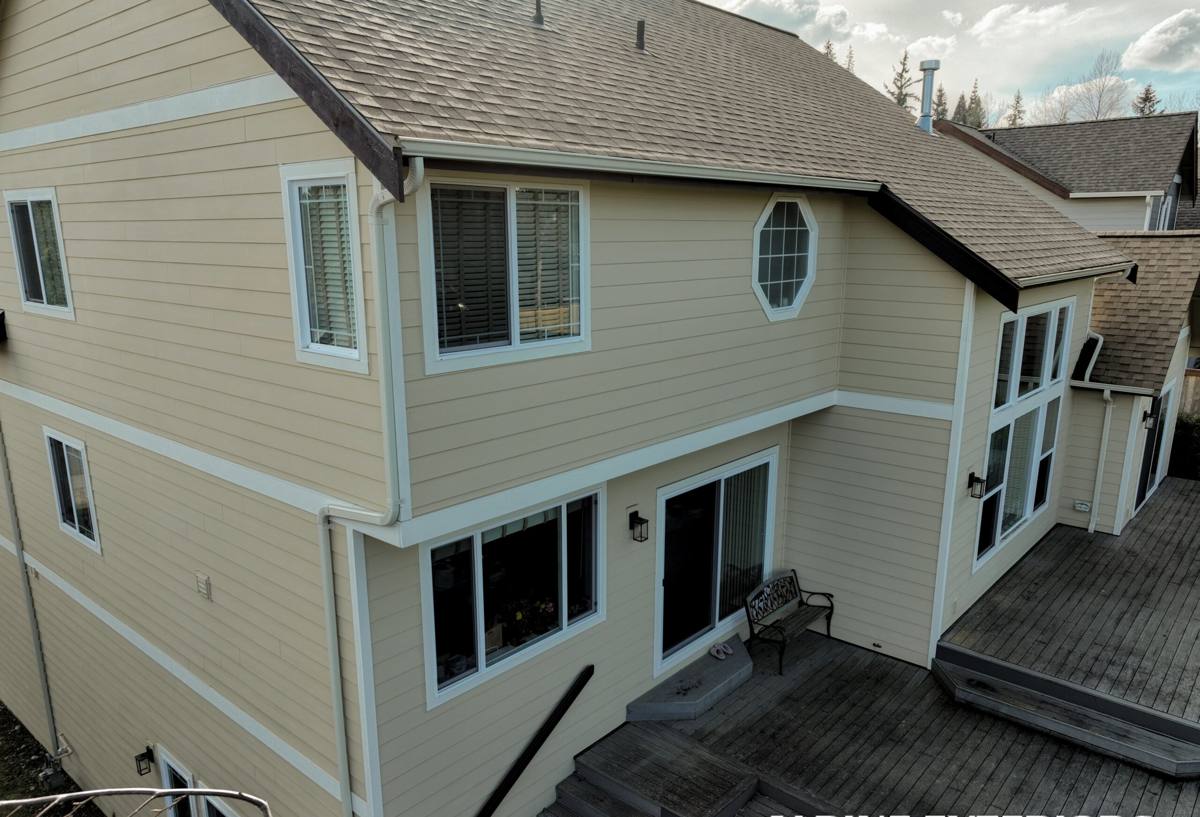
What Grandview's Climate Does to Siding
Salt Air Working the Surface and the Fasteners
Being close to open water means salt-laden air settles on exterior walls continuously, not just during storms. That salt accelerates corrosion on nails, staples, and any exposed metal trim, and it breaks down lower-grade paints and coatings faster than a drier inland climate ever would. On older siding, this often shows up first as rust bleeding through paint at fastener heads — a small sign that the fastener underneath has already lost some holding strength.
Driving Rain, Not Just Rain
Storms moving through this part of Whatcom County frequently arrive with wind behind them, which pushes rain sideways into siding laps, trim joints, and anywhere a wall meets a window or roofline. That sideways load finds gaps a straight-down rain never would, which is why houses in Grandview can develop moisture damage at seams and butt joints well before the field of the siding shows any wear at all.
A Moss Season That Doesn't Really End
Mild temperatures combined with near-constant moisture give moss and mildew a long growing season here, and shaded or north-facing walls are usually the first to show it. Moss and organic growth hold moisture directly against the siding surface, which is exactly the wrong thing for any material with even slight surface porosity. In Grandview, we regularly see moss taking hold on walls that get partial shade for a good part of the day, sometimes well before the homeowner has noticed anything else wrong.
Common Siding Repair Issues We See in This Area
- Soft or spongy siding low on the wall, near grade, or below window sills where water tends to collect and linger
- Rust staining or bleed-through at fastener locations, often the first visible sign of corroding hardware underneath
- Moss or dark staining that returns quickly after cleaning, usually on shaded or north-facing walls
- Cracked, warped, or delaminating boards on older wood-based or engineered wood siding that's absorbed repeated moisture cycles
- Open or failed caulking at trim transitions, corners, and butt joints where wind-driven rain gets pushed in sideways
- Paint that's peeling, bubbling, or chalking faster than expected, often a sign moisture is already working from behind the surface
Diagnosing Before Repairing
A siding repair estimate that's actually worth something starts with figuring out how far a problem goes, not just patching what's visible. That means checking a few things a quick look from the driveway won't tell you:
- Probing soft-looking areas to find the actual boundary of moisture damage, since it's almost always larger underneath than it appears on the surface
- Checking behind trim and at butt joints for water staining or soft sheathing, since these are the most common entry points for wind-driven rain
- Looking for a pattern — if damage clusters on one side of the house, that usually points to prevailing wind and rain direction rather than a single isolated failure
- Checking fastener condition where rust staining shows up, since a corroded fastener has already lost holding strength even if the board around it still looks fine
- Assessing whether house wrap or flashing behind the existing siding is doing its job, or whether water has already been getting past it for a while
We walk through what we actually find, including when a repair is smaller than a homeowner expected, or when it's larger because the damage extends further than what's visible from outside.
Repair vs. Replace: How That Decision Gets Made
Not every damaged section of siding means the whole wall — or the whole house — needs to come off. But not every repair is a good long-term answer either. The factors that actually decide this:
| Factor | Favors Repair | Favors Replacement |
|---|---|---|
| Extent of moisture damage | Isolated to a section or a few boards | Spread across multiple walls or deep into sheathing |
| Age of existing siding | Newer material, otherwise sound | Near or past its practical service life |
| Siding material | Still available or reasonably matched | Discontinued profile or color, poor match likely |
| Underlying cause | A fixable, localized issue (failed caulk, one bad flashing detail) | Systemic — wrong product or installation for this climate |
| Overall home exposure | Sheltered wall, minimal water exposure | Direct wind and rain exposure on a wall that's already struggling |
We'll tell you honestly which category a given repair falls into, including when a targeted repair is genuinely the right call and full replacement would be overkill.
What a Correct Repair Involves
Matching the Existing Material Where Possible
When the existing siding is still available, matching profile, reveal, and finish keeps a repair from standing out as an obvious patch. On older or discontinued siding, an exact match isn't always possible, and we'll say so upfront rather than after the work is done, so the decision to move forward is an informed one.
Fixing the Cause, Not Just the Symptom
A soft board or peeling paint is a symptom. Failed caulking, a missing flashing detail, or house wrap that's torn or improperly lapped is usually the actual cause. Replacing damaged siding without correcting what let water in behind it means the same failure tends to show up again in the same spot, often sooner the second time.
Correct Flashing and Sealing at Every Transition
Repairs around windows, corners, and butt joints get flashed and sealed the way new installation would be — not patched over with caulk alone, which is a common shortcut that fails within a season or two in a climate that sees this much wind-driven rain.
Hardware That Actually Holds Up Here
Where fasteners have corroded, we replace them with hardware suited to salt air exposure rather than a like-for-like swap with standard-grade fasteners that will corrode again on a similar timeline. This is one of the more common places a repair either holds up for years or needs redoing sooner than it should.
Why We Only Repair With — and Onto — James Hardie Siding
Our company installs James Hardie fiber cement exclusively, and that standard carries into repair work too. We don't install LP SmartSide, vinyl siding, Cemplank, Allura, primed spruce, or cedar, and when we're repairing a section of existing siding, we're straightforward about what that means: if the existing material is one of those products, we can talk through options, but we won't represent patch work on a product we don't stand behind as a long-term fix.
The reasons behind that standard come directly from what repeated service calls in coastal, high-moisture towns like Blaine have shown us:
- Non-combustible core — fiber cement doesn't feed a fire the way wood-based siding products can.
- Factory-applied ColorPlus finish — baked on under controlled conditions, so it holds its finish longer against fading and moisture than field-applied paint.
- Climate-engineered HZ product lines — Hardie's HZ5 formulation is built for regions with sustained moisture and freeze-thaw cycling, which describes coastal Whatcom County well.
- Dimensional stability — fiber cement doesn't swell, cup, or warp the way some engineered wood products do after repeated wet-weather cycles.
- A strong transferable warranty — provided the installation follows Hardie's spec, which is the standard we hold repair work to as well.
When a repair area is significant enough, or the existing product has reached the point where patching it no longer makes sense, we'll talk through transitioning that section — or the whole exterior — to Hardie rather than continuing to chase the same failure on a product that isn't built for what this climate does to a house.
Maintenance That Extends a Repair's Life
- Rinse siding periodically to clear salt residue and organic buildup before it works into seams and surface texture
- Keep gutters clear and downspouts directed away from the wall, since overflow is a common source of localized siding damage
- Trim back plants and landscaping that trap moisture against the wall or block airflow and sun from reaching shaded siding
- Check caulking at trim and butt joints once a year, especially after the wetter months, and address gaps before they let water in
- Address soft spots, rust staining, or returning moss right away rather than waiting for it to spread
- Repaint or refinish on a schedule appropriate to the material, since coastal exposure shortens the interval compared to inland homes
Why Hiring a Crew That Already Works Grandview Matters
A repair crew that mostly works inland Whatcom County can still do competent work here, but Grandview's exposure has patterns that come up more often on homes in this part of Blaine than elsewhere in the county — which walls take the worst of the wind-driven rain, how far moisture typically travels once it gets behind siding in this exposure, and which fastener grade actually holds up against this much salt air. Working this area regularly means we're not guessing at those patterns or figuring them out mid-repair. That translates into a more accurate first estimate, and fewer surprises once old siding actually comes off the wall.
Get an Honest Look at Your Siding
Whether you're dealing with a specific problem area — soft siding, returning moss, peeling paint near a window — or just want a straight read on where your home's exterior stands, we're glad to take a look and tell you plainly what we find, including if it turns out to be less than expected. Reach out below for a free, no-pressure estimate.