 Blaine Siding
 Why Siding Installation in Ferndale Requires More Than a Standard Approach
Ferndale sits close enough to the Salish Sea that salt-laden air reaches inland neighborhoods on a regular basis, and it sits squarely inside Whatcom County's marine climate belt — meaning driving rain off the water, heavy fall and winter precipitation, and a moss season that can run eight months or longer in shaded, north-facing yards. Siding here doesn't just need to look good. It needs to shed water aggressively, resist the slow biological growth that thrives in constant damp, and hold up to airborne salt that accelerates corrosion on fasteners and finishes that weren't built for it.
A siding installation that would hold up fine in a drier inland climate can fail early in Ferndale if the crew doesn't account for these conditions. That's the gap we see most often when we inspect older siding jobs in the area: the material choice or the install detailing was fine for "average" Pacific Northwest weather, but not for a property this close to the water.
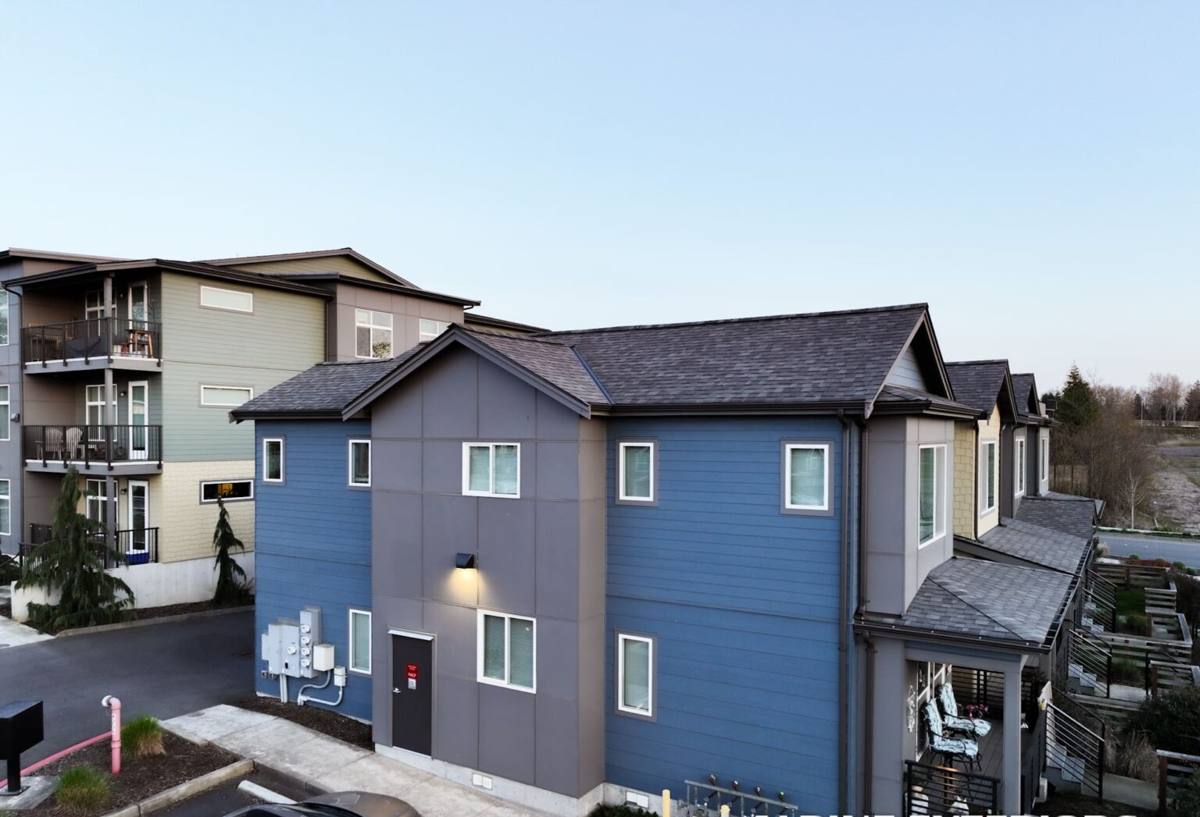
What Ferndale Homes Actually Need From Their Siding
Based on what we see on service calls and replacement jobs throughout Ferndale and the surrounding Blaine area, the priority list looks like this:
- Water management at every horizontal joint, not just at obvious spots like window heads
- A finish that resists moss, algae, and mildew staining without needing yearly power-washing to stay presentable
- Fasteners and trim details that won't corrode or streak from salt air exposure over time
- A substrate that won't swell, rot, or delaminate when it stays damp for weeks at a stretch
- A color and finish system that survives UV and moisture cycling without chalking or fading unevenly
Vinyl, untreated wood, and some engineered wood products each fall short on one or more of these points in a climate like this. That's the core reason our company made the decision to install only James Hardie fiber cement siding — not because it's the only siding product on the market, but because it's the one we're willing to stand behind for homes that sit in this kind of weather year-round.
What Correct Installation Involves in a Marine Climate
Moisture Management Starts Before the First Board Goes Up
The single biggest factor in how long any siding job lasts in Ferndale isn't the siding material itself — it's the water-resistive barrier and flashing behind it. A correct installation includes a properly lapped weather barrier, correctly integrated window and door flashing, and drainage paths that let any incidental moisture escape rather than pool behind the cladding. Skipping or rushing this step is the single most common cause of rot and mold we find when we open up older walls in this area.
Fastening, Clearances, and Joint Treatment
James Hardie publishes specific fastening patterns, minimum clearances from grade, decks, and roof lines, and joint treatment requirements — and all of them matter more in a wet coastal climate than in a dry one. Boards installed too close to grade or a roofline wick moisture. Butt joints that aren't properly caulked or backed become entry points for water. Fasteners that aren't corrosion-resistant can bleed rust streaks down a ColorPlus finish within a couple of seasons near salt air. None of this is optional detailing — it's the difference between siding that reaches its expected service life and siding that needs early repair.
Ventilation Behind the Cladding
Rainscreen or drainage-gap approaches, where appropriate for the wall assembly, give bulk water and trapped humidity somewhere to go instead of sitting against the back of the siding. In a climate with this much sustained dampness, that airflow is part of what keeps a wall system healthy over the decades, not just the first few years.
Why We Install Only James Hardie Fiber Cement in Ferndale
Climate-Engineered HZ Product Lines
James Hardie manufactures siding in different formulations for different climate zones, and the HZ5 line is engineered for the kind of cold, wet, moisture-heavy conditions found throughout Whatcom County. Fiber cement itself is non-combustible and dimensionally stable — it doesn't swell, cup, or warp the way wood-based sidings can when they take on repeated moisture cycling, and it doesn't provide the food source that moss and mildew look for on organic materials.
ColorPlus Factory Finish vs. Field-Applied Paint
Hardie's ColorPlus finish is baked on at the factory under controlled conditions, which gives it more consistent adhesion and UV resistance than paint applied on site in variable weather — a real advantage in a region where you can lose good painting weather to rain for weeks at a time. It also means touch-up and repainting cycles are longer, which matters to homeowners who don't want to re-paint the exterior every few years just to keep ahead of moss staining and coastal weathering.
Warranty Backing That Reflects Confidence in the Product
James Hardie backs its siding with a strong, transferable limited warranty — a meaningful detail for homeowners in a climate that stress-tests exterior products harder than most of the country. We only want to install products we're confident will still be performing correctly a decade or two from now, and Hardie's track record and warranty structure are a big part of why it's the product we settled on.
How Our Ferndale Installation Process Works
- On-site assessment. We look at existing siding condition, wall assembly, moisture history, sun/shade exposure, and any rot or trapped-water evidence before quoting anything.
- Tear-off and substrate inspection. Old siding comes off and sheathing gets inspected; any rot or water damage is addressed before new material goes up — not covered over.
- Weather barrier and flashing installation. This is the step that determines long-term performance, and we don't shortcut it.
- James Hardie installation to manufacturer spec. Correct fastening, clearances, joint treatment, and trim detailing throughout.
- Final inspection and cleanup. We walk the job with the homeowner before calling it finished.
Siding Materials Compared for Whatcom County's Coastal Conditions
| Material | Moisture Behavior | Moss/Mildew Resistance | Salt Air Durability |
|---|---|---|---|
| James Hardie fiber cement | Dimensionally stable, won't swell or rot | Non-organic surface resists growth better than wood | Non-combustible, holds finish well near salt air |
| Vinyl siding | Can warp or buckle with heat/cold cycling | Moss grows on surface film buildup over time | Can become brittle and fade faster in coastal UV/salt exposure |
| Untreated or primed wood/spruce | Absorbs moisture, prone to swelling and rot | Organic surface is a food source for moss and mildew | Needs frequent refinishing to hold up near salt air |
| LP SmartSide (engineered wood) | Better than raw wood, but edges remain moisture-sensitive | Requires consistent maintenance to prevent growth at joints | Edge sealing and caulking upkeep is more critical near the coast |
Cost Factors for a Ferndale Siding Installation
| Factor | Why It Affects Cost |
|---|---|
| Extent of tear-off and rot repair | Hidden moisture damage found during tear-off adds labor and material |
| Home size and wall complexity | More corners, gables, and trim details mean more cutting and detail work |
| Siding profile and trim package | Lap width, shingle-style panels, and trim upgrades shift material cost |
| Color and finish selection | Standard ColorPlus colors vs. premium selections can affect pricing |
| Access and site conditions | Slopes, landscaping, and staging space affect labor time |
We give homeowners a real, itemized number after seeing the property in person — broad ranges without an inspection tend to be more marketing than useful information, and we'd rather give you an honest figure than a lowball estimate that changes once we're on site.
Moss, Mildew, and Salt Air: What Homeowners Can Do Between Services
- Keep gutters clear so overflow doesn't run down siding and feed moss growth
- Trim back vegetation that keeps siding shaded and damp for long stretches
- Rinse siding periodically in salt-exposed areas to reduce residue buildup
- Watch for caulk or joint separation after storms and get it addressed before winter rains set in
- Have flashing and joints checked periodically, especially after major wind or rain events
Why Hiring a Crew That Already Works in Ferndale Matters
A crew that regularly works Ferndale and the greater Blaine area already understands the local weather windows for installation, how aggressively moss and moisture behave on this stretch of Whatcom County, and what wall assemblies typically look like in homes built here across different decades. That local familiarity shows up in fewer surprises during tear-off, better sequencing around weather, and installation details that are actually tuned to this climate rather than generic best practices pulled from a manual written for a drier region.
It also means accountability. A local contractor with a track record in your community has a reputation to protect long after the invoice is paid — which is a meaningful difference from a traveling crew that installs and moves on.
If you're planning a siding replacement in Ferndale and want a straight answer about what your home actually needs, we're happy to take a look and give you a free, no-pressure estimate — no obligation, just an honest read on your siding and what correct installation would involve for your property.