 Blaine Siding
 Siding Installation Built for Everson's Climate
Everson sits inland from Blaine and the coast, but don't let the distance from saltwater fool you into thinking the climate here is easier on a house. Everson homes deal with the same long, wet Whatcom County winters, heavy fall and spring rain, and moss and mildew pressure that the rest of the county fights every year. Add in the humidity that settles into the Nooksack River valley and you have a recipe for siding that stays damp longer than it should, especially on north-facing walls and anywhere tree cover blocks the sun. Siding installation here isn't just about picking a product and nailing it up — it's about detailing every seam, gap, and penetration so water has nowhere to sit.
We install James Hardie fiber cement siding exclusively, and we approach every Everson project the same way: assess how that specific house sits relative to sun, wind, and moisture exposure, then build the water management details around it. A siding job that looks fine on day one but wasn't detailed for this climate will show problems in three to five years — soft spots, peeling paint, trapped moisture behind the cladding. Getting it right the first time matters more here than in a dry climate, because the weather doesn't give siding many chances to dry out between rain events.
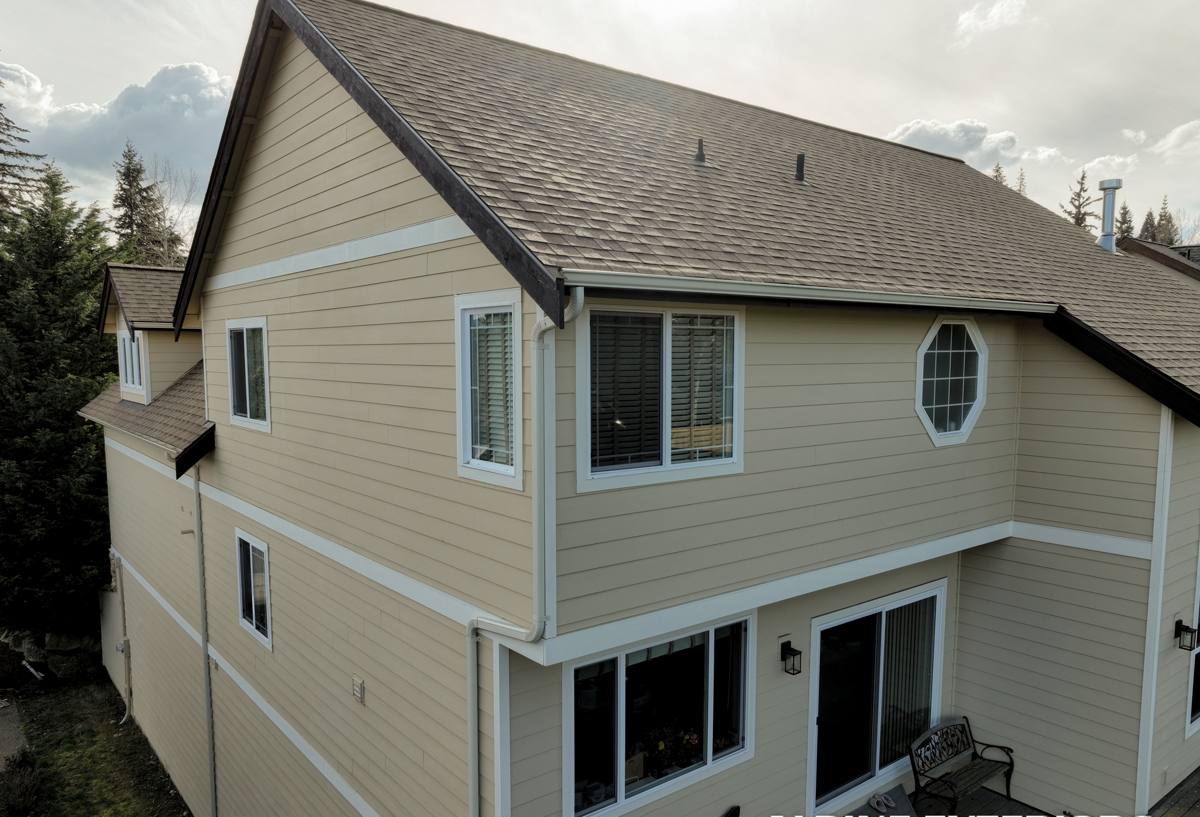
What Everson Homes Actually Need From Their Siding
Moisture Management First
The single biggest factor in how long siding lasts in this area is how well it manages water — not just shedding rain off the face, but keeping moisture from getting trapped behind the cladding where it can rot sheathing or frame the wall for mold. That means a correctly installed weather-resistant barrier, properly lapped flashing at every window and door, and a drainage plane that lets any moisture that does get behind the siding find its way back out.
Moss and Algae Resistance
Whatcom County's moss season is long — shaded walls, north sides of homes, and anywhere gutters overflow are especially prone to green streaking and moss growth on siding that isn't factory-finished well. James Hardie's ColorPlus finish is baked on at the factory and holds up to this kind of biological growth far better than field-applied paint, which is one of the reasons it's the only product we put on homes in this region.
Wind and Impact Durability
Everson doesn't see the coastal wind loads Blaine does, but seasonal storms still move through the valley, and hail and wind-driven debris are a real consideration. Fiber cement's density gives it a durability advantage over lighter-weight cladding options that can crack, dent, or blow off in a hard gust.
Why We Only Install James Hardie Siding
We've made a deliberate decision to install James Hardie fiber cement siding and nothing else — not vinyl, not LP SmartSide, not primed wood, not other fiber cement brands. That's not a marketing angle; it's a standard we hold because of how this climate treats siding over a 10, 20, and 30-year timeline.
- Non-combustible: Fiber cement doesn't feed a fire the way wood-based products can, which matters as wildfire smoke and dry summer stretches become more common even in western Washington.
- Factory-cured finish: ColorPlus finish is baked on under controlled conditions, so it resists the fading, chalking, and moss staining that field-painted siding shows first in shaded, damp spots.
- Climate-engineered product lines: Hardie's HZ10 formulation is built specifically for climates with prolonged moisture exposure and freeze-thaw cycling, which describes Whatcom County's winter and spring.
- Warranty strength: Hardie backs its products with a long, transferable warranty on the substrate and the ColorPlus finish — a real asset if a homeowner sells within the ownership window.
- Proven longevity when installed to spec: Fiber cement doesn't rot, and it holds paint and factory finish far longer than wood-based alternatives, but only when flashing, clearances, and fastening are done correctly.
We won't install products that require homeowners to accept more maintenance, more moisture risk, or more installation sensitivity than we think is fair to ask of them — that's the honest reason we standardized on one manufacturer instead of offering a menu of options.
What a Correct Siding Installation Involves
The siding itself is only part of the job. What separates a siding installation that lasts from one that fails early is almost entirely in the details most homeowners never see once the project is done.
- Tear-off and inspection: Remove existing siding and inspect the sheathing underneath for rot, soft spots, or prior water damage that needs to be addressed before anything new goes up.
- Weather-resistant barrier: Install a code-compliant water-resistive barrier, lapped correctly from bottom to top so water sheds down and out, never into a seam.
- Flashing at every penetration: Windows, doors, hose bibs, vents, and light fixtures all need properly integrated flashing — this is the single most common place we find shortcuts on older installs.
- Proper fastening: Hardie specifies fastener type, spacing, and placement precisely; over-driven or improperly placed nails void warranty coverage and create entry points for water.
- Correct clearances: Siding needs a gap from the ground, roofline, deck, and any other hardscape — skipping this is one of the fastest ways to cause rot at the bottom course.
- Caulking and sealant discipline: Sealant belongs at specific joints, not everywhere — over-caulking can trap moisture just as easily as under-caulking lets it in.
- Finish and trim detailing: Corner boards, trim, and transitions get finished so water is directed away from seams rather than pooling at them.
Our Process for Everson Projects
| Step | What Happens | Why It Matters |
|---|---|---|
| On-site assessment | We walk the property, check existing siding condition, note sun/shade exposure and drainage patterns | Every wall gets detailed differently based on how it's exposed to weather |
| Written estimate | Clear scope, product line, color, and cost breakdown before any work starts | No surprises mid-project |
| Tear-off and sheathing check | Old siding removed, sheathing inspected and repaired as needed | Catches hidden rot before it's covered up again |
| Barrier and flashing install | Weather-resistive barrier and flashing installed per manufacturer and code spec | This is where most long-term failures actually originate |
| Hardie siding install | Panels or lap siding installed with correct fasteners, gaps, and clearances | Protects the warranty and the wall assembly |
| Final walkthrough | We review the finished work with the homeowner before calling the job done | Confirms the job matches what was scoped and estimated |
What to Check Before You Hire Anyone for Siding Work
- Do they install one manufacturer's system consistently, or switch products based on what's cheapest that month?
- Will they show you the flashing and barrier details, not just the finished exterior?
- Do they carry current liability insurance and, if applicable, workers' comp coverage?
- Can they explain why they chose a specific Hardie product line for your wall exposure?
- Do they provide a written estimate with product, color, and scope spelled out?
- Are they familiar with Whatcom County permitting and code requirements for exterior work?
Why Local Experience in Everson Matters
A crew that regularly works Whatcom County homes already knows how moss behaves on shaded walls in this valley, how much rain a typical fall and winter will throw at a house, and where older Everson homes tend to have sheathing issues from decades of moisture exposure. That's not something a crew coming from outside the region picks up on a single job — it comes from doing this work repeatedly in this specific climate. It also means we're not guessing at product selection; we know which Hardie line and profile holds up best on the wall orientations common in this area.
Being local also means we're accountable after the job is done. If a question comes up two years down the line about a seam or a paint line, we're not a company that did one job in the area and moved on — we're here, working on the same streets, season after season.
Cost Factors for Everson Siding Projects
Every home is different, but the factors that drive cost are consistent. Rather than quote a number that won't hold up house to house, here's what actually moves the price:
| Factor | Why It Affects Cost |
|---|---|
| Home size and wall complexity | More square footage and more corners, dormers, and trim details mean more labor and material |
| Existing siding removal | Tear-off of old siding, especially if it's layered or damaged, adds time |
| Sheathing repair needs | Rot discovered during tear-off has to be repaired before new siding goes on |
| Product line and profile | HardiePlank, HardiePanel, and shingle-style profiles carry different material costs |
| Trim and accessory work | Corner boards, fascia, and soffit work done alongside siding adds scope |
| Access and site conditions | Steep lots, mature landscaping, or tight access can slow installation |
The only way to get a real number is a walkthrough of your specific home — anything else is a guess.
Ready to Talk About Your Home?
If your Everson home's siding is showing moss staining, soft spots, peeling paint, or you're just planning ahead for a replacement, we're happy to come take a look and give you a straight answer about what your home needs. There's no pressure and no obligation — just a clear assessment and a written estimate you can think over. Fill out the form below to schedule a free estimate.