 Blaine Siding
 Everson's Climate and What It Does to Siding
Everson sits inland along the Nooksack River valley, but "inland" in Whatcom County doesn't mean dry. The same marine air mass that brings salt-laden gusts and driving rain off the Salish Sea pushes east through the valley, and the river bottom traps humidity that coastal neighborhoods don't have to deal with. The result is a long, wet siding season that starts in October and doesn't really let go until June, plus heavy tree cover and low winter sun angles that keep north and west walls damp for days after a storm passes.
That combination is exactly what wears out the wrong siding material. Wood-based products swell, check, and take on moisture from the back side where you can't see it happening. Paint film fails faster on a substrate that's constantly cycling wet-to-dry. And moss doesn't need much encouragement here — a shaded wall, a little organic debris in a gap, and a few weeks of drizzle is all it takes to get a foothold. Any siding job in Everson has to be evaluated against that reality, not against a showroom photo taken somewhere dry.
Why We Only Install Fiber Cement Here
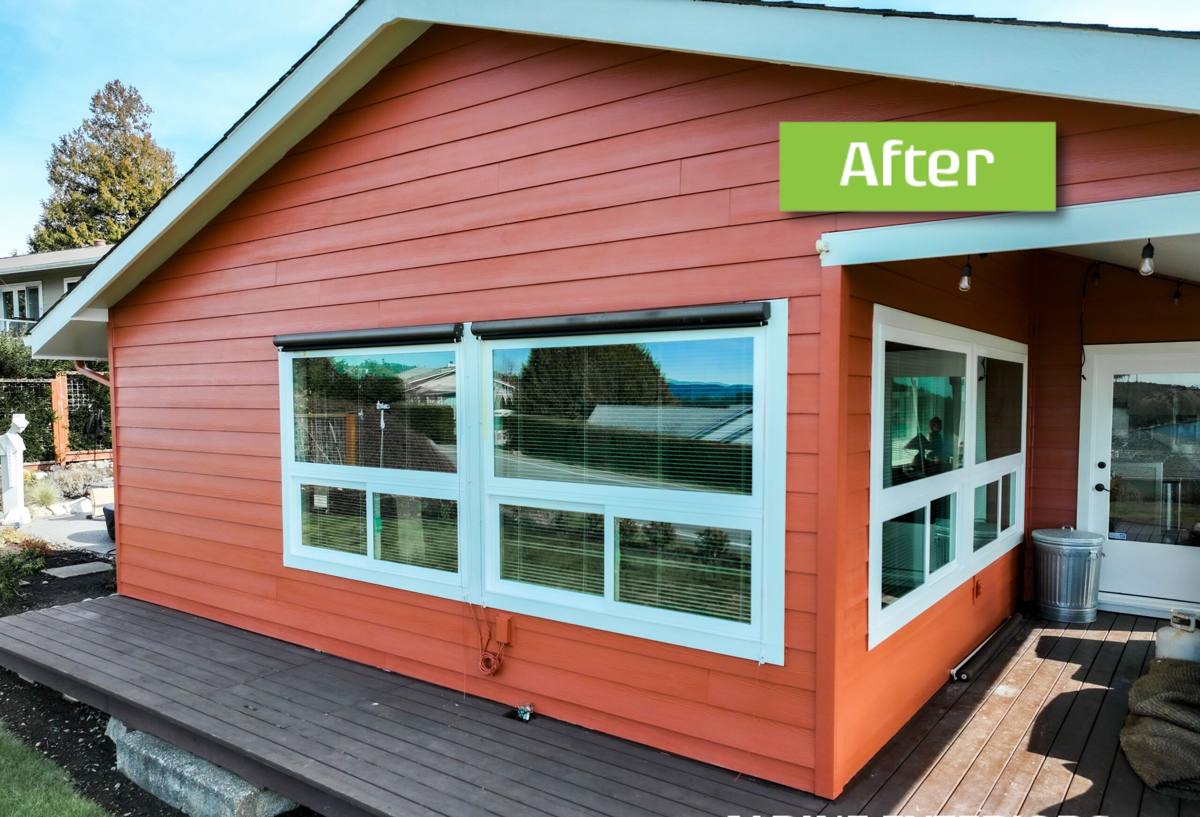
We install James Hardie fiber cement siding exclusively — no vinyl, no LP SmartSide, no primed wood, no cedar. That's not a marketing position, it's a standard we hold because of what we see coming off Whatcom County walls during tear-offs. Vinyl flexes and gaps at its seams, which lets driving rain track behind the panels; wood-based and OSB-core products depend entirely on an intact paint film and can swell at cut edges the moment that film is compromised. Fiber cement is a cement-and-cellulose composite that doesn't rot, doesn't feed moss the way wood fiber can, and doesn't warp when it takes on ambient moisture the way engineered wood panels do.
We're not going to tell you those other products can't be installed correctly by someone — they can, under the right conditions, with disciplined maintenance. We just don't think Everson's climate is the right conditions, and we'd rather stand behind one material we trust completely than offer four options and hope the homeowner picks the durable one.
What Homeowners Give Up With Cheaper Alternatives
- Vinyl: lower upfront cost, but seams and butt joints open small gaps for wind-driven rain, and it can crack in a hard freeze or warp near heat sources
- LP SmartSide and other engineered wood: needs an intact factory or field-applied finish at all times, especially at cut edges, or moisture wicks into the wood strand core
- Cedar and primed spruce: beautiful when new, but requires an ongoing repaint/reseal schedule that most owners underestimate, and it's the material most vulnerable to moss and rot in a shaded, damp wall
What a Correct Fiber Cement Install Actually Involves
Fiber cement siding fails early almost exclusively because of installation mistakes, not material defects. The board itself is rated for decades of service; the water-management details around it are what separate a 30-year wall from one that has rot at year eight. On an Everson job, we pay particular attention to:
Water Management Behind the Cladding
A weather-resistive barrier goes on the sheathing first, lapped correctly top-over-bottom, with all penetrations flashed and taped before a single board goes up. Every window and door gets head flashing and properly integrated pan flashing at the sill — this is the single most common gap we find when we're re-siding a home that failed early.
Gaps, Fasteners, and Clearances
James Hardie's install spec calls for specific clearances above rooflines, decks, and grade, and specific gaps at butt joints and trim to allow for expansion without trapping water. We fasten per the manufacturer's schedule, at the correct depth, into framing — overdriven or underdriven nails are one of the fastest ways to compromise a fiber cement wall, because they crack the board face or leave it loose enough to work moisture in over time.
Caulking and Sealant Discipline
Fiber cement needs sealant at specific joints, not everywhere. Over-caulking traps moisture just as badly as under-caulking lets it in. We follow the manufacturer's joint treatment guide rather than a generic "seal it all" approach.
James Hardie Product Lines for This Climate
Everson falls in the HZ5 climate zone that Hardie engineers its products around — the formulation and finish are built for a Pacific Northwest wet cycle, not adapted from a product line designed for the Southwest or Southeast. We typically spec:
| Product | Best Use | Why It Fits Everson |
|---|---|---|
| HardiePlank Lap Siding | Primary wall cladding | Most common profile locally; handles the valley's wet-dry cycling with a factory finish that doesn't rely on field-applied paint for protection |
| HardiePanel Vertical Siding | Accent walls, gables, shop/outbuilding exteriors | Common on Whatcom County outbuildings and modern-style gables; sheds water fast on steep sections |
| HardieTrim Boards | Corners, window and door trim, fascia | Won't absorb water at cut ends the way wood trim does if it's not resealed promptly |
| ColorPlus Factory Finish | All exposed faces | Baked-on, multi-coat finish backed by its own warranty — holds color and resists moss staining far longer than a field-applied paint job |
Our Process for an Everson Siding Job
The steps are the same whether it's a single wall repair or a full re-side, but the level of detail at each one is what determines how the job ages.
- On-site assessment: We look at the existing siding, sheathing condition where accessible, moisture readings at suspect areas, and drainage around the foundation before quoting anything.
- Written estimate: Scope, product lines, color, and a clear breakdown — no vague allowances.
- Tear-off and inspection: Removing old siding exposes the sheathing and framing. If we find rot or compromised WRB, we flag it before closing the wall back up rather than siding over a problem.
- Weather barrier and flashing: Correct lap, taped seams, flashed penetrations — done before any Hardie product touches the wall.
- Installation to manufacturer spec: Proper clearances, fastener schedule, and joint treatment as outlined above.
- Trim, caulking, and final detailing: Only at the joints that call for it.
- Walkthrough: We go over the finished work with the homeowner before calling the job done.
Cost Factors on an Everson Project
Every quote is specific to the house, but the variables that move the number are consistent enough to explain up front.
| Factor | Why It Matters |
|---|---|
| Wall complexity | Gables, dormers, and cut-up elevations take more labor and trim work than a simple rectangular wall |
| Existing wall condition | Rotted sheathing or framing found at tear-off adds repair scope beyond the siding itself |
| Product line and profile | Lap width, panel vs. plank, and trim detailing all affect material cost |
| Access and staging | Two-story sections, tight lot lines, or landscaping obstructions affect labor time |
| Color and finish | Standard ColorPlus colors vs. custom field-painted finishes price differently |
We'd rather walk a homeowner through these variables in person than throw out a number that doesn't hold up once we're on the roof or pulling the first boards.
Maintenance Once It's Installed
Fiber cement isn't zero-maintenance, but the maintenance burden in Everson's climate is dramatically lower than wood-based alternatives. A rinse-down once or twice a year knocks back the organic buildup that feeds moss before it gets a grip, especially on shaded north walls near trees. Keep an eye on caulked joints for cracking over the years, and address any impact damage promptly so the cut edge doesn't sit exposed through a wet winter. That's essentially the whole list — there's no repaint cycle to plan around the way there is with cedar or field-finished trim.
- Rinse siding annually, more often on shaded or tree-covered walls prone to moss
- Inspect caulked joints each fall before the wet season sets in
- Trim back vegetation and tree limbs that keep a wall shaded and damp
- Address any chips or impact damage at the cut edge before winter
- Check gutters and downspouts direct water away from the wall, not down it
Why a Crew That Already Works in Everson Matters
A siding crew that works regularly across Whatcom County knows what this valley does to a wall before the first board comes off. We know which elevations in this climate need extra attention to flashing, how the Nooksack valley's humidity behaves differently than the coastal towns closer to Blaine, and what tear-offs on homes of this vintage tend to reveal once the old siding comes down. That's not something a crew passing through the area for a one-off job picks up on the first try — it comes from doing this work here, repeatedly, and seeing how the last job held up two or five winters later.
It also means we're accountable locally. If a question comes up after the install, we're not driving in from three counties away.
Questions to Ask Before You Hire
Whether you call us or someone else, these are worth asking any contractor bidding a fiber cement job in this climate:
- Are you certified to install James Hardie products, and do you follow their published fastening and clearance specs?
- What's your plan for flashing at windows, doors, and other penetrations before siding goes on?
- How do you handle sheathing or framing issues discovered at tear-off?
- What warranty applies to the material, the factory finish, and your labor separately?
- Can you walk me through why you'd use a specific Hardie product line on my walls versus another?
If you're weighing a siding project on an Everson home, we're happy to come take a look, walk the walls with you, and put together a straightforward estimate — no pressure, no sales script, just what the house actually needs.