 Blaine Siding
 Semiahmoo sits about as close to the water as a Whatcom County property can get, and that proximity shapes almost every decision that goes into a window project here. Salt-laden air off the bay, wind-driven rain that comes in sideways during winter storms, and the long gray stretch of moss season put more stress on window units in this pocket of Blaine than in most inland neighborhoods. A window that performs fine in a sheltered subdivision ten miles east can fail early here if it wasn't chosen and installed with this exposure in mind. This page covers what custom windows actually need to hold up in Semiahmoo, what a correct installation looks like, and how we handle the job from first visit to final walkthrough.
Why Semiahmoo Is a Different Window Job Than "Anywhere in Blaine"
Whatcom County covers a lot of microclimates, from drier inland valleys to exposed shoreline. Semiahmoo's waterfront and near-waterfront lots get more direct wind loading and salt exposure than homes set back from the coastline. That combination accelerates a few specific failure points: corrosion on lower-grade hardware, seal breakdown on units not rated for coastal moisture cycling, and wood rot around openings where flashing was an afterthought rather than a system.
None of this means Semiahmoo needs exotic materials. It means the ordinary decisions — cladding type, hardware finish, sealant choice, flashing detail — carry more weight than they would in a less exposed setting. A window package that's "good enough" for a sheltered lot inland is often the wrong spec for a home a few blocks from the water.
What the Salt Air Actually Does
Airborne salt accelerates corrosion on unprotected metal — screws, hinges, balance hardware, and lesser-grade aluminum components. Over years, that corrosion is what causes a window to start sticking, a lock to stop aligning, or a screen frame to pit and discolor well before the glass unit itself has any trouble. Choosing hardware and cladding rated for coastal or marine-adjacent exposure isn't an upsell here — it's the difference between windows that operate smoothly at year fifteen and ones that start fighting you at year six.
What Driving Rain Does
Wind-driven rain doesn't just test a window's seal — it tests the entire opening: the flashing behind the trim, the sill pan underneath, and the sealant joints around the frame. Water that gets past a poorly detailed opening doesn't always show up right away. It tracks behind siding and sheathing and shows up later as soft trim, stained drywall, or a musty smell nowhere near the window itself.
What Moss Season Adds
Western Washington's extended damp season keeps exterior wood and low-grade composite trim wet for long stretches, which is exactly the environment moss and mildew need to establish. Window trim and sills that stay damp because of poor drainage detailing become long-term moisture traps, feeding rot from the outside in even when the window unit itself is performing fine.
What a Correct Custom Window Job Involves in This Area
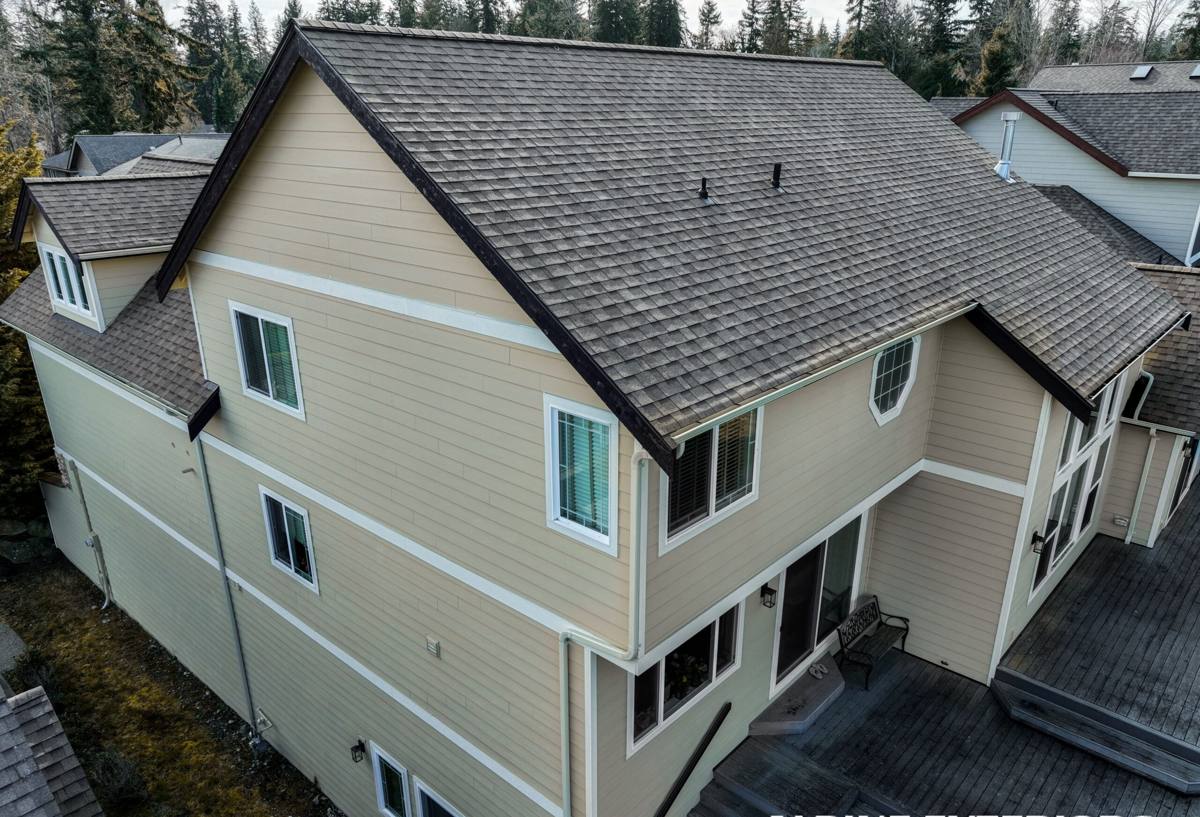
"Custom" doesn't just mean non-standard sizing. In Semiahmoo it means the whole opening is treated as a system — glass unit, frame, flashing, sealant, and trim all matched to the exposure that specific wall faces. A window on the water side of a house does more work than one on a sheltered interior wall, and the spec should reflect that.
- Accurate as-built measurements — older Blaine-area homes are rarely perfectly square, and a custom unit has to be built to the actual opening, not the nominal one
- Frame material and cladding chosen for the wall's specific sun and weather exposure, not a one-size spec across the whole house
- Corrosion-resistant hardware on any elevation facing the water or prevailing weather
- A proper sill pan and drainage path so any water that does get past the primary seal has somewhere to go besides the wall cavity
- Continuous flashing integration with the existing siding or house wrap — not just caulk bridging a gap
- Sealant rated for exterior UV and moisture cycling, applied at the right joints, not everywhere as a catch-all
Frame Materials: Trade-Offs, Not Winners
There's no single "right" frame material for every home in Semiahmoo — the right call depends on the home's exposure, existing trim, and how much upkeep the owner wants to take on. Here's how the common options actually compare in this climate, honestly:
| Material | Coastal/Salt Air Behavior | Maintenance | Notes |
|---|---|---|---|
| Vinyl | Good — won't corrode, handles moisture cycling well | Low | Budget-friendly; limited custom color range on some lines |
| Fiberglass | Excellent — very stable in temperature and moisture swings | Low | Higher upfront cost; holds paint and custom finishes well |
| Aluminum-clad wood | Good exterior protection if cladding and seams are done right | Moderate | Interior wood look; cladding seams need careful detailing near salt air |
| Bare wood | Weakest without diligent upkeep — most exposed to rot and moss | High | We'll install it if that's the owner's call, but we're upfront about the maintenance burden this close to the water |
Our Process for a Semiahmoo Custom Window Project
- On-site assessment. We look at each opening individually — sun exposure, wind exposure, current flashing condition, and any existing moisture or rot signs — rather than quoting off a generic package.
- Measurement and spec. Every custom unit is measured to the actual opening. We spec frame material, glass package, and hardware per elevation based on what that wall actually faces.
- Removal and opening inspection. Old units come out carefully so we can inspect the sheathing and framing underneath before anything new goes in. Hidden rot gets addressed at this stage, not discovered later.
- Flashing and sill pan installation. This is the step that determines whether the window stays dry for the next twenty years. We integrate flashing with the existing water-resistive barrier rather than relying on sealant alone.
- Window installation and leveling. Units are set, shimmed, and fastened to spec, with insulation around the frame to control both drafts and condensation.
- Exterior trim and sealant. Final trim work and sealant application at the correct joints — not a bead everywhere, which can actually trap water instead of shedding it.
- Walkthrough. We test operation, locks, and screens with the homeowner before calling the job done.
Cost Factors Specific to This Job
We don't post blanket window pricing because the real cost drivers vary a lot house to house. For Semiahmoo specifically, the factors that move the number most are:
| Factor | Why It Matters Here |
|---|---|
| Number and size of openings | Larger view windows toward the water cost more in glass and structural framing than standard-size units |
| Frame material | Fiberglass and clad-wood run higher upfront than vinyl but reduce long-term maintenance in salt air |
| Condition behind the old window | Rot or failed flashing found during removal adds repair scope before the new unit goes in |
| Exposure per elevation | Water-facing walls may warrant upgraded hardware or glass packages compared to sheltered walls |
| Trim and siding match | Matching existing exterior trim profiles can add labor versus a simple swap |
Why It Matters That We Already Work This Area
A crew that installs windows across a wide mix of inland and coastal jobs learns fast which details actually matter on the water side of Blaine. We've seen how quickly under-specified hardware corrodes here, how fast a bad flashing detail turns into a rot problem in this rainfall pattern, and which sealant and trim choices actually hold up through a full Whatcom County winter rather than just looking good on installation day. That's not something you get from a general product catalog — it comes from doing the work in this specific exposure repeatedly.
Signs Your Current Windows Are Losing the Fight
- Hardware that's visibly pitted, discolored, or stiff to operate
- Condensation forming between panes, which means the seal has failed
- Drafts you can feel even with the window fully latched
- Soft or discolored trim around the frame, especially at the sill
- Moss or persistent green staining building up on the sill or lower trim
- Difficulty locking or aligning the sash, which often points to frame movement or corroded hardware
What We Won't Do
We won't spec bare wood frames on a fully exposed water-facing wall without a clear conversation about the maintenance commitment that comes with it, and we won't caulk over a flashing problem instead of fixing it — sealant is a supplement to proper flashing, not a substitute for it. Our standard is to install what will actually perform for this specific opening and exposure, even when that means recommending a step up in material or a bit more labor at the flashing stage. It's a more honest way to work, and it's cheaper for the homeowner over the life of the window than redoing a rushed job in five years.
If you're weighing a window project for a Semiahmoo property, we're happy to take a look and walk the exposure with you before recommending anything. Use the form below to request a free, no-pressure estimate.