 Blaine Siding
 Why Board & Batten Needs to Be Built for Cherry Point's Weather
Cherry Point sits out on the water side of Whatcom County, close enough to the Strait of Georgia that homes here take weather most inland neighborhoods never see. Salt-laden air off the water works on fasteners, caulk joints, and paint film year-round. Driving rain comes in sideways during winter storms, testing every seam and lap in a home's exterior. And the long, damp shoulder seasons that stretch from fall through spring give moss and algae months to take hold on anything that stays wet longer than it should. Board and batten siding, with its vertical boards and raised battens, has more seams and more edge detail than flat lap siding — which means more places for that weather to find a weak point if the job isn't built right the first time.
None of this makes board and batten a bad choice for a Cherry Point home. It's a classic look that suits the area's mix of rural acreage, waterfront lots, and newer builds looking for a farmhouse or modern-vertical exterior. But it does mean the material, the water management behind it, and the installation details matter more here than they would on a home twenty miles inland. This page walks through what that actually looks like.
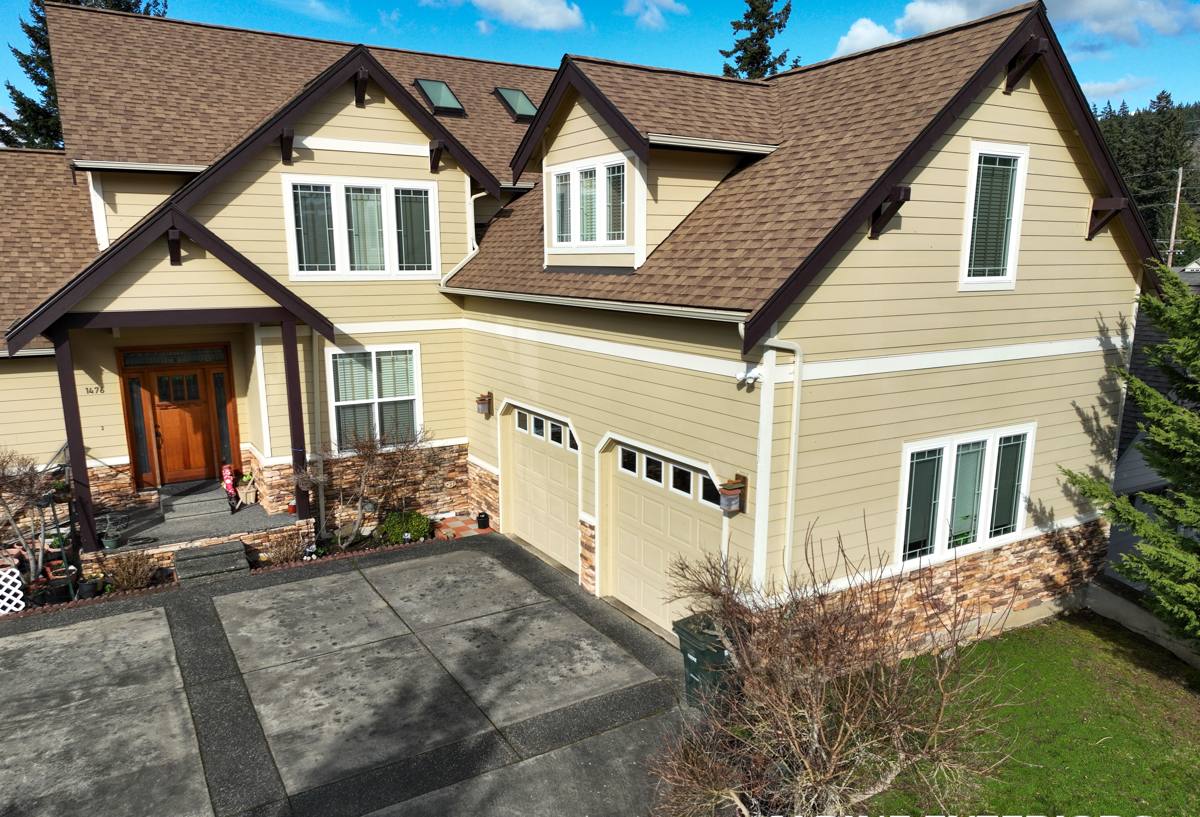
What Board & Batten Siding Actually Is
Two Parts, One Vertical Look
Board and batten is built from two components: wide flat panels or boards run vertically up the wall, and narrower strips — the battens — installed over the seams between them. The battens do double duty. They cover the joint where two panels meet, and they give the wall its signature rhythm of raised vertical lines. Done well, it's a clean, high-contrast look that reads as more custom than standard horizontal lap siding.
Why Homeowners Choose It
Most homeowners pick board and batten for the look — it pairs well with modern farmhouse, craftsman, and contemporary designs, and it's often used as an accent on gables, entries, or dormers even on homes that are lap siding everywhere else. It can also be a full-home siding choice. Either way, the seams between boards are the part that has to be engineered correctly, because that's where water either sheds away from the wall or finds its way behind it.
The Only Board & Batten System We Install: James Hardie
We install James Hardie fiber cement exclusively — no vinyl, no engineered wood, no primed spruce or cedar. For board and batten specifically, that means Hardie vertical panel siding paired with Hardie trim boards for the battens, finished in the factory-applied ColorPlus finish rather than field-painted after installation.
The reason we've standardized on this one system comes down to how board and batten actually behaves in weather like Cherry Point's. Fiber cement doesn't absorb water the way wood-based products can, so it doesn't swell, cup, or rot at the seams the way primed wood battens eventually will. It won't support the growth of moss and mildew the way a porous or moisture-retentive surface can. And because the color coat is baked on at the factory rather than brushed on at the jobsite, the finish holds up to UV and salt exposure without the peeling and touch-up cycle that field-painted wood trim goes through. We won't install a board and batten job with a wood-composite or vinyl vertical panel system, because we've seen what those products are asked to do in this specific climate, and it isn't worth the callback in five years.
What a Correct Board & Batten Installation Involves
Weather-Resistive Barrier and Flashing Come First
Before a single board goes up, the wall needs a properly lapped weather-resistive barrier (WRB) and flashing at every penetration, window, door, and horizontal transition. Board and batten has more vertical seams than lap siding, and every one of those seams needs to shed water down and out — not let it track sideways or sit against the sheathing. On a Cherry Point property exposed to wind-driven rain, this layer is doing more of the real work than the siding itself.
Rain Screen Gap
A rain screen — a small ventilated air gap between the WRB and the back of the siding — lets any moisture that does get past the outer layer drain and dry out instead of sitting against the wall assembly. This detail matters everywhere, but it matters more on a home taking direct exposure off the water, where wind-driven moisture is a regular event rather than an occasional one.
Fastening, Gaps, and Batten Spacing
Board and batten panels need to be fastened per the manufacturer's specified pattern, with proper edge distance and expansion gaps at every joint — fiber cement moves slightly with temperature and moisture, and a joint installed too tight will eventually show stress. Battens are then set to cover the panel seams with consistent reveal and spacing, fastened into framing, not just into the panel below. Fastener choice matters too: in a salt-air environment, the wrong fastener corrodes and eventually bleeds rust streaks down the face of the siding — a cosmetic failure that's entirely avoidable with the right hardware.
Caulking and Sealant Placement
Sealant belongs at specific transitions — around penetrations, at trim-to-panel joints where the manufacturer calls for it — not smeared across every seam as a substitute for correct flashing. Over-reliance on caulk is a common shortcut, and it fails faster in a climate with this much rain and UV cycling than the flashing details it's meant to replace.
Where Board & Batten Installations Fail in a Climate Like This
Most of the board and batten problems we get called out to inspect trace back to a handful of repeatable causes, and they show up faster here than they would in a drier part of the state:
- Missing or shortcut rain screen gap, leaving moisture trapped behind the panel with nowhere to dry out
- Battens face-nailed with no allowance for movement, cracking the panel or splitting the batten over a few seasons
- Wrong or under-spec fasteners that corrode in salt air and stain the face of the siding
- Caulk used to cover a flashing mistake instead of fixing the water path, which fails once the caulk ages and shrinks
- North- and shade-facing walls left without attention to airflow, giving moss and algae a head start during the long wet season
- Field-painted wood or composite trim that starts showing paint failure at the seams within a few years of salt and UV exposure
Board & Batten Materials Compared
Homeowners in Cherry Point often ask what the real difference is between board and batten material options once you get past appearance. Here's how the common choices hold up against the specific stresses of a salt-air, high-rain climate:
| Material | Moisture Behavior | Salt Air Durability | Maintenance | Typical Lifespan |
|---|---|---|---|---|
| James Hardie fiber cement | Does not absorb/swell; engineered for moisture exposure | Factory finish resists salt-driven fade and chalking | Occasional wash; no repainting cycle | Multi-decade with correct install |
| Primed wood or spruce battens/boards | Absorbs water at seams and end grain; prone to swelling | Salt accelerates paint and grain breakdown | Regular repainting and caulk maintenance | Shorter, install- and maintenance-dependent |
| Vinyl vertical panel | Doesn't absorb water but seams can allow bulk water behind panel | Can become brittle with UV/salt cycling over time | Low, but limited repair options if damaged | Variable; appearance degrades with age |
| Engineered wood composite | Better than raw wood but still moisture-sensitive at cut edges | Edge and seam treatment critical in wet climates | Moderate; edge sealing must be maintained | Warranty-dependent, moisture-sensitive |
This is why we don't offer board and batten in every material on that list. We've chosen to install the one system that holds up to this specific set of conditions without asking the homeowner to maintain it into submission.
Our Process for a Cherry Point Board & Batten Project
- On-site assessment — we look at wall orientation, exposure to prevailing wind and rain, existing moisture damage, and shade/moss patterns specific to the property
- Tear-off vs. overlay decision — board and batten generally goes on over a proper WRB and furring, which usually means old siding comes off rather than being covered
- Water management layer — WRB, flashing at every opening and transition, and rain screen installed before any siding goes up
- Panel and batten installation — Hardie vertical panels and trim installed to manufacturer fastening spec, with correct gaps and corrosion-resistant fasteners
- Detail work — corners, window and door trim, and transitions finished to shed water, not just to look finished
- Final walkthrough — we go over the finished siding and the maintenance basics specific to the home's exposure before we consider the job done
Maintenance Checklist for Board & Batten in This Climate
A correctly installed Hardie board and batten system needs very little upkeep, but a little seasonal attention keeps it looking right through Cherry Point's wet stretch:
- Rinse salt residue and grime off the siding once or twice a year, more often on walls facing the water
- Check shaded and north-facing walls in late winter for early moss or algae growth and clean it before it spreads
- Look at caulked transitions (around windows, penetrations) annually for cracking or separation
- Keep gutters and downspouts clear so runoff isn't sheeting down the wall face during storms
- Trim back vegetation that keeps a wall section shaded and damp longer than the rest of the house
- Have any impact damage or loose trim looked at promptly — small issues are cheap to fix, water intrusion behind the panel isn't
Why Hiring a Crew That Already Works Cherry Point Matters
Cherry Point isn't a generic Whatcom County address — it's a specific exposure profile: water on one side, open rural land on others, and weather that comes off the Strait with little to slow it down. A crew that's already worked this stretch near Blaine knows which walls on a typical lot take the worst of the wind-driven rain, where moss shows up first, and how to sequence a board and batten install around the wetter months instead of fighting them. That's the difference between a crew reading a spec sheet and a crew that's watched how these details actually perform once a Cherry Point winter gets ahold of them.
If you're weighing board and batten for a home in Cherry Point or elsewhere around Blaine, we're happy to take a look at the property and walk through what it would actually take to do it right — no pressure, no obligation. Use the form below to request a free estimate.