 Blaine Siding
 Why Roofs Near Blaine Harbor Wear Differently
Blaine Harbor sits right where a home's roof takes the full brunt of what Whatcom County's coastline throws at it. Homes near the water deal with a combination most inland Blaine and Whatcom County properties don't see at the same intensity: salt-laden air off the harbor, wind-driven rain that comes in sideways instead of straight down, and long stretches of gray, damp weather that keep roof surfaces wet for days at a time. None of these factors alone is unusual for the Pacific Northwest. Together, and applied year after year to a roof that's a few hundred feet from saltwater, they shorten the useful life of a roofing system that wasn't installed with that exposure in mind.
Salt Air and Corrosion
Salt in the air doesn't just affect boats and dock hardware. It settles on roofing metal — flashing, drip edge, exposed fasteners, vent caps — and accelerates corrosion compared to the same materials a few miles inland. A fastener or flashing detail that would last decades in a dry, inland neighborhood can start showing rust streaks or pinholing years earlier near the harbor. Once flashing corrodes, it stops shedding water properly, and that's how small leaks start at valleys, chimneys, and roof-to-wall transitions.
Driving Rain Off the Strait
Storms moving through this part of Whatcom County frequently bring rain at an angle, pushed by wind off the water. Driving rain finds weaknesses that vertical rain never would — lifted shingle tabs, marginal step flashing, nail heads that have backed out, or underlayment that was installed to a minimum standard rather than a durable one. A roof that's merely "watertight" in calm weather can still leak during a wind-driven storm if the underlying details weren't built for that kind of exposure.
A Long Moss Season
Blaine's wet season runs long, and roofs in shaded or north-facing spots near the harbor can stay damp for much of the year. That's exactly the environment moss and algae need to take hold. Moss doesn't just look bad — it holds moisture against the roofing material, works its way under shingle tabs as it grows, and can lift and crack aging shingles. A roof that's already moss-covered when we look at it is usually further along in its wear than the surface appearance alone would suggest.
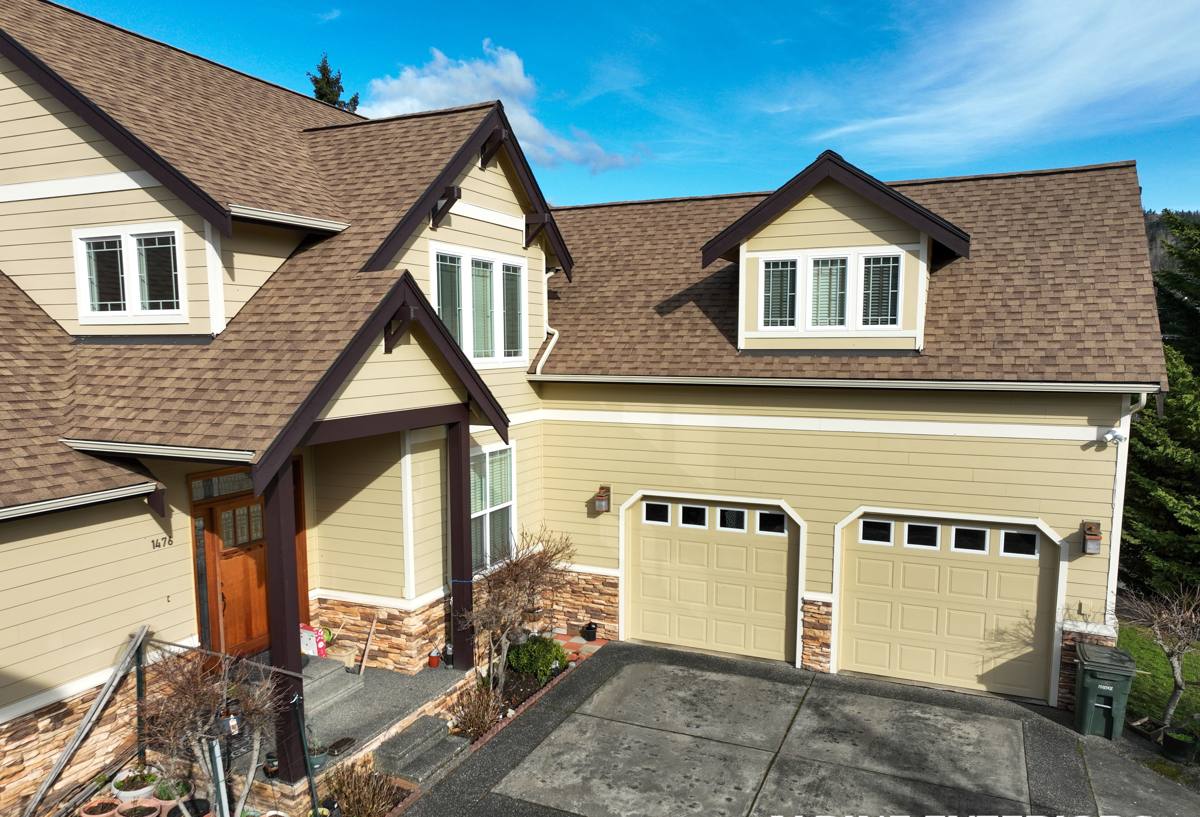
Signs a Blaine Harbor Roof Needs Replacement, Not Another Repair
Repair makes sense for isolated damage on an otherwise sound roof. Replacement becomes the right call once the roofing system as a whole has aged out or the damage is spread across multiple areas. Here's what we look for during an inspection:
- Shingles that are curling, cupping, or losing their granules in patches rather than just at one spot
- Moss or algae established across large sections, not just isolated patches along the north slope
- Flashing around chimneys, skylights, and valleys that's visibly corroded, loose, or was never properly stepped and counter-flashed
- Soft spots or sagging in the roof deck when walked, which usually means the sheathing underneath has taken on water
- Leaks that show up in more than one room, or that reappear after a patch repair
- A roof that's near or past the manufacturer's expected service life for its material and this climate
If a roof is showing two or three of these at once, patching one spot doesn't solve the underlying problem — it just delays a full tear-off while the deck keeps absorbing moisture underneath.
What a Correct Roof Replacement Involves
Tear-Off and Deck Inspection
We remove the old roofing down to the deck rather than layering new material over old. That's the only way to actually see the sheathing. Near the harbor, we pay close attention to soft or delaminated plywood, especially around old flashing points and eaves where water has had the most opportunity to sit. Any damaged decking gets replaced before anything new goes down — installing new roofing over a compromised deck just hides the problem for a while.
Underlayment and Flashing
This is where a lot of the difference between a roof that handles driving rain and one that doesn't gets decided. We use synthetic underlayment across the field and self-adhering ice-and-water membrane at the eaves, valleys, and around every penetration — chimneys, vent stacks, skylights. Flashing gets replaced as part of the job, not reused, and it's installed in the correct step-and-counter-flash sequence rather than caulked into place as a shortcut. Given the salt exposure this close to the water, we favor flashing and fastener materials chosen for corrosion resistance over the cheapest option that meets code.
Ventilation
A roof that can't breathe traps moisture in the attic, which shows up as premature sheathing rot, mildew, and — ironically — more moss growth on the underside of the deck. We check intake at the soffits and exhaust at the ridge or through roof vents, and correct the balance where the existing setup is undersized or blocked. Good ventilation also helps a roof shed the condensation that's common in this area's cool, humid winters.
Choosing a Roofing Material for Blaine Harbor's Climate
There's no single "best" roofing material for every home — the right choice depends on budget, the home's style, and how much long-term maintenance an owner wants to take on. Here's how the common options stack up for a harbor-adjacent property:
| Material | Salt Air Performance | Moss Resistance | Maintenance |
|---|---|---|---|
| Architectural asphalt shingle | Good, with corrosion-resistant flashing and fasteners | Better with algae-resistant (AR) shingles; still needs periodic cleaning in shaded areas | Low to moderate |
| Standing seam metal | Very good when properly coated and detailed; fasteners and trim need to be corrosion-rated | Sheds moss well due to smooth, steep-shedding surface | Low |
| Cedar shake / shingle | Requires diligent maintenance near saltwater; more moisture-sensitive | Prone to moss without regular treatment and airflow | Higher |
| Synthetic composite shake | Good; doesn't absorb moisture the way wood does | Better than cedar; still benefits from periodic cleaning in shaded spots | Low to moderate |
For most Blaine Harbor homes, we lean toward architectural asphalt with algae-resistant granules or standing seam metal, simply because both hold up to the salt-and-moisture combination with the least ongoing upkeep. Cedar can still be the right call for a homeowner who wants that look and is willing to stay on top of maintenance — we'll walk through the honest trade-offs for your specific roof rather than push one material across the board.
What Drives the Cost of a Roof Replacement Here
| Factor | Why It Matters |
|---|---|
| Roof size and pitch | More surface area and steeper pitches mean more material and more time on the roof |
| Number of layers to remove | Tearing off two layers of old roofing costs more than one, and reveals more of what's underneath |
| Deck condition | Rotted or soft sheathing found during tear-off has to be replaced before new roofing goes on |
| Material choice | Standard asphalt, algae-resistant asphalt, metal, and shake all carry different material costs |
| Roof complexity | Valleys, dormers, chimneys, and skylights each add flashing work and labor time |
| Access | Steep pitches or limited staging area around the home can add time for safety setup |
We give homeowners a broad range up front based on a visual assessment, then confirm the final number once the deck is exposed and we know exactly what's underneath. We don't pad estimates to cover surprises we haven't actually found — if the deck comes back clean, the price doesn't move.
Our Roof Replacement Process
- On-site inspection of the existing roof, attic ventilation, and flashing details, with photos and a plain explanation of what we find
- Written estimate covering material options, scope of work, and timeline
- Tear-off to the deck, with damaged sheathing identified and replaced
- Installation of ice-and-water membrane at eaves, valleys, and penetrations, followed by synthetic underlayment across the field
- New flashing installed at all chimneys, walls, and penetrations before the roofing material goes down
- Roofing material installed to manufacturer specification, with ventilation corrected as needed
- Full site cleanup, including a magnetic sweep for stray nails, and a final walkthrough
Why a Crew That Already Works Blaine Harbor Matters
A roofing crew that regularly works this stretch of Whatcom County already knows what to expect before the tear-off even starts. We know which details tend to fail first on harbor-facing homes, which fastener and flashing materials hold up against the salt exposure, and how local permitting works. That familiarity means fewer surprises mid-project and a roof that's built for the conditions it will actually face, not a generic install pulled from a manual written for a drier climate. It also means we're not far away if a question comes up after the job is done.
After the Install: Keeping a New Roof Performing in This Climate
A correctly installed roof still benefits from basic upkeep, especially this close to the water:
- Have gutters and downspouts cleared at least twice a year so water isn't backing up under the eaves
- Keep overhanging branches trimmed back to cut down on shade and debris that feed moss growth
- Rinse off moss or algae buildup gently as soon as it appears, rather than letting it establish
- Check attic ventilation isn't blocked by insulation or storage after any attic work
- Have the roof looked at after any major windstorm, especially one with heavy rain off the water
- Schedule a quick visual inspection every couple of years even if nothing looks wrong
None of this requires a big time investment, but skipping it is how a well-installed roof ends up with the same moss and flashing problems years earlier than it should.
If your roof near Blaine Harbor is showing its age, or you just want an honest read on how much life it has left, we're happy to take a look. The estimate is free, there's no pressure to move forward, and you'll get a straight answer about whether you're looking at a repair or a replacement — just fill out the form below.