 Blaine Siding
 Why Blaine Harbor Is a Different Kind of Siding Job
Blaine Harbor sits about as close to salt water and the Canadian border as a Whatcom County neighborhood gets. That waterfront position is the whole appeal of living here, and it's also why siding wears out faster than it does even a few miles inland. Homes near the harbor take on airborne salt, near-constant onshore moisture, and a long gray stretch from fall through spring when nothing on the exterior fully dries out. We've installed and repaired siding all along this stretch of coastline, and the failure patterns we see in Blaine Harbor are consistent: swollen panel edges, peeling paint, soft trim, and moss creeping up from the ground line on the north and west-facing walls that never see direct sun for weeks at a time.
This page is about one product, in one place: James Hardie fiber cement siding, installed correctly on Blaine Harbor homes. We don't sell vinyl, LP SmartSide, or wood siding here or anywhere else we work — we'll explain why briefly below, but the short version is that Hardie is the only siding system we've found that holds up to this specific combination of salt, rain, and moss without turning into a five-year maintenance project.
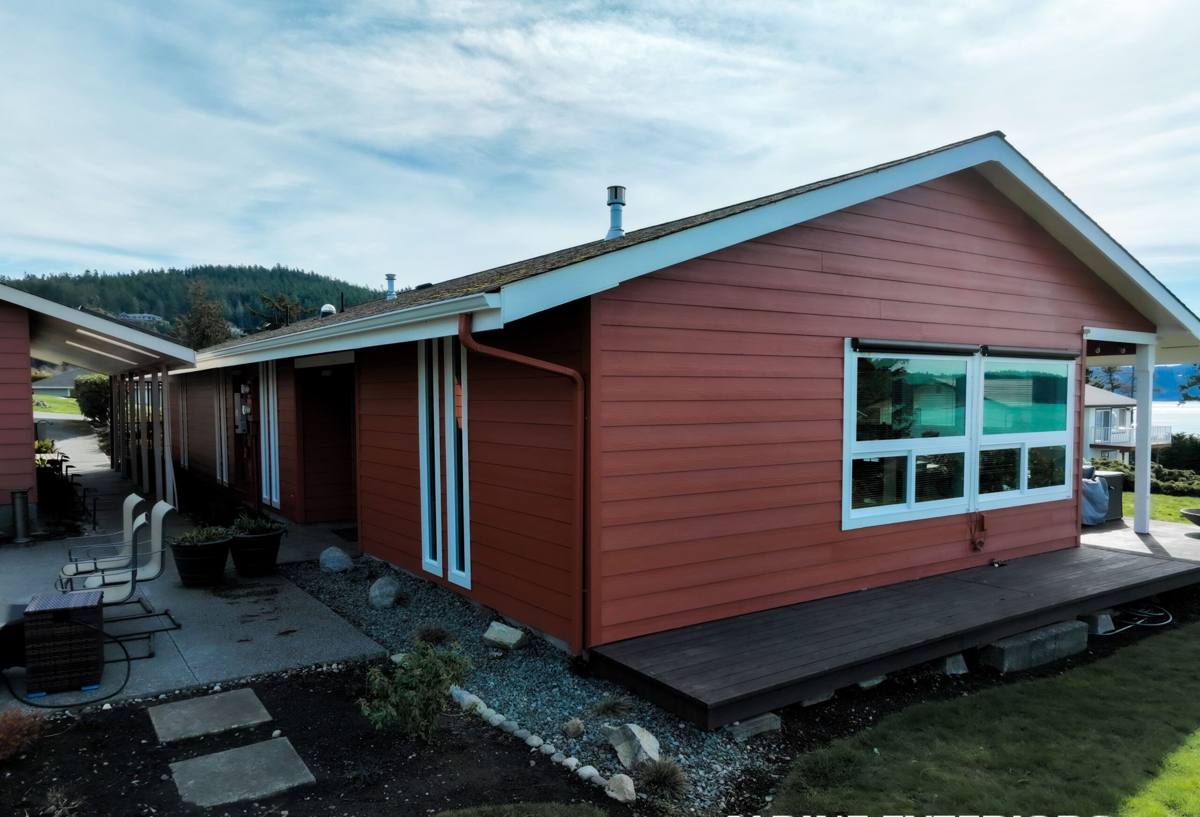
What Salt Air, Driving Rain, and Moss Actually Do to Siding
Salt Air
Salt is hygroscopic — it pulls moisture out of the air and holds it against whatever surface it lands on. On wood and engineered wood siding, that means the fibers stay damp longer than they would a few blocks from the water, which accelerates swelling, checking, and paint failure. On metal fasteners and trim accessories, salt air speeds corrosion, which is why fastener and flashing choice matters more here than on an inland job.
Driving Rain
Wind off Semiahmoo Bay and the Strait doesn't just fall on a house, it drives sideways into it. That pushes water into laps, seams, and butt joints that would stay dry in a calmer rain. A siding system with poor water management — or a lap installed with too little overlap or gap — will take on moisture at exactly those points, and once water gets behind the cladding, it doesn't leave quickly in this climate.
Long Moss Season
Blaine's wet season runs long, and shaded or north-facing walls near mature trees or close neighboring structures can stay damp for months. Moss and algae need three things to establish: moisture, shade, and a surface they can grip. Wood grain and rough-faced products give them plenty to hold onto. A dense, factory-finished fiber cement surface gives them far less.
Why We Standardize on James Hardie Here
James Hardie fiber cement is cement, sand, and cellulose fiber, engineered and factory-cured — it does not swell with humidity the way wood or wood-based products do, and it's non-combustible. For Blaine Harbor specifically, three things matter most:
- ColorPlus factory finish — baked-on coating that resists fading and holds up to UV and salt exposure far better than field-applied paint, which is the first thing to fail on wood siding near the water.
- HZ10 engineered product line — Hardie's HZ10 formulation is built for the Pacific Northwest's wet, moderate climate, with moisture and freeze-thaw performance suited to exactly this region.
- Dense, stable substrate — fiber cement doesn't provide the soft, absorbent surface that moss and algae need to colonize, which matters enormously on shaded harbor-side walls.
We don't install LP SmartSide, vinyl, Cemplank, Allura, or bare cedar. Each of those has a legitimate use somewhere, but none of them combine the moisture stability, fire rating, factory finish durability, and long transferable warranty that a waterfront Whatcom County home needs. We'd rather turn down a job than install something we know won't hold up on this street.
What a Correct Installation Looks Like on a Harbor-Facing Home
Hardie siding performs the way it's rated to perform only when it's installed to spec. In a salt-air, high-wind-driven-rain environment like Blaine Harbor, a few details matter more than they would on a typical inland job:
Water Management Behind the Cladding
A weather-resistive barrier and properly lapped flashing at every window, door, and penetration is non-negotiable here. Any water that does get past the siding face needs a clear path down and out, not a place to pool against sheathing.
Fastener Choice and Placement
We use corrosion-resistant fasteners rated for coastal exposure, driven per Hardie's specifications — not overdriven, not underdriven, and placed to allow the panel to expand and contract normally.
Gaps, Clearances, and Caulking
Correct gapping at butt joints and trim, proper clearance from grade, decks, and roof lines, and the right sealant in the right places — sealed where it should be sealed, left open where it needs to breathe. Getting this wrong is the single most common cause of moisture problems in fiber cement installs we're called out to fix.
Cut Edges Sealed
Factory-finished panels are protected on the face, but any field cut exposes raw fiber cement. Every cut edge gets sealed before installation — skipping this is a shortcut that shows up as edge swelling years later.
Our Process for Blaine Harbor Jobs
- On-site assessment — we walk the exterior, check current siding condition, look at moss and moisture patterns wall by wall, and note trouble spots like north-facing walls, low clearances, or areas near mature landscaping.
- Product and color selection — we help you choose the right Hardie panel profile (lap, shingle, or panel) and ColorPlus color, factoring in how the harbor's light and salt exposure will affect long-term appearance.
- Written scope and quote — a clear breakdown of what's included: tear-off, water-resistive barrier, flashing, siding, trim, and fastener specification.
- Installation — installed to Hardie's fastening, clearance, and sealing requirements, with attention to the wind and moisture details above.
- Final walkthrough — we go over the finished job together before we consider it done.
Cost Factors for Blaine Harbor Homes
Every home is different, but these are the main variables that move the price on a Hardie install near the water:
| Factor | Why It Matters Here |
|---|---|
| Existing siding removal | Older wood or vinyl siding on harbor-side homes often hides moisture damage that needs repair before new siding goes on |
| Sheathing and WRB condition | Salt-air moisture exposure over years can compromise the water-resistive barrier underneath, which needs to be sound before re-siding |
| Panel profile and trim complexity | Shingle-style or detailed trim takes more labor than straight lap siding |
| Wall exposure and height | Multi-story or harbor-facing walls exposed to direct wind-driven rain may call for extra flashing detail |
| Color and finish | ColorPlus factory finishes vary slightly in cost by line, but all outperform field-painted alternatives long term |
We give straightforward, written estimates — no inflated "coastal surcharge," just an honest accounting of what your specific home needs.
Maintenance: What Blaine Harbor Homeowners Actually Need to Do
One of the real advantages of Hardie with a ColorPlus finish is how little upkeep it needs compared to wood or field-painted siding — but "low maintenance" isn't "no maintenance," especially this close to the water.
- Rinse salt residue and grime off the siding once or twice a year, especially on walls facing the water
- Keep gutters clear so water isn't overflowing and running down the siding face
- Trim back vegetation and branches that shade walls and keep them damp longer than necessary
- Check caulking at trim and penetrations periodically and re-seal if it's cracked or pulling away
- Address any moss or algae growth early with a gentle wash rather than letting it establish
Why Hiring a Crew That Already Works This Neighborhood Matters
Blaine Harbor isn't a generic Whatcom County job site. A crew that hasn't worked this specific stretch of coastline can miss the details that matter here — under-flashing a window on a wall that takes direct wind-driven rain, using standard fasteners where corrosion-resistant ones are called for, or not accounting for how long a shaded wall stays wet before moss takes hold. We've worked James Hardie installs across this coastline long enough to know which walls need extra attention before we ever pull a tape measure, and we spec every job around that experience rather than a one-size-fits-all install.
If your siding is showing swelling, peeling, or persistent moss, or you're planning ahead for a full re-side, we're happy to take a look and give you a straightforward, no-pressure estimate — just fill out the form below.