 Blaine Siding
 Why Birch Bay Homes Wear Out Siding Faster
Birch Bay sits right on the Strait of Georgia, and that waterfront exposure changes how siding ages compared to homes a few miles inland. Properties here deal with the same wet Pacific Northwest winters as the rest of Whatcom County, but they add a layer most siding materials weren't built for: near-constant salt-laden air moving off the water, wind-driven rain that hits walls sideways instead of straight down, and a moss and algae season that can run most of the year on shaded or north-facing elevations.
None of that is exotic weather — it's just relentless. Salt air accelerates corrosion on fasteners and trim metal. Wind-driven rain finds every gap in flashing and caulking that a calmer inland climate would never test. Moss and algae hold moisture against a wall long after a storm has passed, keeping that surface damp days longer than it should be. Over years, that combination is what turns small, fixable problems into rot, delamination, or panel failure — usually starting at the joints, corners, and low edges closest to the ground or the water.
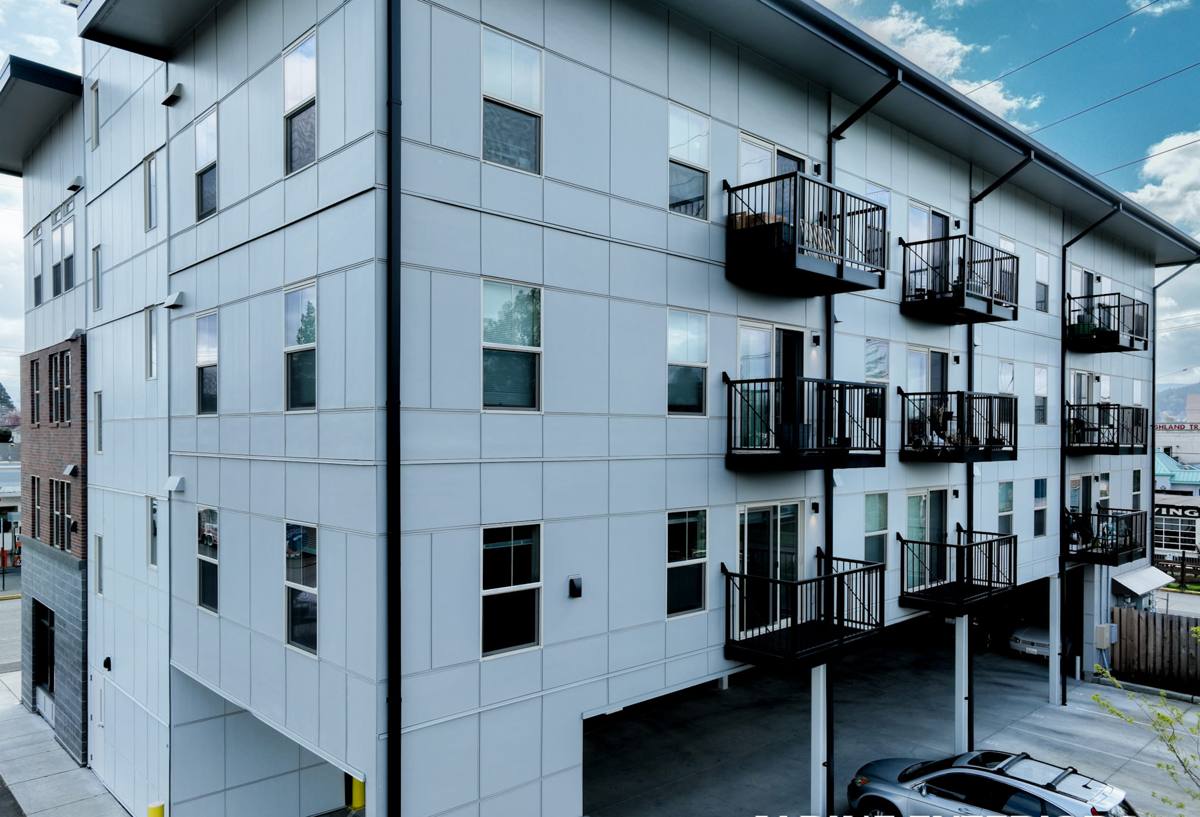
Where Siding Fails First on Birch Bay Homes
Not every wall takes the same beating. On most Birch Bay properties, damage shows up first in a predictable handful of spots, and knowing where to look before it becomes a visible problem is half the battle.
- Elevations that face directly into the water — they take the brunt of wind-driven rain and salt spray
- Lower courses close to grade, where splashback and standing moisture linger longest
- Around window and door openings, where flashing details are doing the most work
- Roof-to-wall transitions and anywhere a deck or porch ledger meets the siding
- Shaded, north-facing, or tree-covered walls where moss and algae get a head start each year
If your home has one or more of these conditions, it's worth a closer look at those specific areas rather than assuming the whole exterior is aging evenly — because it usually isn't.
Signs Your Siding Needs Repair Now, Not Later
Most siding failures in Birch Bay don't start as one big problem. They start small, in the same handful of spots, and they're worth checking a couple of times a year if your home is anywhere near the water.
- Soft, spongy, or bulging spots, especially near the bottom courses or below windows
- Cracked or missing caulking at trim, corners, and window and door edges
- Persistent moss or algae staining that doesn't wash off, particularly on north- and west-facing walls
- Nail heads popping or rust streaks bleeding down from fasteners or trim
- Gaps opening up at seams or where siding meets trim, flashing, or the foundation
- Paint or factory finish that's peeling, chalking, or has gone dull in patches rather than evenly across the wall
- Visible warping, cupping, or separation at panel edges
Any one of these on its own might be minor. Several together, or damage spread across more than one wall, usually means moisture has been getting behind the siding for a while — which is worth catching before it reaches the sheathing or framing underneath.
What a Correct Repair Actually Involves
A siding repair that holds up in Birch Bay's climate is not just swapping a damaged board for a new one and running a bead of caulk around it. Done right, it addresses why that section failed in the first place, not just the part you can see.
Diagnosing the cause, not just the damage
Before anything gets replaced, the damaged area needs to be opened up enough to see what's underneath. Is the water-resistive barrier torn or missing behind that spot? Is flashing at a window or roofline directing water into the wall instead of away from it? Is the sheathing still sound, or has sustained moisture started to soften it? Patching over an unresolved moisture path just means the same repair fails again in a season or two, and you end up paying for the same fix twice.
Matching materials and fastening correctly
Repairs need to be made with compatible material, fastened per the manufacturer's specifications — correct fastener type, spacing, and penetration depth — and finished with the right sealants at the right joints. In a coastal environment, corrosion-resistant fasteners aren't optional; standard fasteners are exactly the kind of detail that shows up as a rust streak bleeding down the wall two years later.
Flashing and drainage first, cosmetics second
Any repair near a window, door, roofline, or deck ledger has to re-establish proper flashing and a working drainage plane before the new siding goes on. That's the part of the job that doesn't show once it's finished — and it's the part that actually determines whether the repair lasts five years or fifteen.
Repair vs. Replace: How We Make the Call
Not every problem area needs a full re-side, and not every home is a good candidate for patch repairs. The right call usually comes down to how much of the exterior is affected, what's underneath the damage once it's opened up, and what's actually driving the failure.
| Factor | Points Toward Repair | Points Toward Replacement |
|---|---|---|
| Extent of damage | Isolated to one or two areas | Spread across multiple walls or elevations |
| Underlying sheathing | Sound once opened up | Soft, rotted, or water-stained |
| Age of existing siding | Mid-life, otherwise performing well | Near or past its expected service life |
| Cause of failure | A localized flashing or caulking failure | A systemic issue with drainage, install, or product |
| Material match | Compatible replacement material available | Discontinued profile, color, or product no longer made |
We'll always tell you honestly which side of that table your home falls on. A targeted repair is the right answer more often than people expect — but when the damage points to a systemic problem, we say so rather than patching something that's going to fail again in another storm season.
Why We Repair — and Rebuild — with James Hardie
When a repair calls for new siding material, whether that's a few boards or a full elevation, we use James Hardie fiber cement. That's not a brand preference we picked at random — it's the only siding system we install on any home in our service area, and Birch Bay's conditions are exactly why.
Fiber cement doesn't feed moss and algae the way some siding materials can, it's non-combustible, and Hardie's ColorPlus factory finish is baked on rather than field-applied — which matters in a spot where UV, salt air, and driving rain all work against a painted surface over time. Hardie also engineers specific product lines for different climate exposures, so a wall facing directly into the wind off the water can be specified differently than a more sheltered elevation on the same house. Hardie's warranty on the product and finish is also transferable, which matters if a Birch Bay property changes hands down the road.
We don't install LP SmartSide, vinyl, Cemplank, Allura, or primed wood siding — not because those products can't be installed correctly, but because after years of doing repair work up and down this coastline, Hardie is what we've consistently seen hold up best against salt air, wind-driven rain, and a moss season that barely takes a break. When we're matching in new material for a repair, that's the standard we hold it to.
Our Repair Process
The process is the same whether we're replacing three boards or reworking an entire wall — the scope changes, the steps don't.
- Inspection. We look at the full exterior, not just the spot you called about, since Birch Bay's exposure means damage often shows up in more than one place at once.
- Diagnosis. We open up the damaged area enough to identify the actual cause — flashing, barrier, fastening, or drainage — before quoting the fix.
- Written scope and estimate. You get a clear explanation of what's being repaired, why, and what it involves, before any work starts.
- Repair. Damaged material comes out, the underlying issue gets corrected, and new material goes in fastened and flashed to spec.
- Finish and check. Joints, caulking, and paint or factory finish are matched and cleaned up so the repair blends in rather than standing out.
What Happens When Repairs Get Put Off
In a drier climate, a small siding problem can sit for a season without much consequence. In Birch Bay, it usually can't. Wind-driven rain keeps testing the same weak point every storm, and once moisture gets behind the siding it doesn't dry out quickly in a marine climate — it sits against the sheathing and framing instead. What starts as a repair measured in a few boards can turn into one measured in sheets of sheathing, insulation, and sometimes interior finish work, at a cost well beyond the original fix. Catching it early is almost always the cheaper path.
Why Local Experience in Birch Bay Matters
A crew that mostly works drier, more sheltered neighborhoods inland treats siding repair differently than one that works this stretch of coastline regularly. Knowing which elevations in Birch Bay take the worst of the wind and salt, which details fail first on homes this close to the water, and which fasteners and finishes actually hold up here isn't something you get from a manual — it's something you get from doing the work in this exact environment, repeatedly, and seeing what comes back a few years later to hold up or fail.
That's the experience we bring to every repair, whether it's a single damaged panel or a full wall that's been taking wind off the water for twenty years.
If you've got soft spots, cracked caulking, or moss that won't quit on your Birch Bay home, we're happy to take a look. Reach out for a free, no-pressure estimate — we'll tell you honestly whether you're looking at a repair or something bigger, and what we'd recommend either way.