 Blaine Siding
 Why Decks Wear Out Faster in Birch Bay
Birch Bay sits right on the water, and that location is exactly why decks here fail years before decks in drier, inland parts of Whatcom County. Salt air carries fine airborne salt that settles on every exposed surface, including the screws, brackets, and joist hangers holding your deck together. Combine that with driving rain that gets pushed sideways into ledger boards and railing joints during winter storms, and you have two separate problems working on the same structure at once: corrosion from the inside and moisture intrusion from the outside.
Then there's moss season, which in this part of Washington runs long — often eight months or more of the year with consistent dampness. Moss and algae don't just make a deck look neglected. They hold water against wood fibers, keep boards from drying out between rain events, and turn walking surfaces slick. A deck that never fully dries out is a deck that rots from the top down as well as the frame up.
None of this means a deck in Birch Bay is doomed to fail early. It means the materials, fasteners, and construction details matter more here than they would somewhere drier, and cutting corners on any one of them shows up faster than it would inland.
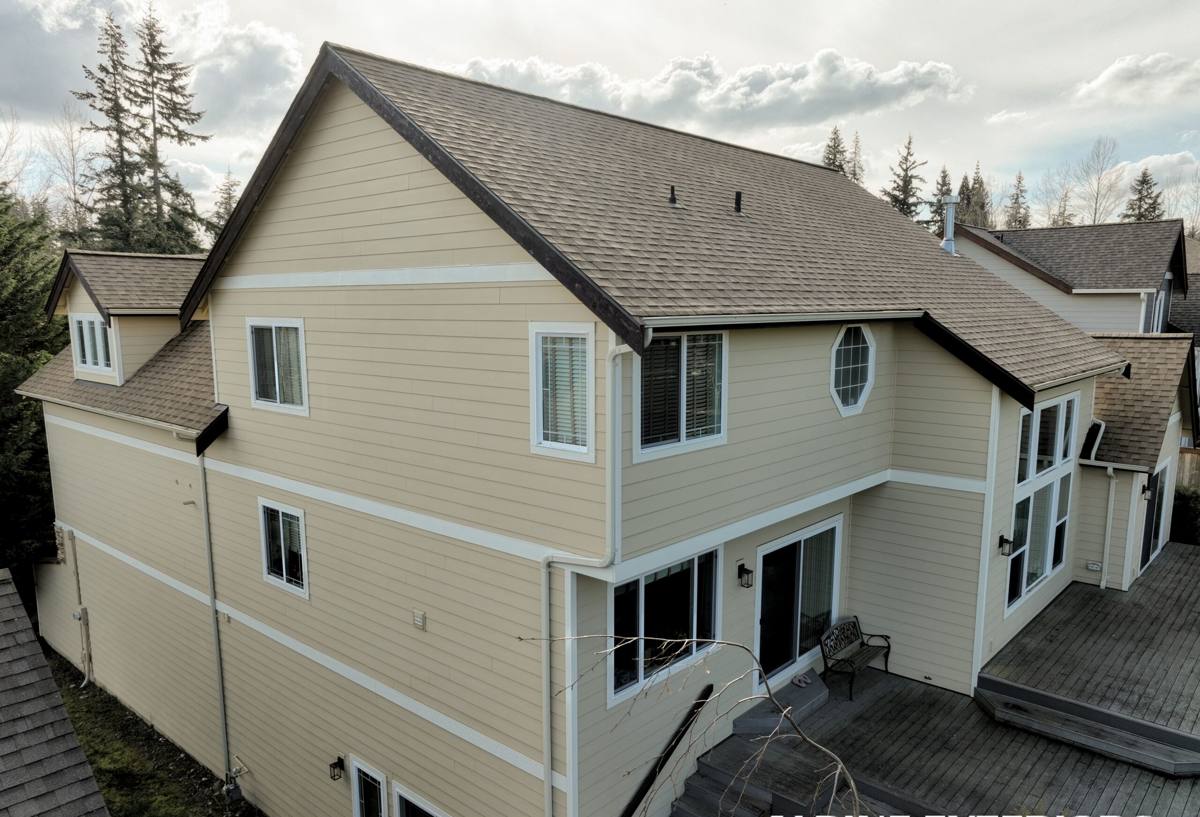
Signs Your Deck Needs Replacing, Not Just Patching
Homeowners often call us wanting a repair and find out the deck has passed the point where patching makes sense. Here's what tells us a full replacement is the honest recommendation instead of a board-by-board fix:
- Soft, spongy, or bouncy spots underfoot, especially near the house or stairs
- Rust streaks bleeding from screw heads or bracket edges onto the decking
- Visible gap or separation where the ledger board meets the house
- Joist hangers that are rusted through or flaking rather than just surface-stained
- Persistent moss or dark staining that comes right back within weeks of cleaning
- Cupped, split, or delaminating boards across more than a small section
- Railings or stair stringers that flex or feel loose when you lean on them
One or two of these on an otherwise sound deck can often be repaired. Several at once, or any sign of ledger or framing failure, usually means the structure underneath has been compromised and a patch will just fail again in a season or two.
The Ledger Board Is the One Detail That Matters Most
The ledger board is the piece bolted directly to your house that the rest of the deck hangs from, and it's the single most common point of failure in deck construction anywhere in the country. In a climate with this much driving rain, a ledger without proper flashing lets water track behind it and into the house's rim joist, rotting both the deck attachment and the wall framing behind it — often invisibly, until the deck starts to sag or pull away.
What a Correct Deck Replacement Actually Involves
A deck replacement done right isn't just pulling up old boards and screwing down new ones. The framing underneath is what determines whether the new deck lasts five years or twenty-five. On every full replacement, that means:
- Removing the old ledger board and installing new self-adhered flashing tape and proper counterflashing where the deck meets the house siding
- Sizing and spacing joists to current code span tables for the actual load and decking material being installed
- Applying joist tape over the top of every joist so fastener penetrations don't create a path for water to wick into the wood
- Confirming footings meet local frost-depth and bearing requirements, and adding footings where the old deck was under-supported
- Using corrosion-rated joist hangers, hurricane ties, and fasteners suited to both the lumber's chemical treatment and the coastal air
Skipping any one of these to save time is exactly how a deck that looks fine on day one starts showing rot at the ledger by year three. It's not visible from the top, which is why so many failing decks look fine from the yard right up until they don't.
Decking Material Options for a Salt-Air, High-Moss Climate
Material choice matters more here than in a dry climate, because every option behaves differently once it's wet more often than it's dry. Here's how the common choices actually compare for a Birch Bay property:
| Material | Upfront Cost | Maintenance | Moss/Moisture Behavior |
|---|---|---|---|
| Pressure-treated lumber | Lowest | Needs re-staining/sealing every 1-2 years | Absorbs moisture; prone to surface moss if not cleaned and resealed regularly |
| Cedar | Moderate | Regular oiling or sealing to maintain color and resist checking | Naturally more rot-resistant than treated pine, but still needs upkeep in constant damp |
| Capped composite | Higher | Occasional washing, no staining or sealing | Shrugs off moisture and moss much better; surface doesn't absorb water like wood |
| PVC decking | Highest | Lowest of all options — washing only | Fully synthetic, essentially immune to rot; performs consistently in constant damp conditions |
There's no universally "correct" answer — it's a trade-off between upfront cost and how much maintenance you're willing to keep up with. What we won't do is put a low-maintenance decking board over framing that wasn't built to last as long as the boards on top of it. That mismatch is common in the industry and it's how homeowners end up replacing "20-year" composite decking after twelve years because the frame underneath gave out first.
Fasteners and Hardware: The Parts You Don't See
In a salt-air environment, hardware is often the first thing to fail — usually well before the wood or decking shows any problem. Standard coated screws can corrode faster near the water, and mixing incompatible metals (like the wrong screw in ACQ-treated lumber) can trigger galvanic corrosion that eats through fasteners from the inside. We spec stainless steel or coastal-rated hardware for fasteners, joist hangers, and structural connectors on Birch Bay jobs specifically because standard-grade hardware that holds up fine twenty miles inland doesn't hold up the same way this close to the water.
This is also where hidden-fastener decking systems earn their keep in this climate — no exposed screw heads on the walking surface means fewer entry points for water and fewer rust streaks to deal with down the road.
Permits and Local Considerations in Whatcom County
Most deck replacements that involve new footings, structural framing changes, or any attachment to the house require a building permit through Whatcom County, even when the footprint doesn't change. If a property is close to the shoreline, setback and shoreline management requirements can also come into play, which is worth checking before demolition starts rather than after. Guardrail height and baluster spacing are code-driven as well, and older decks built before current code often don't meet today's requirements — a replacement is the natural point to bring those up to standard.
We handle the permit process as part of the job rather than leaving it to the homeowner to sort out, because getting it wrong means delays or having to open up finished work for inspection later.
Our Deck Replacement Process
- On-site assessment of the existing deck, ledger connection, and framing to determine what's salvageable versus what needs full replacement
- Straightforward written estimate covering material options, scope, and timeline — no pressure to upsell materials you don't need
- Permit application through Whatcom County where required
- Demolition and haul-away of the old structure
- Framing and ledger work, including flashing and joist tape, before any decking goes down
- Decking, railing, and stair installation
- Final walkthrough so you know exactly what was done and how to maintain it
Maintaining Your New Deck Through Moss Season
Even the best-built deck benefits from a little seasonal attention in this climate. A few habits go a long way:
- Keep gutters and downspouts clear so water doesn't sheet directly onto the deck surface
- Sweep debris off the boards regularly — trapped leaves and needles hold moisture against the surface
- Trim back overhanging branches to improve airflow and sun exposure, which slows moss growth
- Wash the surface at least once a year, more often on shaded sections, before moss gets established
- Check railings and stair connections annually for any looseness before it becomes a safety issue
Why Hiring a Crew That Already Works in Birch Bay Matters
A contractor who works this stretch of coastline regularly already knows which hardware holds up here, how far inland the salt exposure actually reaches, and what Whatcom County inspectors look for on a deck permit. That's the difference between a deck that's built to a generic spec sheet and one that's actually built for this specific location. We'd rather walk your existing deck with you, tell you honestly what's failing and why, and give you a straightforward estimate than sell you a replacement you don't need or a shortcut that won't hold up through a few winters of driving rain.
If your deck is showing any of the signs above, or you just want an honest opinion on whether it's a repair or a replacement, we're happy to come take a look. Fill out the form below for a free, no-pressure estimate.