 Blaine Siding
 Siding Installation for Grandview Homes in Blaine
Grandview sits close enough to the water and to open farmland that its homes take a different kind of weather beating than houses ten miles inland. Salt-laden air off the Strait and Semiahmoo Bay, wind-driven rain that finds every gap in a wall assembly, and a moss season that can run eight or nine months out of the year all work against ordinary siding. When we install siding in Grandview, we're not just swapping old material for new — we're building an exterior wall system that's supposed to hold up to that specific combination for decades, not years.
This page covers what a correct siding installation looks like for this neighborhood specifically: the climate stresses at play, what the job actually involves from tear-off to finish, and why we install James Hardie fiber cement exclusively rather than the cheaper or more common alternatives.
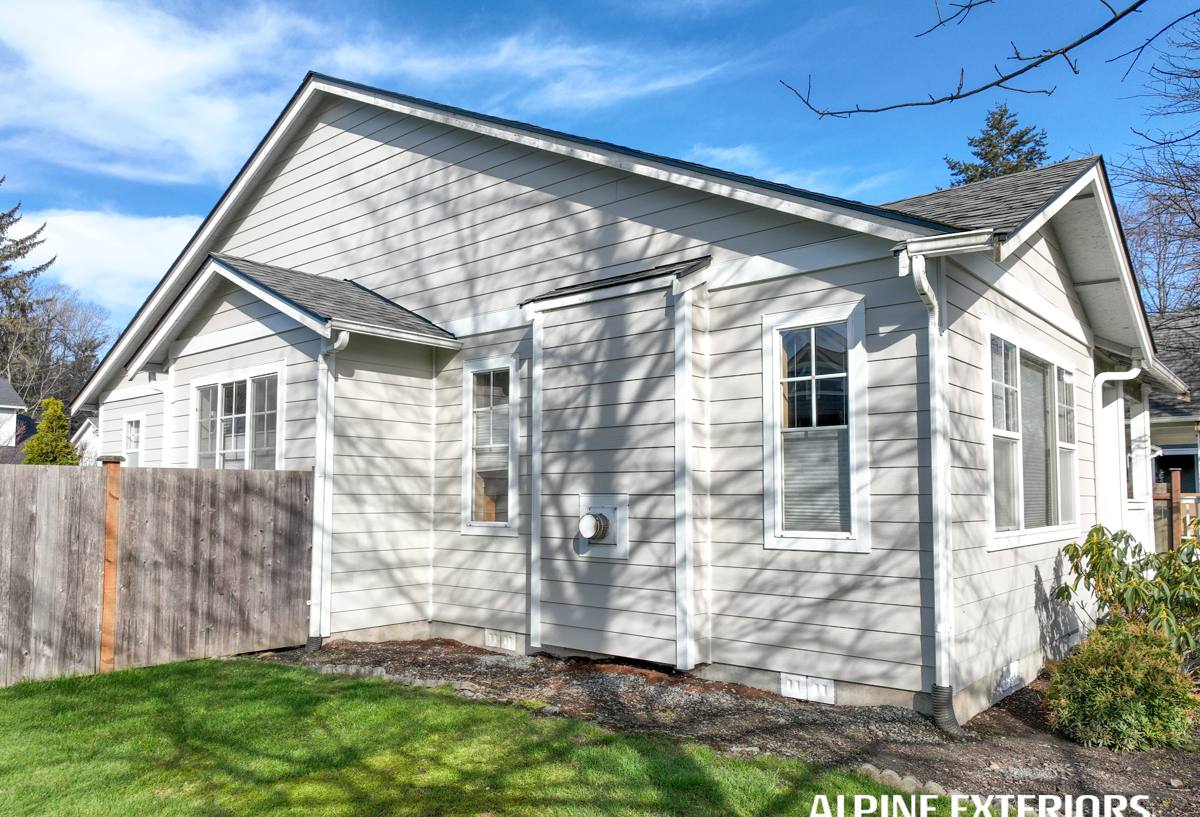
What Grandview's Climate Actually Does to Siding
Salt Air and Coastal Moisture
Blaine's proximity to the water means airborne salt is a constant, low-grade corrosive presence. It doesn't just affect metal — it accelerates the breakdown of paint films, softens caulk and sealant joints faster than inland exposure would, and speeds up wood rot wherever moisture gets trapped behind cladding. Siding that isn't engineered for coastal exposure tends to show its age early: chalking paint, swollen seams, fastener corrosion.
Driving Rain
Whatcom County storms coming off the Strait of Georgia don't fall straight down — they come in sideways. That matters more than most homeowners realize, because it means water is being pushed laterally into every lap joint, every trim gap, and every penetration in the siding, not just running down the face of the wall. A siding system with weak water management at the seams and a house wrap that isn't detailed correctly will let moisture in behind the cladding, where it does the most damage and is the hardest to spot.
Moss and Sustained Dampness
The long wet season here means siding surfaces stay damp for extended stretches, especially on north-facing walls and anywhere shaded by trees or a neighboring structure. That sustained dampness is exactly what moss and mildew need to establish themselves, and it's exactly what causes untreated or under-primed wood-based products to soften and swell over time. Products that absorb moisture rather than shed it are working against the climate here, not with it.
Why We Install Only James Hardie Fiber Cement
We get asked regularly why we don't offer vinyl, LP SmartSide, or other engineered wood options. It's a fair question, and the honest answer is that we made a standard for ourselves based on what actually performs in this climate over the long term, not just what's cheapest to install.
What Fiber Cement Does Differently
James Hardie siding is cement, sand, and cellulose fiber — it doesn't absorb water the way wood-based products do, and it doesn't soften, swell, or provide a food source for moss and mildew the way engineered wood can if a seam or cut edge is compromised. It's also non-combustible, which matters increasingly for insurance considerations even on the wet side of the state. The ColorPlus factory finish is baked on under controlled conditions, which gives it a more consistent, fade-resistant, chip-resistant surface than field-applied paint — and in a salt-air environment, that factory-cured finish holds up noticeably longer than a job-site paint job.
Where Other Products Fall Short Here
Vinyl siding is inexpensive and low-maintenance in the sense that it never needs painting, but it's dimensionally unstable in temperature swings, it can crack in impacts, and its seams and J-channels are only as good as the installer's attention to detail — in driving rain, a sloppy vinyl install leaks. Engineered wood products like LP SmartSide perform reasonably well when installed and maintained exactly to spec, but they rely on an intact factory treatment and careful field sealing of every cut edge; any gap in that maintenance in a climate this wet shortens their service life. Primed spruce and cedar are honest, traditional materials, but they require an ongoing paint and maintenance commitment that most homeowners underestimate, and cedar in particular is a natural moss magnet in sustained damp conditions.
None of these are bad products in the abstract. They're just not what we're willing to warranty our workmanship against in a Whatcom County coastal microclimate. James Hardie's HZ5 product line is engineered specifically for climates with freeze-thaw cycling and high moisture exposure — it's built for exactly the conditions Grandview sees.
What a Correct Installation Involves
The siding material is only part of the equation. A large share of siding failures we get called to look at aren't material failures at all — they're installation failures. Getting it right in this climate means:
- Removing old siding down to the sheathing and inspecting for hidden rot or moisture damage before anything new goes up
- Repairing or replacing any compromised sheathing rather than covering over it
- Installing a correctly lapped weather-resistant barrier (house wrap) with all seams and penetrations properly taped and flashed
- Flashing every window, door, and roof-to-wall intersection so water is directed out and down, never trapped behind the cladding
- Maintaining proper clearance between siding and grade, decks, and roof lines to avoid wicking moisture
- Using corrosion-resistant, manufacturer-approved fasteners driven to the correct depth — over-driven or under-driven nails are a common failure point
- Following James Hardie's specified gapping, caulking, and painting requirements at joints and trim
- Proper flashing and sealing around all penetrations — vents, hose bibs, light fixtures, electrical
Skipping any one of these steps can undermine an otherwise good material. This is also why we don't subcontract installation out to whoever's available — our crews install Hardie specifically and regularly, in this region, and know where local homes tend to have problems.
Our Process for a Grandview Project
1. On-Site Assessment
We walk the exterior with you, note problem areas (moss buildup, soft spots, failing caulk, drainage issues), and talk through what's driving the need for new siding — whether it's age, storm damage, or ongoing maintenance fatigue.
2. Product and Color Selection
We go through the relevant James Hardie HZ product lines and ColorPlus color options together, factoring in your home's exposure (how much direct salt air and driving rain a given wall sees) and any HOA or neighborhood aesthetic considerations.
3. Written, Detailed Estimate
You get a scope of work that spells out tear-off, sheathing repair allowances, house wrap and flashing details, the specific Hardie products being used, and a realistic timeline — not just a lump-sum number.
4. Installation
Tear-off, sheathing inspection and repair, weather barrier installation, flashing, siding installation, and trim and caulking, done in that order and inspected at each stage before moving to the next.
5. Final Walkthrough
We walk the finished job with you, point out the water management details we built in, and go over basic care so the siding performs the way it's designed to for the long haul.
Cost Factors for Grandview Siding Projects
Every home is different, but the variables that actually move the price on a Grandview job tend to be the same handful of things:
| Factor | Why It Matters Here |
|---|---|
| Sheathing condition | Coastal moisture exposure means hidden rot is more common than in drier inland areas — repairs add cost but are essential |
| Home size and wall complexity | More corners, dormers, and trim details mean more cutting, flashing, and labor time |
| Siding profile and texture | Lap width, shingle-style panels, and specialty trim all price differently |
| ColorPlus vs. field-painted | Factory-finished ColorPlus costs more up front but eliminates a paint job and holds color longer in salt air |
| Access and site conditions | Tight lots, mature landscaping, or fencing near the home can add labor time |
| Removal and disposal | Tear-off and haul-away of old siding, especially layered or damaged material, adds to scope |
We'd rather walk your specific home and give you real numbers than quote a range that doesn't mean much either way.
Signs a Grandview Home Needs New Siding Soon
- Persistent moss or algae staining that returns shortly after cleaning
- Soft or spongy spots when you press on the siding, especially near the bottom courses or around windows
- Paint that's chalking, peeling, or bubbling faster than a normal repaint cycle would explain
- Visible warping, buckling, or gaps opening up at seams and corners
- Rising heating or cooling costs that point to a compromised building envelope
- Any history of water intrusion, staining, or mold on interior walls that share an exterior wall
Catching these early matters — the longer moisture sits behind failing siding, the more likely it's affecting the sheathing underneath, which turns a siding job into a structural repair job.
Why a Crew That Already Works Grandview Matters
A lot of siding problems in this area trace back to installation practices that would be fine in a drier, calmer climate but aren't sufficient here — under-flashed windows, house wrap that isn't lapped correctly for wind-driven rain, or caulking schedules that don't account for how much UV and salt exposure a south- or west-facing wall actually gets. A crew that regularly works Blaine and the surrounding Whatcom County coastline has already seen where those shortcuts show up years later, and builds around them from the start. That local pattern recognition is worth more than it sounds like on paper — it's the difference between siding that looks right on installation day and siding that's still performing correctly ten years later.
If your Grandview home needs new siding or you're not sure whether what you have is holding up the way it should, we're glad to take a look. Reach out for a free, no-pressure estimate — no obligation, just an honest read on where things stand.