 Blaine Siding
 Why Semiahmoo Windows Wear Out Faster Than Inland Homes
Homes along Semiahmoo Bay and the surrounding waterfront face a tougher climate than most Whatcom County properties even a few miles inland. Salt-laden air off the water settles on frames, hardware, and glazing seals year-round, and it doesn't take a storm to do damage — a steady onshore breeze is enough to slowly corrode metal components and break down exterior finishes. Add in wind-driven rain that hits west- and north-facing windows almost sideways during fall and winter, and you've got water finding its way into gaps that would stay dry on a calmer site.
Then there's moss season, which in this part of Blaine runs long — often eight months or more of damp, low-sun conditions where anything shaded or north-facing stays wet. Moss and mildew don't just look bad on a window frame; they hold moisture against wood and vinyl surfaces and accelerate rot and seal failure. Windows here simply have to work harder, and that's exactly why a replacement job that would hold up fine in a drier climate can fail early in Semiahmoo if it isn't detailed correctly.
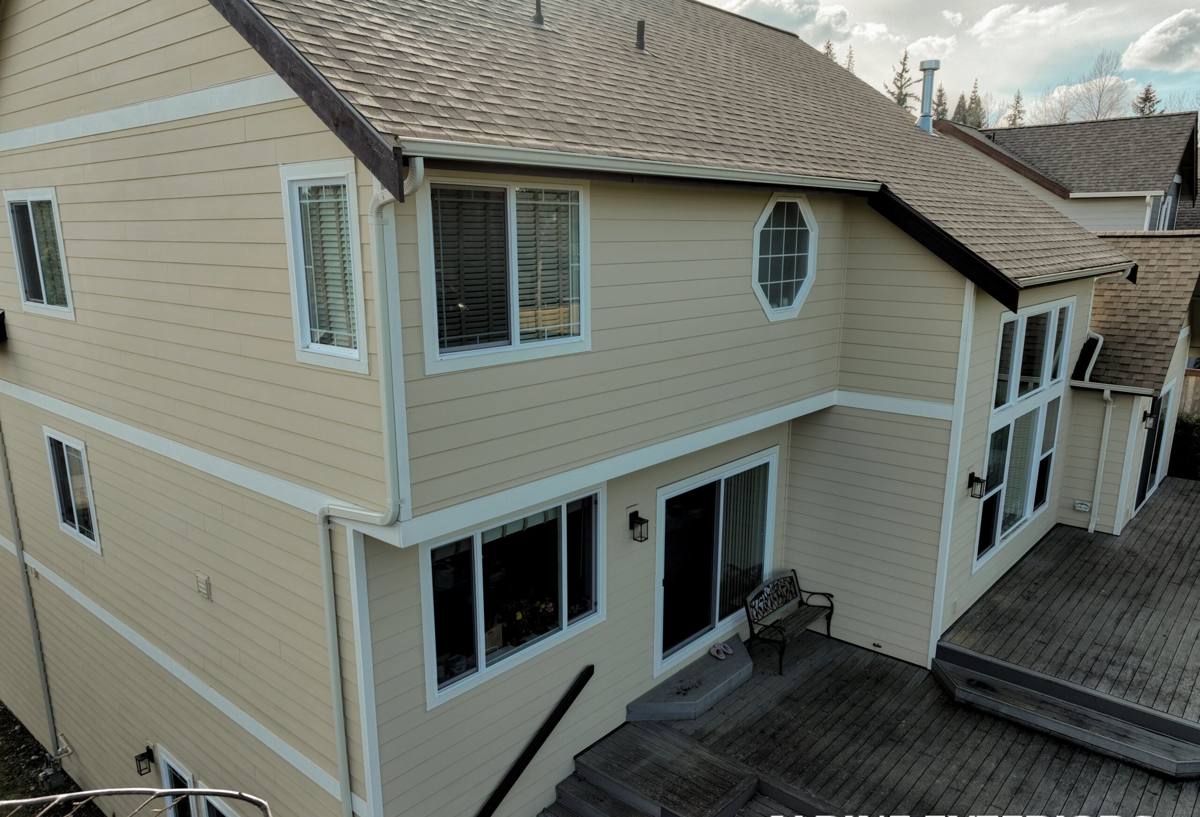
Signs a Semiahmoo Home's Windows Are Due for Replacement
Coastal exposure tends to show up in specific, predictable ways. If you're noticing any of the following, it's worth having the windows looked at before small problems turn into structural ones:
- Fogging or a hazy film between panes — a sign the seal has failed and the insulating gas or dead-air space is gone
- Persistent drafts you can feel near the frame, especially during windy weather off the water
- Windows that stick, won't latch fully, or have swollen sashes from repeated wetting
- Soft or discolored wood at the sill or lower frame corners — usually the first place rot shows up
- Condensation collecting on the inside of the glass even in mild weather
- Moss, algae, or dark staining building up on the frame faster than you can keep it cleaned off
- Noticeably higher heating bills without a change in usage
- Peeling or bubbling paint around the window casing, which usually points to trapped moisture underneath
What a Correct Window Replacement Job Actually Involves
Window replacement looks simple from the outside — old unit out, new unit in — but in a wind-and-rain-exposed spot like Semiahmoo, the details around the window matter as much as the window itself. A rushed install can look fine for a season and then leak for years afterward, hidden inside the wall.
Removal and Structural Check
Once the old window is out, the rough opening gets inspected before anything new goes in. This is the point where hidden rot, soft sheathing, or old water staining shows up — problems that need to be addressed now, not covered over. Skipping this step is the single most common reason a "new" window ends up with the same moisture problem a few years later.
Flashing and Water Management
This is the part that matters most in a driving-rain climate. Proper flashing directs any water that gets behind the siding or trim back out and away from the wall assembly, rather than letting it pool at the sill. That means correctly lapped flashing tape, a sloped sill pan, and integration with the existing weather-resistive barrier — not just a bead of caulk around the edges. Caulk alone is not a water management system; it's a backup, and it's the first thing to fail under sustained wind-driven rain.
Insulation and Air Sealing
The gap between the window frame and the rough opening needs to be filled with the right material — typically a low-expansion foam or backer rod and sealant — so there are no voids that let cold air or moisture track through. Overfilling with rigid foam can actually bow the frame and cause operational problems, so this step takes some judgment, not just a full can of spray foam.
Interior and Exterior Finish
Trim, casing, and exterior cladding get reinstalled or repaired so the water management layer is fully protected and the finish matches the rest of the wall. Any exterior wood trim in a salt-air environment should be primed and sealed on all sides, including cut ends, before it goes back up.
Choosing the Right Window for a Semiahmoo Property
Frame material and glass package both matter more here than in a typical inland install, because the window has to shrug off salt exposure and constant moisture cycling, not just look good on day one.
| Frame Material | Salt Air / Moisture Behavior | Maintenance | Typical Use Case |
|---|---|---|---|
| Vinyl | Won't corrode or rot; performs well in salt air | Low — occasional rinsing | Most cost-effective option for full-home replacement |
| Fiberglass | Very stable in temperature swings and moisture; strong long-term performer near the water | Low | Good fit for larger openings or higher-exposure elevations |
| Wood-clad | Attractive interior wood look, but the exterior cladding and any exposed wood need consistent upkeep in this climate | Higher — finish and seals need regular attention | Homeowners prioritizing a specific interior aesthetic who are prepared for the upkeep |
| Aluminum | Strong and low-maintenance, but a poor insulator unless thermally broken, and prone to condensation without it | Low | Typically limited to specific architectural applications |
On glass, dual-pane with a Low-E coating and argon fill is the practical standard for this climate — it cuts heat loss and helps control condensation on cold, damp days. For homes with more direct exposure to wind and water, we'll also talk through impact-resistant or laminated glass options, along with reinforced frame hardware, since a window facing open water takes a different wind load than one tucked on a sheltered side of the house.
Our Window Replacement Process
- Site visit and measurement — we look at each opening individually, note exposure direction, existing water damage, and any structural concerns before recommending anything
- Product selection — we walk through frame material, glass package, and hardware options based on that specific window's exposure, not a one-size answer for the whole house
- Scheduling around weather — given how much rain this area gets, we plan install timing to keep openings covered and dry for the shortest possible window
- Removal and opening inspection — old units come out, and any rot or damage found is addressed before the new window goes in
- Installation, flashing, and sealing — the new window is set, shimmed level and plumb, flashed, and air-sealed to spec
- Trim and exterior finish — casing, trim, and siding tie-ins are completed to match the surrounding wall
- Cleanup and walkthrough — we clear debris and walk the job with you so you know how each window operates and what warranty coverage applies
What Affects the Cost of a Window Replacement
There's no single price that applies to every home, but a few factors consistently move the number up or down. Getting a written, itemized estimate that accounts for these is the only way to compare quotes fairly.
| Factor | Why It Matters |
|---|---|
| Frame material | Vinyl is generally the most budget-friendly; fiberglass and wood-clad cost more up front |
| Number and size of windows | Larger openings and full-home replacements have different economics than a handful of units |
| Glass package | Impact-resistant or upgraded Low-E glass adds cost but pays off in performance on exposed elevations |
| Existing damage | Rot or moisture damage found at the opening adds repair scope beyond the window itself |
| Access and exposure | Waterfront-facing or hard-to-reach openings can take more time and precaution to do right |
| Trim and siding tie-in | Matching existing exterior finish sometimes requires more trim work than a straight swap |
As a broad range, homeowners in this area are typically looking at a few hundred to a few thousand dollars per window depending on size, material, and glass package — but the only way to know your actual number is a site-specific estimate, since exposure and existing condition vary a lot even between neighboring homes.
Why It Matters to Hire a Crew That Already Works in Semiahmoo
A window install that's technically fine in a typical suburban setting can fall short here if the crew doesn't account for the specific conditions. A contractor who regularly works this stretch of Blaine already knows to prioritize flashing detail over shortcuts, to expect wind loads that inland jobs don't see, and to plan installs around a wet season that can stretch on for months. That local pattern recognition — knowing which elevations take the worst of the weather, how moss and staining tend to build up here, and how window work ties into the rest of the exterior envelope including siding and trim — is the difference between a job that holds up and one that needs revisiting in a few years.
It also matters for coordination. If your siding, trim, or flashing needs attention at the same time as your windows, a crew that handles both sees how the pieces fit together as one weather-tight system, rather than treating the window as an isolated component dropped into someone else's wall.
Caring for New Windows in a Salt Air, Moss Season Climate
New windows still need some routine attention in this environment to get their full service life:
- Rinse salt residue off exterior frames and hardware periodically, especially after windy weather off the water
- Keep weep holes (the small drainage openings at the base of the frame) clear of debris and moss so water can escape properly
- Check exterior caulking and sealant lines once a year for cracking or gaps
- Wipe down interior sills during the wet season to prevent condensation from sitting and causing mildew
- Trim back vegetation that keeps a window shaded and damp longer than necessary, which encourages moss growth
None of this is difficult, but it's the kind of low-effort maintenance that noticeably extends how long a well-installed window performs before needing attention.
Get a Straight Answer on Your Windows
If your windows are showing any of the wear signs above, or you're just planning ahead for a home near the water, we're happy to take a look and give you a clear, no-pressure estimate — no guesswork, no upsell, just an honest read on what your home actually needs. Use the form below to get started.