 Blaine Siding
 Roofing a Point Roberts Home Is Its Own Job
Point Roberts sits on its own peninsula, cut off from the rest of Whatcom County by the international border. That geography isn't just a curiosity — it shapes what a roof has to survive out there. You've got open water on three sides, salt-laden wind coming straight off the Strait of Georgia, long stretches of driving rain through fall and winter, and shade pockets under conifers where moss and moisture never really let up. An asphalt shingle roof that would hold up fine twenty minutes inland can wear out early here if it wasn't built for these specific conditions.
We treat Point Roberts as its own microclimate within our Blaine service area, not a smaller version of it. The materials, the ventilation plan, and the flashing detail all get adjusted for a peninsula home, and that's the difference between a roof that looks right on install day and one that's still performing in year fifteen.
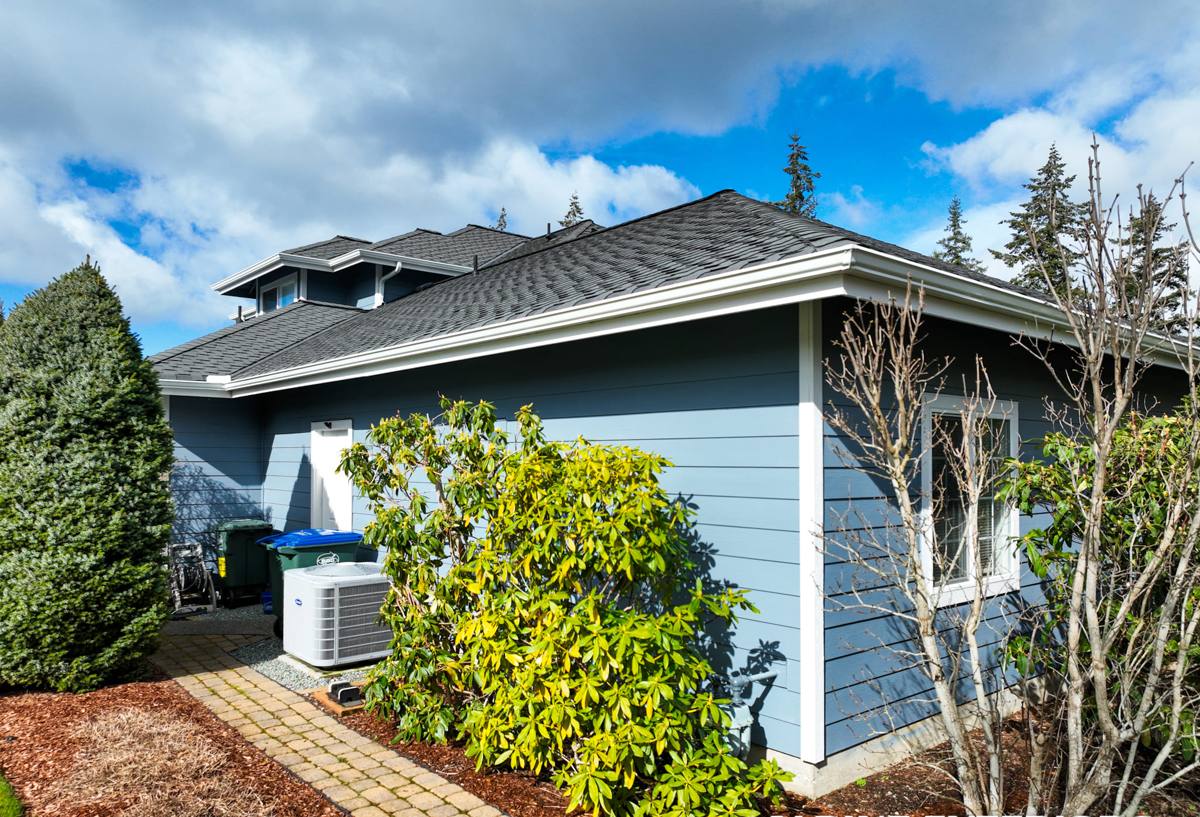
What Salt Air, Rain, and Moss Actually Do to a Shingle Roof
Salt Air
Airborne salt doesn't rot asphalt shingles the way it corrodes metal, but it does accelerate wear on exposed metal components — nail heads, flashing, vent stacks, and drip edge — and it settles into granule loss over time, leaving the asphalt mat more exposed to UV and moisture. Any metal we use on a Point Roberts roof needs to be rated for coastal exposure, and that's not optional the way it might be for an inland job.
Driving Rain
Whatcom County gets plenty of straight-down rain, but Point Roberts catches wind-driven rain off the water that pushes moisture sideways and up under shingle edges, ridge caps, and anywhere flashing meets a wall or chimney. A roof system that only relies on shingle overlap to shed water will eventually leak here. Underlayment and flashing details have to assume water is going to get pushed where gravity alone wouldn't take it.
Moss Season
Tree cover and near-constant winter dampness make moss growth close to a year-round issue on north-facing and shaded slopes. Moss isn't just cosmetic — it holds moisture against the shingle surface, lifts tabs as it grows, and works its way under the shingle edge, which is exactly where you don't want standing moisture. A roof with poor airflow underneath will grow moss faster and dry out slower after every rain.
What a Correct Asphalt Shingle Job Includes Out Here
A shingle roof is a system, not a single product. On Point Roberts specifically, we pay close attention to a handful of details that matter more here than they would on a sheltered inland lot:
- Ice-and-water underlayment at eaves, valleys, and any low-slope transition, not just where code minimums require it
- Corrosion-resistant flashing and fasteners rated for coastal/salt exposure, at chimneys, walls, skylights, and vent penetrations
- Balanced attic ventilation — intake at the eaves and exhaust at the ridge — so the underside of the deck dries out between rain events instead of staying damp
- Proper starter strip and drip edge so wind-driven rain can't wick back under the first course
- Algae-resistant (AR) shingle granules on shaded or north-facing slopes where moss and moss-staining are the biggest long-term risk
- Correct nailing pattern and fastener count — under-nailing is one of the most common reasons a shingle roof fails wind and warranty inspections early
None of this is exotic. It's standard trade practice done correctly, with material choices adjusted for a coastal, tree-shaded peninsula instead of copy-pasted from an inland spec sheet.
Signs a Point Roberts Roof Needs Attention
Most shingle roof failures out here don't start as a dramatic leak — they start small and get ignored because the symptoms are easy to write off as normal weathering. Worth checking for:
- Granules collecting in gutters or downspout splash areas
- Moss visibly bridging across shingle tabs, not just growing in isolated patches
- Dark streaking on north-facing slopes (early algae growth, a precursor to heavier moss)
- Curling or cupping shingle edges, especially on the side that catches the most wind
- Soft spots or staining on interior ceilings near exterior walls or chimneys after a windy rain
- Rusted or lifted flashing around any roof penetration
Any one of these on its own isn't an emergency. Several together, or anything showing up on a roof under 12-15 years old, is worth a real inspection rather than a guess.
Shingle Options and How They Hold Up Here
| Shingle Type | Typical Lifespan | How It Handles This Climate |
|---|---|---|
| 3-Tab (economy) | 15-20 years | Lowest upfront cost, but thinner mat wears faster under salt exposure and offers the least wind resistance in coastal gusts |
| Architectural / Dimensional | 25-30 years | Heavier mat and higher wind ratings; the standard choice we recommend for most Point Roberts homes |
| Premium/Designer Architectural | 30+ years | Best granule adhesion and warranty coverage; worth it on fully exposed, high-wind lots or where long-term low maintenance matters most |
| Algae-Resistant (AR) upgrade | Adds to any above tier | Copper-infused granules slow algae/moss staining — a genuine upgrade for shaded, north-facing slopes here |
For most Point Roberts homes we're recommending at least an architectural-grade shingle with the AR upgrade on shaded slopes. It costs more than 3-tab upfront, but the maintenance and moss-cleaning burden on a bare 3-tab roof out here tends to erase the savings within a few years.
What Drives the Cost
| Factor | Why It Matters Here |
|---|---|
| Roof pitch and access | Steeper or harder-to-reach roofs take longer and need more safety setup, regardless of location |
| Tear-off vs. overlay | We don't recommend overlaying old shingles on a coastal roof — trapped moisture underneath is exactly the moss/rot risk you're trying to avoid |
| Deck condition | Damp climates increase the odds of finding soft or delaminated decking once old shingles come off |
| Shingle tier and AR upgrade | Higher-grade and algae-resistant shingles cost more per square but reduce moss-related maintenance and re-roofing frequency |
| Flashing and ventilation scope | Coastal-rated metal and proper intake/exhaust venting add cost but are not optional on this peninsula |
| Material delivery and crew logistics | Point Roberts is a U.S. exclave reached by land through Canada; scheduling and material delivery need to be planned around that, not treated as a same-day inland job |
We give a straight, itemized estimate before any work starts — no vague per-square guess. If tear-off reveals deck damage, we show you what we found before repairing it, not after the invoice.
Our Process
- On-site inspection. We walk the roof, check the attic for ventilation and moisture issues, and note flashing, moss, and wear patterns specific to that lot's exposure.
- Written estimate. Shingle tier, underlayment scope, flashing, and ventilation plan spelled out — no surprise add-ons mid-job.
- Scheduling around the border. Because Point Roberts is only reachable by land through Canada, we plan material delivery and crew logistics in advance so the job runs on the timeline we quote.
- Tear-off and deck check. Old roofing comes off, the deck gets inspected, and any soft or damaged sheathing gets flagged and repaired before anything new goes down.
- Underlayment, flashing, and ventilation. This is where the coastal-specific details go in — ice-and-water at vulnerable areas, corrosion-resistant flashing, balanced intake/exhaust venting.
- Shingle installation. Correct nailing pattern, starter strip, and ridge cap detail, installed to manufacturer spec so the warranty is actually valid.
- Final walkthrough and cleanup. We review the finished roof with you, clean the site of debris and stray fasteners, and go over basic moss-prevention upkeep.
Maintenance That Actually Matters Out Here
- Keep gutters clear so water isn't backing up under the eave line during heavy rain
- Trim overhanging branches to cut down on shade and debris buildup on north-facing slopes
- Have moss physically removed (not just chemically treated) if it's already bridging across shingles
- Check attic ventilation isn't blocked by insulation, especially after any attic work
- Get a roof looked at after any major windstorm, not just on a fixed yearly schedule
- Address small flashing rust or lifted edges early — they're a cheap fix now and an expensive leak later
Why Hire a Crew That Already Works Point Roberts
Roofing a home out here isn't just about picking the right shingle — it's about knowing how this peninsula behaves differently from the rest of Whatcom County. We've built our flashing and ventilation approach around what actually holds up against salt air and driving rain on this specific stretch of coastline, and we plan our scheduling around the reality of border-crossing logistics instead of treating it as an afterthought. That's not something a crew coming from outside the area gets right on the first try.
If you're dealing with granule loss, moss buildup, or you just want an honest read on how much roof life you've got left, we'll come take a look. No pressure, no inflated estimate to scare you into a sale — just a straight assessment and a written quote you can think over.
Reach out for a free, no-obligation estimate using the form below, and we'll get a time on the calendar to come take a look at your roof.