 Blaine Siding
 Siding Built for the Peace Arch Corner of Whatcom County
Homes near the Peace Arch border area sit in one of the more punishing microclimates in Whatcom County. You've got salt-laden air drifting off Semiahmoo Bay and Boundary Bay, near-constant onshore moisture, and long stretches of the year where fences, roofs, and north-facing walls stay damp enough to grow moss. Siding that would hold up fine twenty miles inland can start showing real problems here in half the time. That's the reason we install James Hardie fiber cement exclusively, and why a Peace Arch-area James Hardie project needs to be approached differently than a standard re-side.
This page covers what the local climate actually does to siding, what a correct James Hardie installation looks like for this specific area, and how our process is built around the conditions Peace Arch homes face every year.
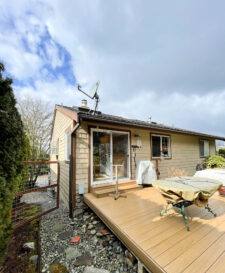
What Salt Air, Driving Rain, and Moss Season Do to a Home's Exterior
Salt air
Airborne salt is corrosive and hygroscopic — it draws moisture and holds it against whatever surface it lands on. Over years, that accelerates paint breakdown, pits and corrodes exposed metal fasteners and flashing, and speeds up wood decay in anything that isn't fully sealed. Siding within a mile or two of Semiahmoo Bay or Boundary Bay takes more of this exposure than siding further inland, even within the same city.
Driving rain
Blaine sits in a wind-driven rain pattern, not just a wet one. Storms coming off the Strait of Georgia push rain sideways into wall assemblies, which means water finds its way into laps, seams, and butt joints that a straight-down rain would never reach. A siding system and installation detail that only accounts for gravity — not wind-driven water — will eventually let moisture behind the cladding.
Moss season
Shaded, damp, north- and west-facing walls in Whatcom County can stay wet for months at a stretch, especially under tree cover or close to neighboring structures. Moss and algae don't just look bad — they hold moisture against the siding surface, which is exactly what wood-based and wood-composite products can't tolerate long-term.
Why James Hardie Is the Right System for This Exposure
Fiber cement doesn't behave like wood or wood-composite siding in wet conditions. James Hardie boards are made from cement, sand, and cellulose fiber — there's no wood core to swell, delaminate, or rot when it stays damp during a long moss season. That matters more here than in drier parts of the state.
- Moisture stability: Hardie fiber cement doesn't absorb and release water the way wood or wood-composite panels do, so repeated wet-dry cycling doesn't warp or swell the board.
- Non-combustible core: not a driving factor for salt or rain exposure specifically, but part of why we standardized on the product across every job we take.
- ColorPlus factory finish: a baked-on finish applied and cured under controlled conditions, which holds color and resists the chalking and fading that salt air and UV speed up on field-painted siding.
- HZ5 engineered formulation: James Hardie makes climate-specific product formulations, and the versions engineered for wetter, more humid regions are the ones we use in this area — not a one-size-fits-all board.
None of that replaces correct installation. Fiber cement is durable, but it's not magic — a poorly installed board in a high-exposure spot like Peace Arch will still fail early if water gets behind it.
What a Correct Installation Involves Here
The product is only half the equation. In a high wind-driven-rain, high-salt environment, installation details matter more than they would in a milder climate. A correct job includes:
Drainage plane and rainscreen gap
A weather-resistant barrier behind the siding, installed with proper lapping so water sheds outward and down, combined with a ventilated rainscreen gap that lets any moisture that does get behind the cladding drain and dry out instead of sitting against the wall sheathing.
Flashing at every penetration
Windows, doors, hose bibs, light fixtures, and anywhere trim meets a wall need flashing detailed to shed water outward, not just caulk. Caulk fails; flashing doesn't, if it's installed correctly the first time.
Fastener spec and placement
Corrosion-resistant fasteners, driven per James Hardie's published fastening schedule — not overdriven, not underdriven, and placed at the correct distance from panel edges. In a salt-air environment, fastener corrosion is one of the more common causes of early staining and streaking on any siding system.
Joint and butt seam treatment
Proper gapping and sealant at butt joints, factory-primed cut edges recoated in the field, and correct clearance from grade, roof lines, and horizontal surfaces so water doesn't wick up into the board.
Ventilation and clearance
Keeping siding off decks, patios, and grade by the manufacturer's minimum clearance, which matters more in a moss-prone area where organic debris and standing moisture accumulate faster against a wall.
| Installation Detail | Why It Matters Near Peace Arch |
|---|---|
| Rainscreen gap | Lets wind-driven rain that gets behind the siding drain and dry instead of trapping moisture against sheathing |
| Corrosion-resistant fasteners | Salt air accelerates corrosion on standard fasteners, leading to streaking and loosened boards |
| Flashing at penetrations | Sideways-driven rain reaches window and door edges that vertical-rain flashing wouldn't need to handle |
| Grade and deck clearance | Reduces standing moisture and moss/algae growth at the base of the wall |
| Field-primed cut edges | Unsealed cut ends are the fastest path for moisture intrusion into the board itself |
Our Process for a Peace Arch-Area Hardie Project
- On-site walkthrough: we look at wind exposure, tree cover, drainage patterns, and which walls take the most direct weather before we spec anything.
- Tear-off and sheathing inspection: we check what's behind the existing siding for moisture damage or rot before anything new goes up — this is where hidden problems from years of wet-behind-the-wall conditions usually show up.
- Weather barrier and rainscreen installation: installed and lapped correctly, not just stapled up as an afterthought.
- Hardie board installation: installed to James Hardie's published fastening and clearance specifications, with the HZ5 product line specified for this climate.
- Flashing and trim detail: every window, door, and penetration flashed before trim goes on.
- Final inspection and warranty registration: we register the installation so the manufacturer's transferable warranty is active from day one.
Why It Matters That We Already Work This Area
A crew that regularly works the Blaine and Whatcom County coastline knows which walls on a given lot orientation take the worst of the wind-driven rain, how much clearance to leave given how slow things dry out under tree cover, and what corrosion-resistant hardware actually holds up here versus what's rated for a drier climate on paper. That's not something you get from a crew that installs siding across a huge, climate-mixed territory and treats every job the same. Local experience shows up in the details you can't see once the siding is up — the flashing behind the trim, the fastener spec, the rainscreen gap — which is exactly where most premature siding failures start.
Cost Factors for a Peace Arch-Area Hardie Project
| Factor | How It Affects Cost |
|---|---|
| Existing siding removal | Tear-off and disposal of old material, plus any sheathing repair found underneath |
| Wall exposure and orientation | Walls facing prevailing wind-driven rain may need additional flashing detail |
| Home size and complexity | Number of corners, penetrations, window/door count, and trim detail |
| Product line and profile | Lap siding, shingle-style panels, and board-and-batten carry different material and labor costs |
| ColorPlus vs. field-painted finish | Factory-finished ColorPlus costs more upfront but removes a future repaint cycle |
We won't quote a number without seeing the home — every one of these factors changes the total, and giving a broad range without an inspection does homeowners a disservice.
Maintaining Hardie Siding in This Climate
- Rinse siding annually to remove salt residue and organic buildup, especially on shaded or north-facing walls
- Keep gutters clear so overflow doesn't run directly down the siding face
- Trim back vegetation and tree limbs that keep a wall shaded and slow to dry
- Inspect caulking at trim and penetrations every year or two and re-caulk as needed
- Address any moss or algae growth early rather than letting it establish
- Watch for any loose or popped fasteners and have them addressed promptly
None of this is heavy maintenance — it's the kind of upkeep any exterior in this climate needs, and Hardie's durability means you're maintaining the finish, not fighting rot or delamination.
Ready for a Straight Answer on Your Home
If you own a home near the Peace Arch area and your siding is showing streaking, soft spots, moss buildup, or paint failure, we're happy to take a look and tell you honestly what we see — no pressure, no inflated scope. Request a free estimate below and we'll walk the exterior with you and explain exactly what a correctly installed James Hardie system would look like on your home.