 Blaine Siding
 Why Peace Arch Homes Take a Harder Hit From the Weather
The Peace Arch area sits about as close to the water and the border as a Blaine neighborhood gets, and that location comes with a specific set of exterior problems. Homes here catch salt-laden air rolling in off the Salish Sea, take wind-driven rain almost sideways during winter storms, and sit under a marine cloud layer for months at a stretch that keeps north-facing walls, fence lines, and roof shadows perpetually damp. That combination is what drives Whatcom County's long moss and algae season — and it's harder on siding than most homeowners realize until they're dealing with soft trim boards, peeling paint, or streaked, discolored walls.
None of this is unique to one house. It's the baseline condition for anything built near the Peace Arch border crossing and the shoreline around it. Siding that works fine forty miles inland, in a drier or more sheltered spot, can fail years early out here simply because it was never engineered for this much sustained moisture and salt exposure.
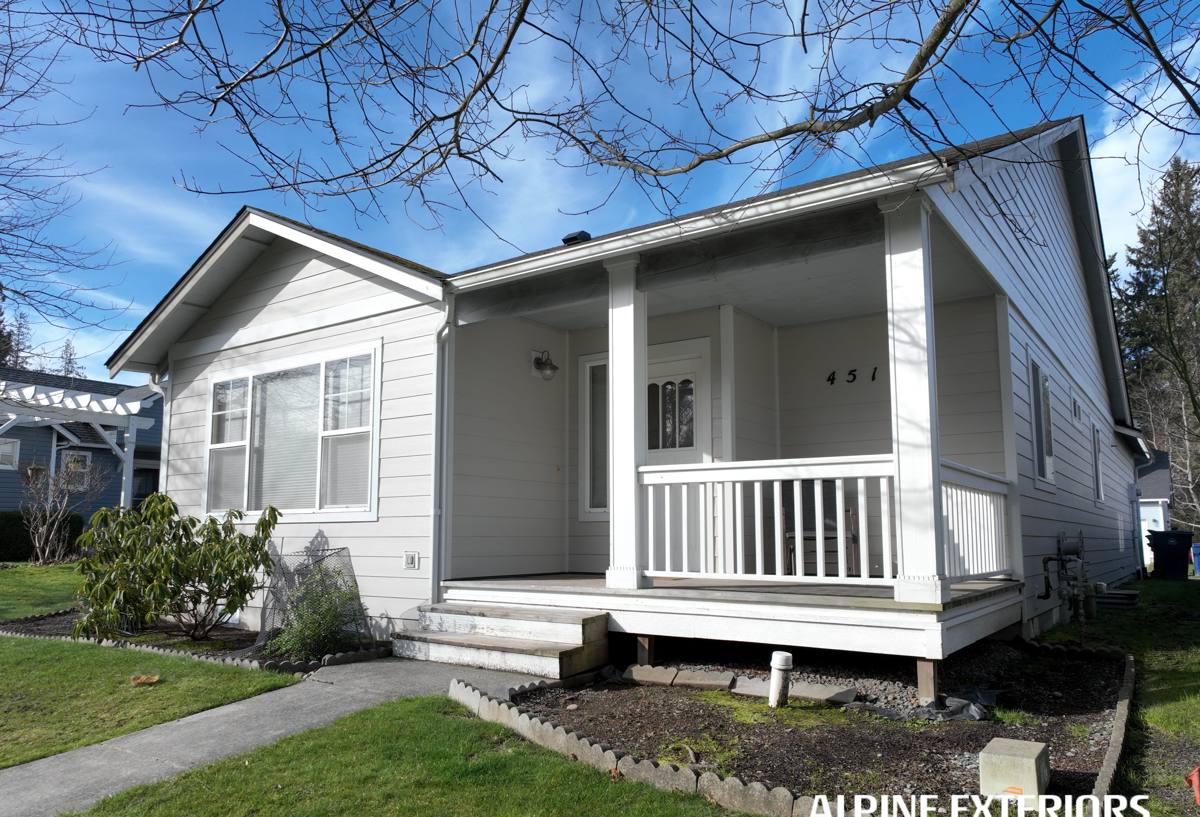
What Happens When the Wrong Siding Meets This Climate
Every siding material behaves differently once it's exposed to constant dampness and salt air over years, not days. The table below is a plain look at how the common options actually hold up in a marine environment like Blaine's — not in a showroom, but on a wall facing the weather year-round.
| Material | How It Handles Salt Air & Moisture | Typical Weak Point Locally |
|---|---|---|
| Vinyl | Doesn't absorb water, but expands and contracts with temperature swings and can warp or crack in wind-driven rain events | Seams and corners open up over time, letting moisture behind the panel |
| Cedar / primed wood | Attractive but porous; needs a sound paint film to keep water and salt out | Moss and algae take hold fast in shaded, damp spots; repainting is frequent |
| Uncertified fiber cement (various brands) | Resists rot better than wood, but formulations vary — not all are engineered for high-moisture coastal climates | Field-applied paint finishes fail faster in salt air than factory finishes |
| James Hardie fiber cement | Non-combustible, engineered for moisture resistance, factory-baked finish built for weather exposure | Still requires correct installation — moisture problems come from installation gaps, not the board itself |
The pattern that matters most: in a marine climate, the material's resistance to moisture and salt is only half the story. How it's installed — the gap behind it, the flashing above windows, the way trim is caulked — decides whether that resistance actually gets used or gets defeated by water finding its way in behind the siding.
What James Hardie Fiber Cement Is Built to Handle
Formulated for Wet, Humid Conditions
James Hardie doesn't make one board for the whole country. It engineers its fiber cement differently depending on the climate it's going into — one formulation built around heavy freeze-thaw cycling, and a separate one built around sustained moisture and humidity, which is the more relevant concern for a coastal Whatcom County property. That distinction matters here because the failure mode in Peace Arch isn't ice — it's months of damp air and rain finding every weak point in a wall assembly.
A Factory Finish, Not a Field One
Hardie's ColorPlus Technology finish is baked on in a controlled factory environment and backed by its own finish warranty, rather than sprayed or brushed on site after installation. In a salt-air environment, that difference shows up directly in how long the color and the protective film actually last. Field-applied paint on siding near the water tends to chalk, fade, and let moisture in at the film edges well before a factory-cured finish does. Fewer repaint cycles also means fewer chances for water to get behind trim during the repainting process itself.
Non-Combustible Composition
Fiber cement is cement, sand, and cellulose fiber — it doesn't burn, feed a fire, or contribute fuel the way wood-based or foam-backed products can. That's a separate benefit from moisture performance, but it's part of why we standardized on it rather than mixing in other siding systems.
What a Correct Installation Actually Involves
Drainage Behind the Siding
In a climate that gets this much wind-driven rain, siding needs a way to shed the water that inevitably gets past the surface. That means a proper weather-resistive barrier, correctly lapped and taped, with a drainage gap or rainscreen behind the siding so any moisture that does get through has somewhere to go besides sitting against the sheathing. Skipping this step is invisible on installation day and expensive five years later.
Fastening and Flashing
Hardie's installation instructions specify fastener type, spacing, and placement for a reason — get it wrong and you create thousands of tiny entry points for water over the life of the siding. Flashing above windows, doors, and any horizontal trim has to be detailed so water sheds outward, not into the wall cavity. This is the part of the job that's easy to rush and impossible to inspect once the siding is up, which is exactly why it needs to be done right the first time.
Trim, Caulking, and Touch-Up
Cut edges of fiber cement board need to be sealed and any factory finish that's nicked during installation needs proper touch-up paint, not a generic exterior paint that won't match or perform the same way. Caulking at joints and trim has to use a product rated for the movement and moisture conditions here, and it has to be applied correctly the first time — recaulking a wall isn't a quick fix once gaps start letting water in behind the boards.
Our Process for a Peace Arch Siding Job
Assessment First
We start by looking at what's actually happening on the house — where moss and algae are concentrated, where paint or old siding is failing fastest, and what that tells us about wind exposure and shade patterns on that specific lot. A house closer to open water or in a shaded, damp pocket gets treated differently than one that's more sheltered, even within the same neighborhood.
Tear-Off and Prep Done Right
Once old siding comes off, we check the sheathing and weather barrier underneath before anything new goes up. Covering a compromised barrier with brand-new siding just locks a moisture problem inside the wall — so any issues get addressed before installation starts, not after.
Installation to Manufacturer Spec
Hardie siding gets installed according to the manufacturer's published fastening, spacing, and flashing requirements — not shortcuts based on what's faster. This is also where the warranty depends on getting it right: an install that doesn't follow spec can affect warranty coverage down the road.
Final Walkthrough
Before we call a job finished, we walk the exterior with the homeowner, checking seams, trim, caulking, and finish consistency so nothing gets missed.
Why It Matters That We Already Work This Area
A contractor who mostly works drier, more sheltered parts of Whatcom County can still do competent work — but they're guessing at how much rainscreen gap, flashing detail, and fastener corrosion resistance a Peace Arch property actually needs. A crew that regularly works siding jobs in and around Blaine's marine-exposed neighborhoods has already seen where moss builds up fastest, which wall orientations take the worst of the driving rain, and where salt air causes problems other parts of the county never see. That's not a marketing point — it changes real decisions on the job, like where to add extra flashing attention or which fastener hardware to specify.
What to Expect Over the Life of the Siding
Fiber cement installed correctly is a long-term exterior, but "long-term" still depends on ongoing factors specific to this location. The table below breaks down what actually drives cost and maintenance over time for a Peace Arch home, separate from the base price of materials and labor.
| Factor | Why It Matters in Peace Arch |
|---|---|
| Home's exposure to open water and wind | More direct exposure means more attention to flashing, gap sizing, and fastener corrosion resistance |
| Existing wall condition | Rot or moisture damage found during tear-off adds repair scope before new siding can go on |
| Shade and moss-prone areas | North-facing and heavily shaded walls need the drainage details done right, since they stay damp longest |
| Trim and detail complexity | More corners, windows, and transitions mean more flashing and caulking work, which affects both cost and long-term performance |
| Color and finish choice | ColorPlus factory finishes reduce future repainting, which matters more here than in a drier climate |
Moss and algae will still land on any exterior surface in this climate — that's a function of the air and shade, not the siding material. What changes with correctly installed Hardie siding is that a rinse and occasional cleaning keeps the surface looking right, instead of moss taking hold in failing paint or soft trim.
Questions to Ask Before You Hire Anyone for This Job
Because so much of what makes siding last here happens behind the boards, homeowners in Peace Arch are better off vetting a contractor on process, not just price. A few questions worth asking before signing anything:
- Do you install a drainage gap or rainscreen behind the siding, and can you explain why?
- What weather-resistive barrier do you use, and how do you detail the seams and window flashing?
- Are you a certified installer for the siding brand you're proposing, and what does that certification actually require?
- What fastener type and spacing will you use, and is it rated for a coastal, high-moisture environment?
- Will you check and address the condition of the sheathing and barrier before new siding goes up, not just after old siding comes off?
- What does the manufacturer's warranty require from the installation to stay valid?
A contractor who answers these clearly, without hesitation, is telling you something about how they actually work — not just what siding brand is on their truck.
If your home is in the Peace Arch area and you're weighing a siding replacement, we're happy to take a look and talk through what your specific wall exposure needs — no pressure, no obligation. Use the form below to request a free estimate.