 Blaine Siding
 Building a Deck That Can Actually Handle Peace Arch
Peace Arch sits close to the water on Blaine's border with British Columbia, and that location shapes what a deck out here has to put up with. Salt-laden air off the bay, wind-driven rain that gets pushed sideways into ledger boards and railings, and a moss season that can stretch from October well into spring all work against a deck's structure, not just its looks. A deck that would hold up fine forty miles inland can start showing real problems within a few years out here if it wasn't built with this specific exposure in mind.
We replace decks in Peace Arch on a regular basis, and the pattern we see is consistent: it's rarely the decking boards that fail first. It's the framing, the fasteners, and the connection points underneath that give out quietly, while the surface still looks okay from a few feet away. This page walks through what that means for a replacement done right, what it involves, and how we approach the job.
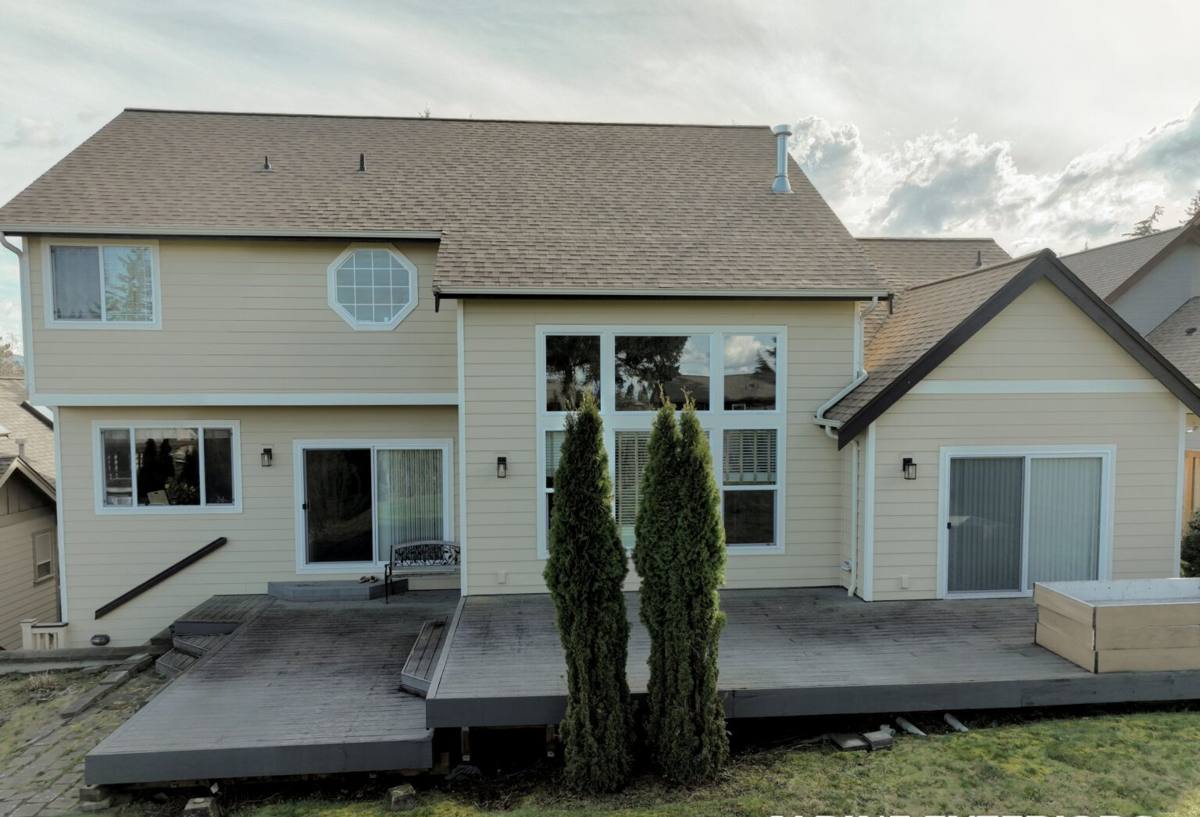
What Salt Air, Driving Rain, and Moss Do to an Aging Deck
Salt Air and Metal Fasteners
Even a mile or two from Semiahmoo Bay and Drayton Harbor, airborne salt accelerates corrosion on anything metal. Standard fasteners and connectors that aren't rated for coastal exposure can start rusting from the inside of the wood, where you can't see it, years before a visible problem shows up. Once a joist hanger or bolt corrodes enough to lose grip, the structural connection it's holding is compromised — and that's a safety issue, not a cosmetic one.
Driving Rain and Ledger Board Rot
Blaine gets rain that doesn't just fall straight down — wind off the water pushes it sideways into the house, right where the deck ledger board attaches to the framing. If that connection wasn't properly flashed when the deck was originally built (and on a lot of older decks, it wasn't), water works its way behind the ledger and into the rim joist year after year. This is one of the most common failure points we find on decks we're asked to replace, and it's almost always hidden until the wood is soft enough to probe with a screwdriver.
The Long Moss Season
Whatcom County's damp, mild winters mean moss and algae get a long runway to establish themselves on horizontal wood surfaces — deck boards, stair treads, and the tops of railings. Beyond making a deck slippery, moss holds moisture against the wood surface far longer than open air would, which speeds up rot in real wood decking and can trap grime in the surface texture of some composite products if they're not cleaned periodically.
Signs a Peace Arch Deck Needs Replacement, Not Just Repair
Not every aging deck needs a full teardown. But there's a point where patching boards or re-securing a railing is just delaying a bigger problem. Signs we look for when we assess a deck include:
- Soft, spongy, or dark-stained wood at the ledger board or where posts meet the deck frame
- Visible rust bleeding from fasteners or connector hardware
- Railings or stair stringers that flex or feel loose when you put weight on them
- Gaps opening up between the ledger board and the house siding
- Persistent moss or algae that comes back within weeks of cleaning
- Joists or beams with cracking, splitting, or noticeable sagging between supports
- A deck older than 15-20 years that has never had the substructure inspected
If you're seeing two or more of these, it's worth having someone look underneath before you plan a party around it. Surface-level cosmetic wear is one thing; structural fatigue from years of salt air and moisture is another, and it's the kind of problem that gets more expensive the longer it sits.
Choosing the Right Decking Material for This Climate
There's no single "best" decking material for every homeowner — it depends on your budget, how much upkeep you want to do, and how long you plan to stay in the house. Here's how the main options actually perform in a coastal, high-moisture climate like Blaine's:
| Material | How It Handles Salt Air & Rain | Moss/Algae Resistance | Maintenance |
|---|---|---|---|
| Pressure-treated wood | Needs consistent sealing to resist moisture intrusion; lowest upfront cost | Prone to moss without regular cleaning | Annual cleaning and re-sealing recommended |
| Cedar | Naturally moisture- and insect-resistant, but still needs sealing near the coast | Better than pressure-treated but not immune | Periodic cleaning and refinishing |
| Composite decking | Doesn't absorb water or rot; performs well in coastal exposure | Can hold surface grime in textured boards if not rinsed periodically | Occasional washing; no sealing or staining |
| PVC/capped polymer | Fully moisture-sealed; among the most resistant to salt-air corrosion effects | Smooth cap resists algae buildup well | Lowest maintenance; occasional cleaning |
Whatever decking surface you choose, it only performs as well as what's underneath it. We've replaced plenty of decks where the top boards were composite but the framing and fasteners underneath were standard-grade and already corroding — a mismatch that shortens the life of the whole structure regardless of what the walking surface is made of.
What a Correct Deck Replacement Actually Involves
Structural Framing and Footings
A replacement starts from the ground up, literally. Footings need to be sized and set to local frost and load requirements, posts need proper bases to keep end-grain wood off standing water, and the framing itself should use lumber rated for ground contact or exterior exposure where applicable. This is the part of the job nobody sees once it's finished, which is exactly why it's the part that matters most.
Ledger Board and Flashing
Given how much rot we trace back to ledger connections in this area, we treat ledger flashing as non-negotiable. That means proper flashing between the ledger and the house, a water-resistant barrier behind it, and correct fastening into the home's rim joist or framing — not just lag bolts into siding.
Fasteners and Hardware
For a deck this close to the water, we use corrosion-resistant fasteners and connector hardware rated for coastal or treated-lumber exposure. It costs more than standard hardware, but it's the difference between a deck that holds its structural integrity for decades and one where hidden corrosion forces another rebuild in half that time.
Guardrails and Code Compliance
Railings, guard height, baluster spacing, and stair geometry all need to meet current building code — which matters both for safety and for passing inspection. Older decks built to a previous code cycle sometimes don't meet current standards, and a replacement is the right time to bring that up to date.
Our Process for Peace Arch Deck Replacements
- On-site assessment of the existing deck, including probing the ledger board, posts, and framing for hidden moisture damage
- Honest recommendation on repair versus full replacement, with the reasoning explained plainly
- Material selection conversation based on your budget, maintenance preference, and how the deck will be used
- Permit handling with the City of Blaine or Whatcom County as required for the scope of work
- Removal of the old structure and inspection of the ledger connection and any affected house framing
- Rebuild of footings, framing, ledger flashing, decking, and railings to current code
- Final walkthrough so you understand what was done and how to maintain it going forward
Permits and Local Code Considerations
Deck replacement in Blaine typically requires a permit once you're rebuilding structural elements like framing, footings, or railings — not just swapping worn boards on an otherwise sound structure. Requirements can also depend on deck height, size, and proximity to property lines. We handle the permit process as part of the job so you're not the one tracking down requirements or inspection scheduling, and so the finished deck is documented as built to code — which matters if you ever sell the house.
Why Hiring a Crew That Already Works in Peace Arch Matters
A contractor who mostly works inland doesn't always think to spec corrosion-resistant hardware or ledger flashing as a default, because in a drier climate those details matter less. Working regularly in Blaine and along this stretch of Whatcom County means we build every deck assuming salt air, driving rain, and a long wet season are part of the deal — not an edge case. That shapes material choices, fastener grade, and flashing details from the start, rather than as an upsell after something's already failed once.
Keeping Your New Deck in Good Shape
A well-built deck in Peace Arch still needs some seasonal attention. Clear moss and debris from between boards before it has a chance to hold moisture, keep gutters and downspouts near the deck clear so runoff isn't draining onto it, and do a quick visual check of railings and stairs each year. Wood surfaces will need periodic sealing or staining; composite and PVC surfaces mainly just need washing down a couple times a year. None of this is complicated, but staying on top of it is what lets a correctly built deck actually reach its full lifespan in this climate.
If your deck is showing its age, or you're not sure whether it needs repair or full replacement, we're happy to take a look. We offer a free, no-pressure estimate — just fill out the form below and we'll get back to you.