 Blaine Siding
 Decks Near Dakota Creek Take a Different Kind of Beating
If you own a home in the Dakota Creek area of Blaine, you already know your deck doesn't age the way a deck would inland. The combination of salt-laden air off the water, long stretches of driving rain, and a moss season that can run from early fall well into spring puts real stress on wood, fasteners, and footings. A deck that might last twenty years in a drier part of Whatcom County can start showing serious problems in half that time out here if it wasn't built — or isn't being maintained — with this specific environment in mind.
We replace decks throughout Blaine, and the ones we see fail early near Dakota Creek almost always share the same root causes: moisture that had nowhere to go, fasteners that corroded faster than expected, and a structure that was never really rated for the freeze-thaw and wet-dry cycling this stretch of coastline puts it through. Replacing a deck the right way here means designing around those realities, not just swapping old boards for new ones.
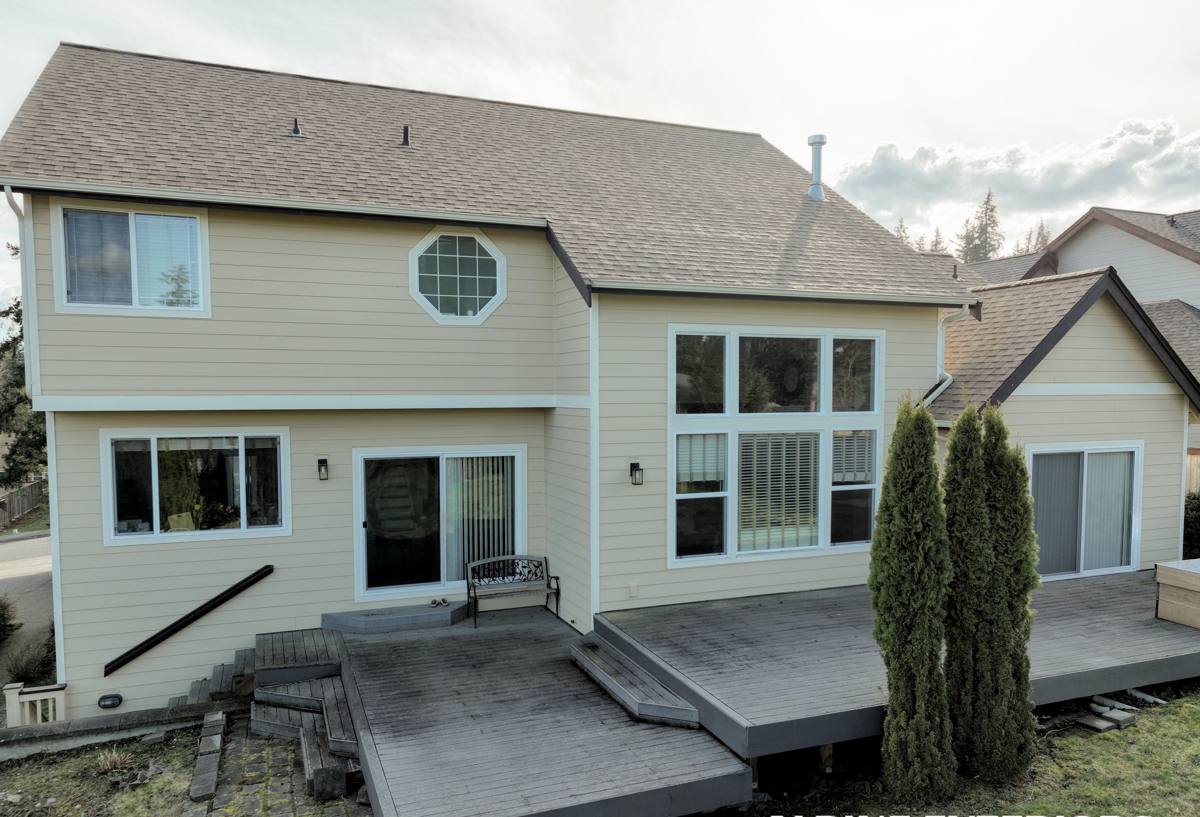
Why This Climate Is Hard on Decks
Salt Air and Metal Fatigue
Blaine sits close enough to saltwater that airborne salt reaches yards and structures well inland from the shoreline itself. Salt accelerates corrosion in anything metal — nails, screws, joist hangers, post bases, and railing hardware. Once corrosion starts on a fastener buried inside a joist or ledger connection, it's invisible until the connection itself starts to fail.
Driving Rain and Wind-Driven Moisture
Rain here doesn't just fall straight down. Wind off the water regularly pushes it sideways, driving moisture up under decking boards, behind fascia, and into any gap in flashing or trim that wouldn't be a problem in a calmer climate. Decks that rely on gravity alone to shed water — rather than proper flashing and drainage detailing — end up holding moisture in places it was never supposed to sit.
A Long, Persistent Moss Season
Shaded decks, north-facing decks, and decks under tree cover stay damp for months at a stretch during Blaine's moss season. Moss doesn't just look bad — it holds moisture directly against the decking surface, keeps that surface from drying out between rains, and accelerates rot in wood decking far faster than open sun exposure would.
Signs a Deck Needs Replacement — Not Just Repair
Not every problem deck needs to come out entirely. But there's a point where patching individual boards or hardware stops being cost-effective and starts being a way to delay an inevitable full rebuild. We look for these signs when we evaluate a deck near Dakota Creek:
- Soft, spongy, or springy decking boards, especially near the house or in shaded areas
- Visible rot or dark staining at the ledger board where the deck attaches to the house
- Rust streaking below joist hangers, screws, or bolts
- Posts that feel loose at the base, or visible rot at ground contact points
- Persistent moss or algae growth that returns within weeks of cleaning
- Railings that flex or feel less rigid than they used to
- A deck more than 20-25 years old that has never been substantially rebuilt
If you're seeing two or more of these at once, it's usually a sign the structure — not just the surface — is compromised.
What a Correct Deck Replacement Actually Involves
Ledger Board and Flashing
The connection between the deck and the house is the single most important — and most commonly failed — part of any deck. Proper flashing here has to shed water away from the house structure, not funnel it toward the ledger board. We treat this connection as the starting point of every replacement, not an afterthought.
Framing, Joists, and Footings
Framing has to be sized and spaced for the actual load the deck will carry, and footings need to reach adequate depth and bearing for this soil and climate. We don't reuse old footings or posts unless they genuinely check out — a new deck built on a compromised substructure just inherits the old deck's problems.
Fastener and Hardware Selection
Given the salt exposure here, we don't treat fastener choice as a minor detail. Stainless steel or heavy hot-dip galvanized hardware, rated for coastal exposure, costs more up front than standard hardware but is a large part of what determines whether a deck holds up structurally for the long haul rather than failing quietly from the inside.
Decking Material and Surface Drainage
Board spacing, ventilation underneath the deck, and drainage detailing all affect how quickly the structure dries out after rain. A deck that traps moisture underneath it — because it sits too close to grade or has poor airflow beneath the joists — will struggle no matter what decking material sits on top.
Choosing a Decking Material for This Climate
There's no single right answer for every homeowner — budget, maintenance tolerance, and how the deck is used all factor in. What we can tell you honestly is how each common option actually performs given Blaine's salt air, rain, and moss pressure.
| Material | Moisture Resistance | Moss/Algae Resistance | Maintenance | Typical Lifespan Here |
|---|---|---|---|---|
| Pressure-treated wood | Fair — needs sealing | Low without upkeep | Annual cleaning/sealing recommended | 10-18 years |
| Cedar | Good natural resistance | Moderate | Periodic oiling/sealing | 15-20 years |
| Composite decking | Very good | Good, varies by product | Occasional washing | 25-30+ years |
| PVC/capped polymer | Excellent | Very good | Minimal | 25-30+ years |
Wood costs less to install but asks more of the homeowner over time — sealing, cleaning, and watching for early rot are part of owning it here. Composite and PVC decking cost more up front but hold up better against the moss and moisture cycle this area sees year after year, which is why we see more homeowners near the water moving that direction when they replace an aging wood deck. We'll walk through the honest trade-offs for your specific deck and budget rather than push one option.
Our Deck Replacement Process
- On-site evaluation — we inspect the existing deck's framing, ledger connection, footings, and hardware to understand what's actually failing and why.
- Honest scope and estimate — you get a clear picture of what full replacement involves, what it costs, and what material options fit your situation.
- Demolition and disposal — the old deck comes out, including hardware and any compromised framing, with the site left clean.
- Structural rebuild — new footings where needed, properly sized framing, and a correctly flashed ledger connection.
- Decking and railing installation — installed to the manufacturer's specifications for whichever material you've chosen, with attention to drainage and ventilation underneath.
- Final walkthrough — we go over the finished deck with you and explain anything you should watch for or maintain going forward.
Permits and Local Considerations
Deck replacement in Blaine typically involves permitting through the appropriate local authority, and requirements can depend on the deck's size, height, and proximity to property lines or the water. We handle the permitting conversation as part of the job so you're not left figuring out what applies to your property on your own. If your property is close enough to Dakota Creek or Drayton Harbor that shoreline or setback considerations come into play, that's something we flag and address up front, not something that surfaces as a surprise mid-project.
Maintaining a New Deck in a Salt-Air, High-Moisture Climate
A well-built deck still benefits from some basic upkeep in this environment. A few habits go a long way toward protecting the investment:
- Sweep or hose off debris regularly, especially under tree cover where moss takes hold fastest
- Check railing and stair hardware once a year for early signs of corrosion
- Keep gutters and downspouts near the deck clear so runoff isn't draining onto or under it
- Reseal wood decking on the schedule recommended for the specific product used
- Address any soft spots or loose hardware promptly rather than waiting for the next dry season
Why Hire a Crew That Already Works Near Dakota Creek
A lot of deck problems we're called out to fix started with a design decision that made sense somewhere drier — a fastener choice, a drainage detail, a decking material — that simply doesn't hold up against Blaine's combination of salt air, driving rain, and a moss season that doesn't let up for months. Working in this area regularly means we're not guessing at what performs here; we're building around conditions we deal with on every job. That local familiarity shows up in the small decisions — flashing details, hardware grade, board spacing — that determine whether a deck lasts fifteen years or thirty.
If your deck near Dakota Creek is showing soft spots, rust, persistent moss, or is simply getting old enough to worry about, we're glad to take a look and give you a straightforward, no-pressure estimate on a full replacement. Fill out the form below and we'll get in touch to schedule a time that works for you.