 Blaine Siding
 California Creek's Climate Puts Real Stress on Exterior Walls
Homes near California Creek sit close to tidal water in one of the wettest, saltiest stretches of Whatcom County. Air coming off Semiahmoo Bay and the Strait of Georgia carries salt that settles on siding, trim, and fasteners year-round. Add driving rain that comes in sideways during fall and winter storms, plus a moss season that can stretch from October into May under the area's heavy tree cover, and you have a set of conditions that will find every weak point in an exterior wall system within a few years.
This isn't a climate where "good enough" siding holds up. Wood siding takes on moisture and starts to soften at butt joints and lower courses. Vinyl siding expands and contracts with temperature swings, and its unsealed overlapping joints do nothing to stop wind-driven rain from getting behind it. Even fiber cement, if it's the wrong product line or installed without attention to this specific climate, can fail early at fastener points, corners, and anywhere water is allowed to sit. Siding here has to manage sustained moisture load, resist fastener corrosion from salt exposure, and resist moss and algae growth on the shaded, damp sides of the house — usually north and west-facing walls under tree cover.
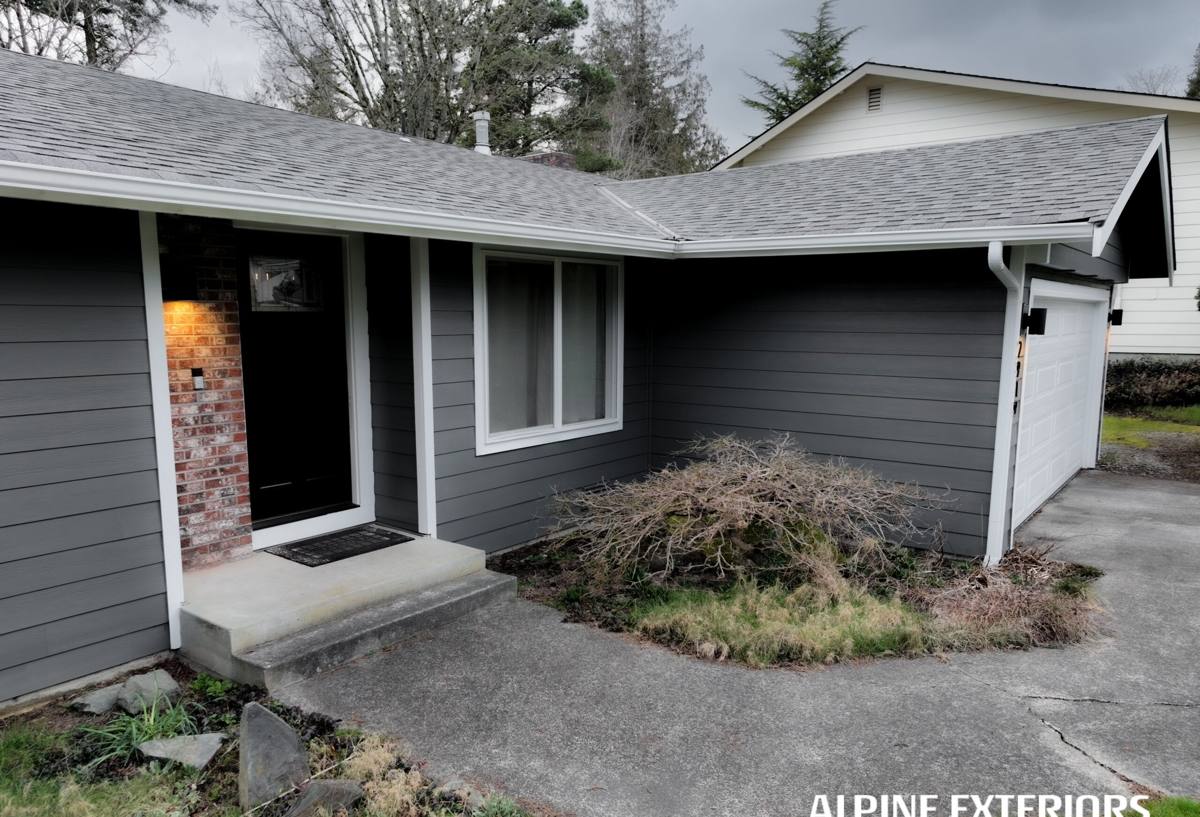
What Correct Fiber Cement Installation Actually Requires Here
The Weather Barrier and Drainage Plane
In a high-moisture coastal climate like this one, the weather-resistive barrier behind the siding matters as much as the siding itself. It needs to be installed with correct shingle-style lapping so water is shed downward and out, not trapped behind the cladding. On homes exposed to sustained wind-driven rain — which describes most of the California Creek area — a rainscreen drainage gap between the siding and the weather barrier gives any moisture that does get past the surface a way to drain and dry out instead of sitting against the sheathing.
Clearances and Fastening
James Hardie's installation specs call for minimum clearances — roughly 6 inches from grade and 2 inches from roofing or decking surfaces — and those numbers aren't arbitrary. They keep splash-back and standing water away from the bottom edge of the siding, which is where rot and moss problems start on poorly installed jobs. Fasteners matter just as much: in a salt-air environment, corrosion-resistant nails (stainless steel or hot-dip galvanized, per Hardie's fastener requirements) are the difference between siding that holds its finish for decades and one that shows rust streaks and loosening boards within a few years.
Joints, Caulking, and ColorPlus Touch-Up
Factory-finished ColorPlus siding is designed to use Hardie's own touch-up product at specific joints rather than field caulk everywhere. Caulking joints that shouldn't be caulked — a common shortcut — traps moisture instead of letting the assembly breathe and drain as designed. Getting this detail right is a small thing that has an outsized effect on how the siding performs after ten winters of driving rain.
James Hardie Product Lines That Make Sense for California Creek Homes
Not every Hardie product line is the right fit for every house. The table below covers the lines we use most often on homes in this area and why.
| Product Line | Best Use | Look | Why It Fits Here |
|---|---|---|---|
| HardiePlank Lap Siding | Most full-home applications | Traditional horizontal lap | Widest range of profiles and colors; performs well under sustained wind-driven rain when installed with correct lap and clearance |
| HardiePanel Vertical Siding | Accent walls, gables, modern facades | Clean vertical lines | Fewer horizontal joints to manage moisture at, useful on steep gable ends that see heavy rain exposure |
| HardieShingle Siding | Accent areas, dormers, Craftsman-style detailing | Staggered or straight-edge shingle profile | Holds up well where moss and algae are a concern if installed with proper spacing for drying |
All three are manufactured in Hardie's HZ5 formulation, engineered for the moisture and freeze-thaw conditions of the Pacific Northwest — which is the zone this part of Whatcom County falls into.
Why We Only Install James Hardie — Not LP SmartSide, Vinyl, or Unfinished Wood
We standardized on James Hardie fiber cement and don't install LP SmartSide, vinyl, Cemplank, Allura, or bare cedar and primed spruce siding. That's a deliberate call, not a marketing line, and it's worth explaining honestly.
LP SmartSide is an engineered wood product with an OSB-based core. It performs reasonably in drier climates, but wood-based cores are inherently more sensitive to sustained moisture exposure than cement-based siding — and sustained moisture is exactly what California Creek gets most of the year. Vinyl siding is inexpensive and low-maintenance in the sense that it doesn't need painting, but it's not a water management system: it relies on gaps and overlaps that assume most water runs off the surface, which doesn't hold up as well under the kind of driving, wind-pushed rain this area sees. It also fades and can become brittle over time, especially with sun and salt exposure combined. Unfinished cedar and primed spruce look good on day one, but they demand an ongoing maintenance commitment — refinishing, caulking, and moisture monitoring — that most homeowners don't want to sign up for in a climate this wet.
James Hardie fiber cement is non-combustible, dimensionally stable in wet climates, and comes with a factory-applied ColorPlus finish that resists fading and chalking from salt-air exposure far better than a field-applied paint job. It's backed by a strong transferable warranty when installed to spec, and it's built specifically for climates like this one. That's why it's the only product we put on homes.
Our Process for California Creek Projects
Every job starts with a walk of the property, not a generic quote. Here's what that involves and what follows it:
- Full exterior assessment, including a check for existing moss growth, soft spots, or moisture staining that points to sheathing damage underneath the current siding
- Inspection of trim, window and door flashing, and grade clearance before any siding comes off
- Removal of old siding and repair of any damaged sheathing found underneath — this is where hidden problems from years of moisture exposure usually surface
- Correct installation of the weather-resistive barrier and, where the wall assembly calls for it, a drainage gap
- Installation of Hardie siding to manufacturer spec: clearances, fastener type and spacing, and joint treatment
- Final walk-through covering caulk lines, touch-up work, and cleanup
We schedule around the weather as much as this climate allows, since fiber cement installation and finishing work go best in dry conditions — which means planning matters more here than in drier parts of the state.
What Affects the Cost of a Fiber Cement Siding Project Here
Costs vary house to house, but the factors that move the number are consistent. This isn't a price list — it's what to expect a contractor to walk through with you.
| Factor | How It Affects Cost |
|---|---|
| Home size and number of stories | More square footage and taller walls mean more material and labor, plus added equipment for upper stories |
| Tear-off and disposal of existing siding | Removing old wood, vinyl, or aluminum siding adds labor and disposal costs before new siding goes on |
| Hidden sheathing repair | Moss and moisture damage found underneath old siding can require sheathing replacement before installation continues |
| Trim and corner detail | Homes with more windows, dormers, or architectural detail take more time to flash and trim correctly |
| Color and finish selection | Factory ColorPlus finishes and certain HardieShingle or panel profiles carry different material costs than standard lap siding |
| Site access | Creek-adjacent lots, mature tree cover, or tight setbacks can slow staging and equipment access |
Why Hiring a Crew That Already Works in California Creek Matters
A crew that's worked this specific area knows which walls tend to hold moisture longest based on tree cover and orientation, how far storm-driven rain typically reaches up a wall, and what kind of moss and algae growth to expect after a wet winter. That's not something you get from a general-market siding book — it comes from doing the work here repeatedly. Local familiarity also helps with the practical side: permitting through Whatcom County or the City of Blaine depending on exactly where a property sits, and navigating the tree cover, easements, and lot access that are common on properties near the creek.
It also means a contractor isn't guessing about product fit. HZ5-rated Hardie siding, correct clearances, and corrosion-resistant fasteners aren't optional upgrades in this climate — they're the baseline for siding that's still doing its job in twenty years instead of five.
Keeping Hardie Siding Looking Right Through Moss Season
Fiber cement siding installed correctly needs very little upkeep, but a few habits go a long way in this specific climate:
- Rinse siding gently once or twice a year rather than pressure washing directly at joints and seams, which can force water where it shouldn't go
- Trim back branches and vegetation touching or shading the walls to cut down on the damp, shaded conditions moss needs to take hold
- Keep gutters and downspouts clear so runoff doesn't sheet down the siding face during heavy rain
- Do a yearly walk-around to check caulk lines, flashing, and any spots where paint or finish looks worn, especially on the sides of the house that get the least sun
These are small, occasional tasks — not a maintenance schedule — which is part of why fiber cement makes sense for a climate that punishes anything less durable.
If you're planning a siding project near California Creek, we're happy to walk the property, point out what we see, and put together a straightforward, no-pressure estimate using the form below.