 Blaine Siding
 Why Birch Bay Siding Takes a Different Approach
Birch Bay sits right on the water, and that changes what a siding system has to survive. Homes here don't just deal with rain — they deal with salt-laden air blowing off the bay, wind-driven moisture that gets pushed sideways into wall assemblies, and a long stretch of the year where shaded and north-facing walls barely dry out at all. That combination is harder on exterior cladding than what you'll find a few miles inland in Blaine proper or further into Whatcom County.
Salt air is corrosive to fasteners and finishes that aren't rated for it. Driving rain finds every gap in flashing and caulk that a calmer climate would forgive. And moss doesn't just grow on roofs here — it colonizes north-facing siding, window trim, and anywhere moisture sits against a surface without enough sun or airflow to dry it out. A siding installation in Birch Bay has to be planned around all three of these realities from day one, not patched around them later.
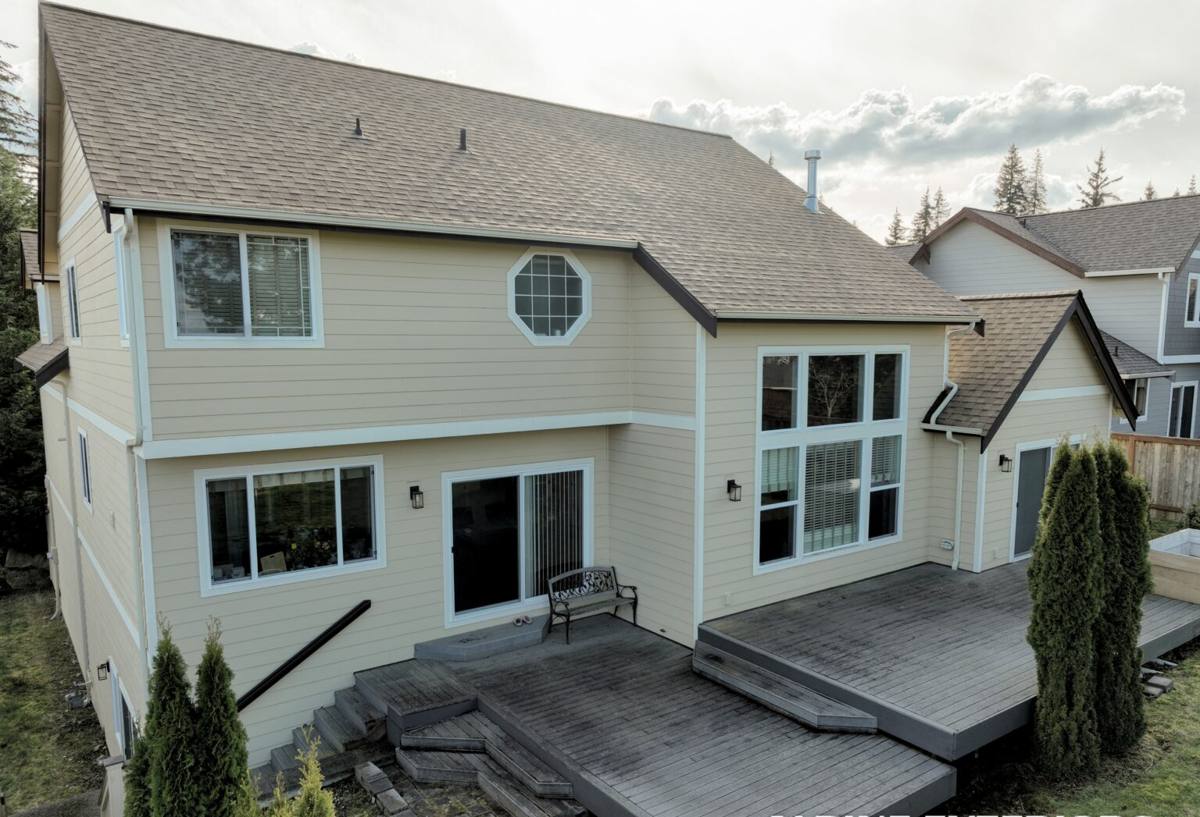
What Birch Bay Homes Need From Their Siding
Corrosion Resistance
Salt air accelerates corrosion on exposed metal — fasteners, flashing, trim screws. Standard interior-grade or even typical exterior-grade fasteners can start showing rust streaks and weakening well before the siding itself would otherwise need attention. Everything used in a Birch Bay installation needs to be rated for coastal exposure, not just general exterior use.
Moisture Management, Not Just Water Shedding
Driving rain doesn't fall straight down here — wind off the bay pushes it at an angle into wall surfaces, seams, and penetrations. A siding system that only sheds water on calm days isn't enough. The assembly behind the siding — house wrap, flashing at windows and doors, proper laps and overlaps — has to be built to handle water that's actively being pushed toward the wall, not just water that's falling on it.
Dimensional Stability in a Wet-Dry Cycle
Whatcom County swings between saturated winters and drier summer stretches. Siding material that swells when wet and shrinks when it dries — repeatedly, year after year — eventually opens gaps at joints and around fasteners, which is exactly where the next round of moisture gets in. A material that holds its dimensions through that cycle keeps the whole system tighter for longer.
Resistance to Moss and Organic Growth
Moss needs moisture and a surface it can hold onto. Siding that stays damp for extended periods, especially on shaded elevations, gives moss exactly what it needs. The product, the finish, and how the installation allows walls to dry all affect how much moss pressure a home deals with over the years.
Why We Install James Hardie Fiber Cement — and Only James Hardie
This company installs James Hardie fiber cement siding exclusively. We don't install vinyl, LP SmartSide, primed spruce, cedar, or other fiber cement brands like Cemplank or Allura. That's not a marketing position — it's a standard we've settled on because of what Birch Bay's climate does to alternatives over time.
Fiber cement is non-combustible and dimensionally stable in a way wood-based and engineered-wood products aren't — it doesn't absorb and release moisture the same way, which matters directly in a marine environment with this much sustained humidity. James Hardie's HZ5 product line is engineered specifically for climates like this — freeze-thaw cycling, sustained moisture exposure, and coastal conditions — rather than being a general-purpose product used everywhere regardless of local demands.
The ColorPlus factory finish is baked on under controlled conditions and backed by its own finish warranty, which matters in an area where a field-applied paint job has to fight sun, salt, and damp all at once to hold its color and adhesion. And James Hardie's product warranty is transferable, which is a real consideration on the coast, where buyers are increasingly asking pointed questions about how the exterior has held up.
We're not going to tell you vinyl or LP SmartSide are junk — they're not, and they work fine in plenty of climates and price points. But vinyl can warp and fade under sustained UV and salt exposure, and it doesn't hold paint if you ever want to change the color. Engineered wood products carry moisture-sensitivity warnings that are worth taking seriously on a property that sits in wind-driven rain and salt air for months at a stretch. Given what we see fail first on this stretch of coastline, fiber cement — installed correctly — is what we're willing to put our name on.
What a Correct Installation Actually Involves
The siding material is only part of the equation. Most siding failures we get called out to inspect trace back to installation details, not the product itself. In Birch Bay specifically, these details carry extra weight:
- Proper drainage plane and house wrap installed as a continuous water-resistive barrier behind the siding, not just stapled up as an afterthought
- Correct flashing at every window, door, and penetration, integrated with the house wrap so water is directed out and down, not behind the siding
- Rain screen gap where conditions call for it, so walls can actually dry between wet spells instead of staying saturated
- Fasteners rated for coastal, corrosion-prone environments, driven at the correct depth and spacing per James Hardie's installation specifications
- Correct nail lines and butt joint treatment so panels aren't relying on caulk alone to stay sealed over time
- Proper clearance from grade, decks, and roof lines to keep siding from sitting in standing moisture or splashback
- Caulking and sealant only where James Hardie's specifications call for it — over-caulking traps moisture just as often as under-caulking lets it in
Skip or rush any of these and you can end up with a house wearing a premium siding product that still fails early — trapped moisture, buckling panels, or paint and caulk breaking down years ahead of schedule. The material has to be matched with correct execution, and that's a crew and process issue, not a product issue.
Our Process for a Birch Bay Installation
1. On-Site Assessment
We walk the property and look at exposure by elevation — which walls take the brunt of the wind-driven rain, which stay shaded and slow to dry, and where existing moss or moisture staining is already telling us something about the current system's weak points.
2. Tear-Off and Substrate Check
Removing the old siding lets us actually inspect the sheathing and framing underneath for rot or existing moisture damage before anything new goes up. Covering over a compromised substrate just hides a problem, it doesn't fix it.
3. Water-Resistive Barrier and Flashing
This is the layer that does the real work when wind-driven rain hits the wall. We install a continuous drainage plane and integrate flashing at every window, door, and penetration before a single piece of siding goes up.
4. James Hardie Panel or Lap Installation
Installed to James Hardie's published specifications for fastening, spacing, and clearances — the specific requirements that keep the manufacturer's warranty intact and keep the assembly performing the way it's designed to.
5. Trim, Caulk, and Final Detailing
Corner boards, trim, and sealant are finished per spec, with attention to the joints and transitions that are most exposed to driving rain.
6. Walkthrough
We go over the finished work with you, including basic guidance on what routine upkeep looks like in a salt-air, high-moisture environment like Birch Bay.
Comparing Siding Approaches for a Coastal Bay Property
| Factor | James Hardie Fiber Cement | Vinyl | Engineered Wood (e.g., LP SmartSide) |
|---|---|---|---|
| Salt air / coastal exposure | Engineered HZ5 line built for this exposure | Can fade and become brittle under sustained UV/salt | Manufacturer moisture-exposure warnings apply |
| Moisture cycling | Dimensionally stable wet to dry | Stable but can warp with heat/UV stress | Wood-based core is moisture-sensitive |
| Fire resistance | Non-combustible | Combustible | Combustible |
| Finish durability | Factory ColorPlus finish, own warranty | Color molded in, can chalk/fade | Field or factory paint, repaint cycles needed |
| Repainting needed | Not for many years under ColorPlus | Cannot be painted easily | Yes, on a regular cycle |
| Warranty transferability | Transferable | Varies by manufacturer | Varies, often with moisture exclusions |
Why Local Experience in Birch Bay Matters
A crew that installs siding across a wide range of inland climates doesn't necessarily know how differently a bayfront property behaves. Where the moss pressure is worst on a given lot, which elevations catch the most wind-driven rain, how close a property sits to salt spray zones — these aren't things you learn from a spec sheet. They're things you learn by working properties in Whatcom County's coastal areas specifically, seeing what holds up after a few winters and what doesn't.
That local pattern recognition changes real decisions on a job: where we add extra flashing attention, whether a rain screen gap is worth the added step on a particular elevation, how we sequence work around the wetter months so the substrate isn't sitting exposed longer than it has to be. It's the difference between a technically correct installation and one that's actually correct for this specific property, in this specific location, on this specific stretch of the bay.
What to Expect Cost-Wise
Siding installation cost depends on the size and complexity of the home, how much of the existing siding and substrate needs to be removed and repaired, the amount of trim and detail work involved, and the specific James Hardie product line and finish selected. Coastal properties can sometimes carry a modest premium over inland jobs, simply because of the additional attention flashing and drainage details require to hold up against wind-driven rain. We'll walk you through the specific factors driving cost on your property during an on-site estimate rather than quoting a number that doesn't reflect your home's actual conditions.
Signs Your Current Siding Isn't Holding Up
- Persistent moss or algae growth that returns quickly after cleaning, especially on shaded or north-facing walls
- Visible rust streaking from fasteners or trim hardware
- Soft spots, bubbling, or staining near window and door trim
- Caulk that's cracked, shrunk, or pulled away from joints
- Paint that's peeling or chalking faster than expected for its age
- Panels that appear warped, bowed, or separated at seams
Any of these on a Birch Bay property is worth a closer look sooner rather than later — coastal conditions don't give minor issues much time to stay minor.
If you're weighing a siding replacement for a Birch Bay home, we're glad to walk the property with you, look at what your specific elevations and exposure are dealing with, and put together a straightforward, no-pressure estimate — just fill out the form below to get started.